Promotional materias for the animated film The Reunion Journey Photos: Courtesy of Beijing New United Films
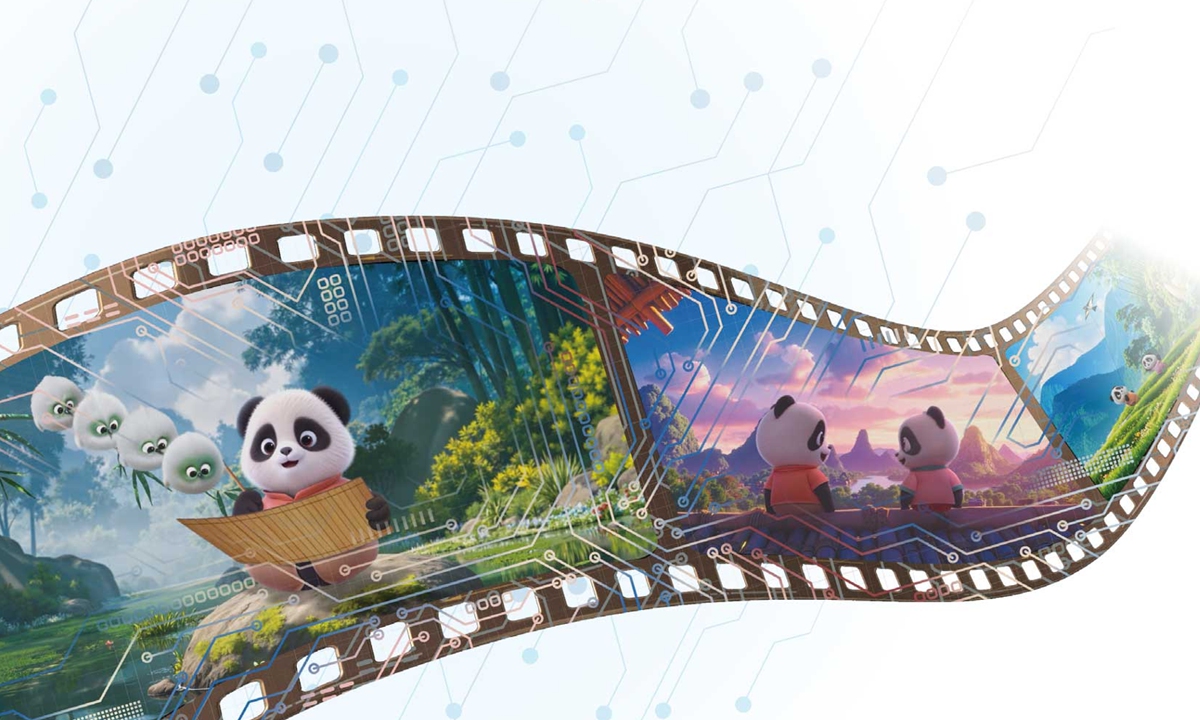
When the giant pandas Tuantuan and Yuanyuan, symbols of peace and reunion, appear on the big screen as animated characters, they are more than just cute symbols. The animated film The Reunion Journey is now in theaters, with its core inspiration drawn from this pair of pandas that the mainland gifted to the island of Taiwan.
Against the backdrop of the global surge in artificial intelligence generated content (AIGC) technology, The Reunion Journey not only tells a story about family and reunion but also - through its full-process AI industrial practice - provides a vivid example for global animation and even the broader film industry.
The Global Times sat down with the film's cast and crew to unveil the dual exploration behind the film's artistic expression and technological revolution.
Choosing pandas as the protagonists of the film was a "natural" decision for the team. Chief planner Li Guanyu explained that this stemmed from the public's hope for Taiwan's return to the motherland in recent years, while the story of the pandas Tuantuan and Yuanyuan themselves provides an excellent creative foundation.
"We thought telling a reunion story of two pandas was a great subject," added director Ma Teng. He noted that the panda, as a cultural symbol of China, with its endearing image, possesses universal appeal and potential without "cultural differences between the East and the West," making it an ideal vehicle to convey Chinese customs and values.
The film follows panda siblings Tuan Zai and Yuan Niu, who are separated in childhood, on an adventure as the brother Tuan Zai embarks on a journey to find his sister, culminating in their reunion.
While seemingly a conventional "road movie" and "coming-of-age narrative," its core is closely tied to the cross-Straits theme. Xing Yan, from co-producer Beijing New United Films, said that the team did not create an "absolute villain"; even the opposing character "Grandma Eagle" only acts out of a misunderstanding stemming from historical rumors, with the film ultimately pointing toward the idea of "harmony in diversity."
"Reunion, coming together - this is the core we aim to express at the end of the day," said Li, also chairman of co-producer Beijing Shrub Culture and Technology Co, Ltd. "We hope to use a gentle way to call for the return of our compatriots."
This expression has resonated with some Taiwan people. The team learned during early contacts and screenings that some Taiwan participants found the plot, where the sister Yuan Niu initially remains distant even after learning Tuan Zai is her brother, very realistic. "They said Chinese people are always very inclusive, willing to give things time. This is exactly what we want to convey: Based on shared values and blood ties, communication and inclusiveness are inevitable."
If the subject choice reflects creative plans, the film's production method is even more disruptive. Li revealed that this is the first complete AIGC animated feature film to reach theatrical quality standards.
"Internationally, everyone is racing to be 'the first,' but many are experimental shorts unable to support 90 minutes of precise narrative. We managed to comply with traditional film industry standards," Li said.
This technological revolution brings fundamental changes. Traditional animated film production involves long cycles and high costs, while The Reunion Journey, which relied on the team's self-developed full-process AI production platform, reduced costs to about one-fifth of comparable traditional films and shortened the production cycle to a remarkable five to six months.
Li noted that while R&D investment was significant, once the platform matures, the production cost per film will be drastically lower. "This completely changes the business model. Before, like with Ne Zha, there was a five-year gap between the first and second films. Now, if the market responds well, we could release a sequel in half a year," Li said.
AIGC is not simply "machine drawing." Director Ma pointed out that overcoming the "AI feel" was key to achieving theatrical quality. "Many online AIGC videos feel uncomfortable because the performance and emotions are not controlled. Our core technology achieves precise control over character performance, micro-expressions, and interaction, reaching 99 percent accuracy."
The team restructured the workflow into three main blocks: AI technology R&D, setting AI aesthetic standards and AI execution. While traditional roles like director, screenwriter, and art designer remain, their work has changed dramatically.
"The creative part stays with humans; AI is responsible for efficiently and accurately executing human creativity," Li added.
He predicted that animated films might first evolve into a "theatrical series" model. "With low costs and fast iteration, multiple series could be released in a year, like watching Netflix series in theaters. Distribution strategies may also change, with exclusive screenings and segmented distribution becoming possible."