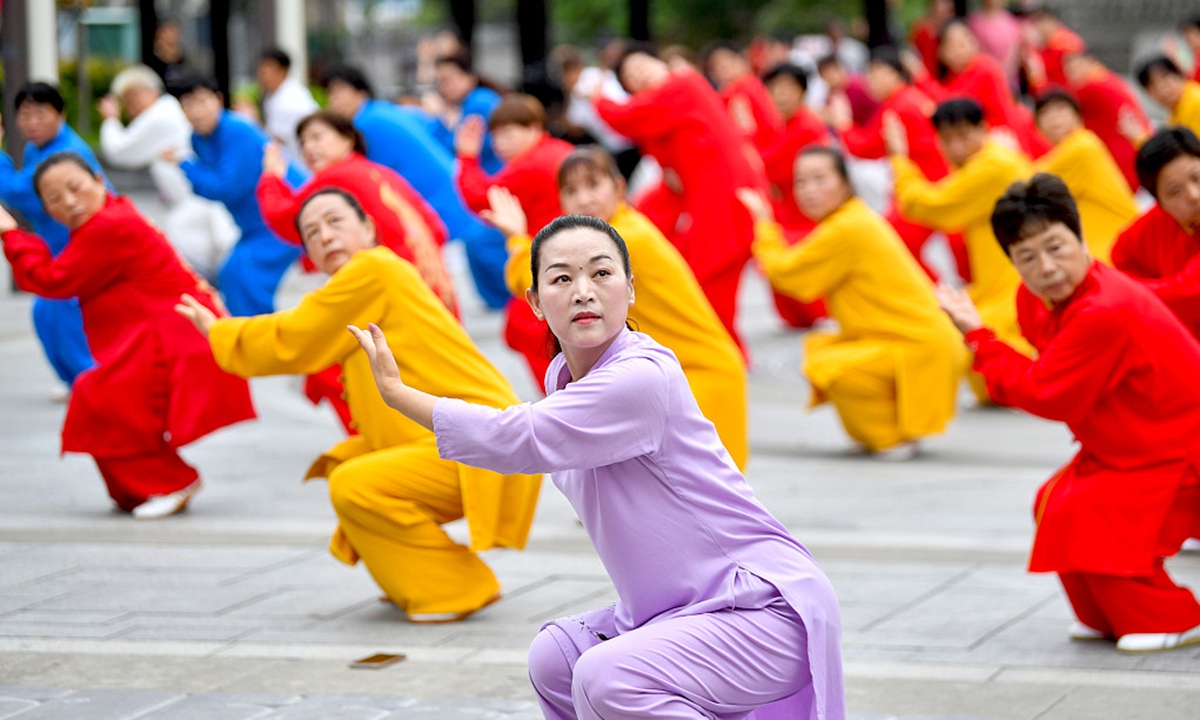
Fitness enthusiasts practice wuqinxi, an ancient Chinese physical exercise mimicking the movements of five animals, at a qigong event in Bozhou, East China's Anhui Province, on August 7, 2023, a day before China's National Fitness Day. Photo: VCG
Editor's Note:"Building a Healthy China by 2035 is a strategic decision made by the Communist Party of China Central Committee" - Chinese President Xi Jinping made the remarks while attending a joint group meeting during the fourth session of the 14th National Committee of the Chinese People's Political Consultative Conference, the top political advisory body, on Friday. What makes the Healthy China Initiative appealing, and how will it benefit people's everyday lives? The Global Times has invited four foreign observers - currently residing in China - to share their personal experiences and observations. Through their perspectives, this series aims to illustrate how the initiative reflects a human touch, embodies China's governance philosophy and demonstrates its institutional strengths.
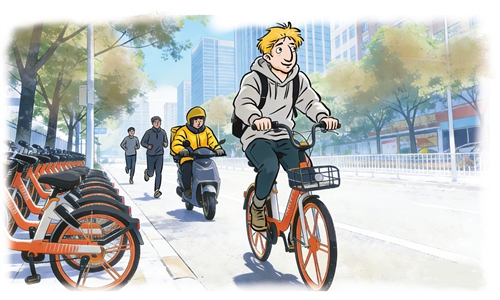
I'm known for having ridden the length and breadth of China, and consider myself to be one of the luckiest people in the world to live in a place that makes cycling so easy, convenient and accessible. But it isn't just riding a bike that's important, it's the benefits that come with it.
Chinese President Xi Jinping once said, fitness for all is the foundation and guarantee for people to build up their physiques and live a healthy life. His words and desire to see a healthy society reflect what is perhaps the most important facet of China's growth.
Global economists agree that there are many ways to measure improvements of a country. GDP is one, and Price Purchase Parity is another. However, the most important measure, without a doubt, is life expectancy. A healthy country increases in life expectancy, an unhealthy one declines.
When a country's life expectancy increases, it's because everything else is in place. There is good education, good facilities, healthy living conditions and a national awareness that health and fitness are important. Nowhere is this more apparent than in China.
There are private gyms where people can sign up and join with a view to keeping fit. Meanwhile, the government has provided something better. There are free exercise machines in every community, which can be found in even the most remote villages. Cycling around Zhongshan, my adopted hometown, I see public parks filled with people dancing; I see walkways along the river spanning several kilometers, recently constructed for citizens to stroll, jog or run through the many trees planted there. Within 100 meters of my home is a square, on one side of the road where people gather in the mornings and evenings to play music and dance together, on the other side of the road is a public gymnasium with several different forms of exercise machines.
Many people I know outside of China have doubts about China and these facts constantly surprise them. In September last year, the government announced that by 2030, it will create 10,000 convenient "life circles," ensuring that residents can access community services, including childcare and elderly care, cultural and sports facilities, and healthcare centers, within a 15-minute walk from their homes.
China is well aware that a healthy society is a happy society and instead of just talking the talk, China encourages its citizens to actually get out and walk the walk, or dance, run, swim, skate or cycle. Whatever it is, we're getting out and doing it.
The author is a British-Australian freelance writer who has studied cross cultural change management in China and has lived in the country, traveling extensively for almost two decades. opinion@globaltimes.com.cn
RELATED ARTICLES