Chinese youth File Photo: CFP
Editor's Note:"Building a Healthy China by 2035 is a strategic decision made by the Communist Party of China Central Committee" - Chinese President Xi Jinping made the remarks while attending a joint group meeting during the fourth session of the 14th National Committee of the Chinese People's Political Consultative Conference, the top political advisory body, on Friday. What makes the Healthy China Initiative appealing, and how will it benefit people's everyday lives? The Global Times has invited four foreign observers - currently residing in China - to share their personal experiences and observations. Through their perspectives, this series aims to illustrate how the initiative reflects a human touch, embodies China's governance philosophy and demonstrates its institutional strengths.
The increasing weight put on the health of Chinese people at all phases of life accords with the shifting emphasis to high-quality development. In recent years, China has begun to experience the challenges of developed countries, with gradual increases in obesity and age-related illnesses. To face these, China finds itself uniquely equipped with increasingly medium- and long-term planning abilities and central-local policy coordination.
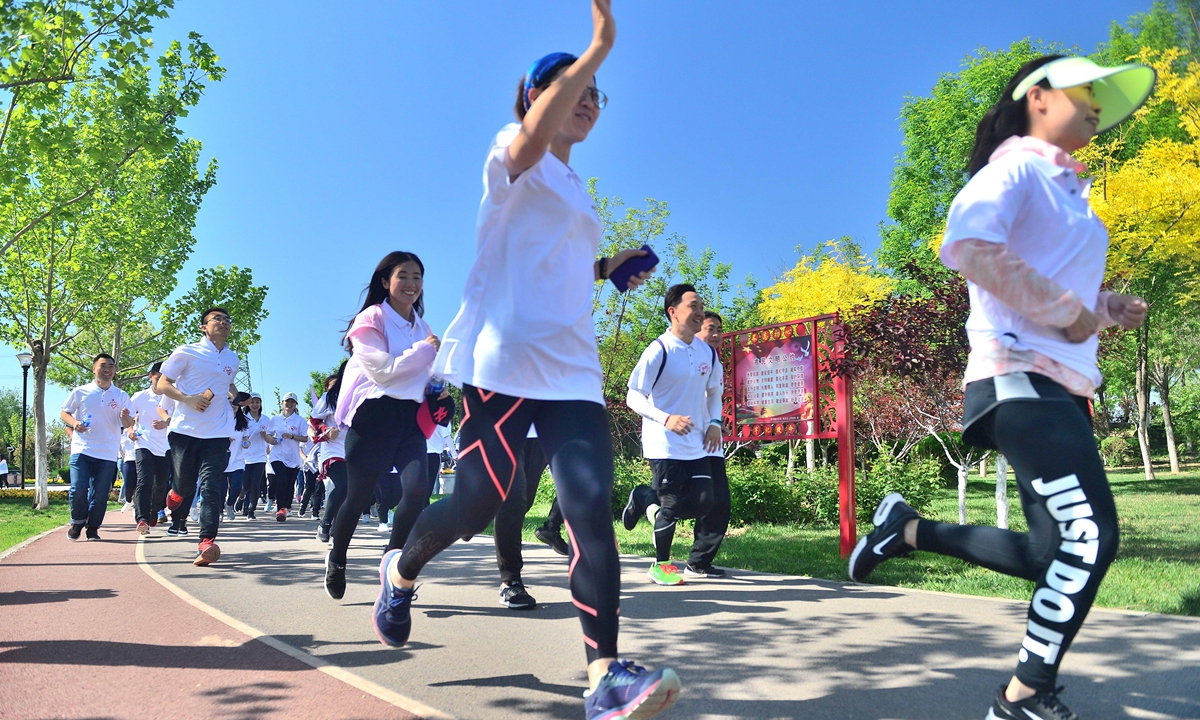
A highly encouraging development that I have personally experienced here is the increasing emphasis and availability of sports, particularly among young and working-aged people. Just a few days after settling into my new home in west Beijing, I joined a local amateur football club that practices for free at newly built facilities in our neighborhood that also includes basketball courts as well as cycling and running tracks. Entire amateur football leagues, with teams composed of Chinese and foreigners alike, have sprung up in Beijing, particularly in Chaoyang district, with serious competition and demanding fitness requirements.
China's minister of education stated on Saturday that China will begin promoting football, basketball and volleyball competitions in schools with class- and school-level leagues. In my home country of Portugal, I saw how school leagues contributed to the continued health and fitness of students into university and adulthood, as well as an invaluable means of combatting loneliness.
Outside of school hours, I've seen an uptick in after-school sports activities, with the ice hockey and skating rinks at my local mall constantly populated by young Chinese athletes and their teachers. Recent local and international media reports noted a large uptick in winter sports activities, signaling an early success to the government's post-Beijing Winter Olympics push. At my local climbing gym, many parents are now making sure their children have a good outlet for their youthful energy and fitness needs on the climbing wall. Policies to lighten homework loads and increase awareness of the importance of life-long fitness have likely contributed to this uptick.
Elderly people in China are also remarkably fitness-conscious by global standards. Many might take it for granted here but the ubiquitous site of groups of senior citizens dancing in squares and parks, walking and jogging clubs and even calisthenics and rehab exercises is quite an achievement and would be uncommon elsewhere.
Overall, China is uniquely suited to rapid and large-scale social change through proactive health-related measures. The consultative aspect of the whole-process people's democracy ensures that the clearly growing demand for improved health-related infrastructure and services is heard and taken into account when formulating policy plans; while the evaluative aspect of China's system allows for ever-changing measures by which policymakers at all levels are held to account. With clear and unambiguous qualitative, non-GDP targets like raising the average life expectancy to 80 years by 2030, China's central authorities create governance incentives that guide the policy implementations of provincial and local governments which are then realized in the communities.
As President Xi once noted, "health is the most important indicator of people's happy life." This vision lies at the heart of the Healthy China Initiative, which seeks to embed health into all policies and empower every citizen to lead a thriving life. And only when people live a healthy and thriving life can national prosperity and strength be guaranteed, and Chinese modernization be achieved.
The author is a comparative legal jurist currently studying Chinese at Beijing Language and Culture University. opinion@globaltimes.com.cn
RELATED ARTICLES