Medical care moments in China feel more human
By Published: Mar 08, 2026 04:17 PM

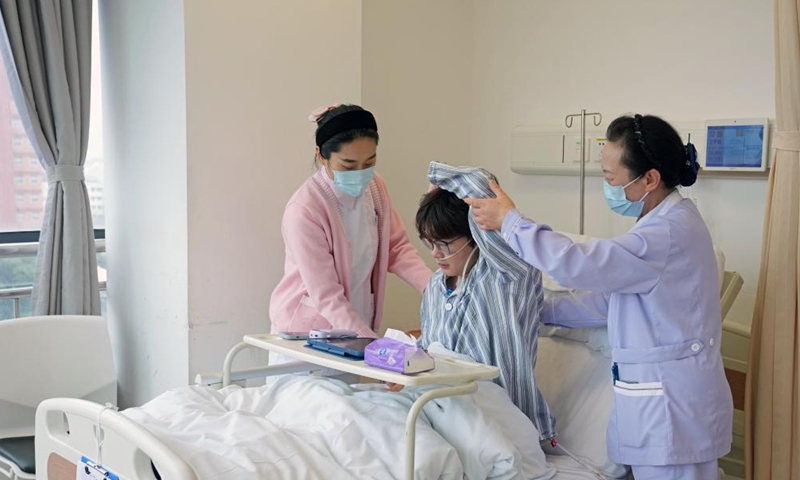
A nurse (L) and nursing assistant (R) help an inpatient with post-surgery rehabilitation exercises at a hospital in Shanghai, east China, Feb. 26, 2026. China's hospitals are piloting "companion-free" care services to ease the heavy burden of daily care-giving on the inpatients' families. The new mode of operation requires hosting hospitals to directly employ trained nursing assistants to provide 24-hour non-medical care for inpatients with particular needs. Such services used to rely solely on family members of the inpatients or private caregivers they hire.(Xinhua/Liu Ying)
Editor's Note:"Building a Healthy China by 2035 is a strategic decision made by the Communist Party of China Central Committee" - Chinese President Xi Jinping made the remarks while attending a joint group meeting during the fourth session of the 14th National Committee of the Chinese People's Political Consultative Conference, the top political advisory body, on Friday. What makes the Healthy China Initiative appealing, and how will it benefit people's everyday lives? The Global Times has invited four foreign observers - currently residing in China - to share their personal experiences and observations. Through their perspectives, this series aims to illustrate how the initiative reflects a human touch, embodies China's governance philosophy and demonstrates its institutional strengths.
Based on my experiences with the medical system in China, what has stood out most is not ideology or policy rhetoric, but the practical realities of accessibility, efficiency and the way everyday medical care is handled. It fully embodies the important statements by Chinese President Xi: "We must give strategic priority to ensuring the people's health and improve policies on promoting public health." This kind of guarantee is a real warmth integrated into every medical experience.
I have seen how quickly the system can respond in urgent situations. On one occasion, I suffered heat stroke at the beach in Sanya, Hainan Province, during a vacation, and began vomiting uncontrollably. The hotel manager immediately put me on a scooter and drove me to a nearby hospital while reassuring me along the way. From the onset of symptoms to receiving treatment took roughly an hour. In another instance, when I became seriously ill and was sent to the hospital, hospital staff promptly conducted tests, and a Chinese colleague of mine came to the hospital to see how I was doing.
One feature I noticed is the high level of personal interaction with doctors. In my experience, physicians here take time not only to address the medical issue but also to reassure the patient. For example, I have received treatment for asthma, including during a particularly severe episode. Most recently I went to the hospital for heart-related discomfort and was very anxious about the possibility of something serious. The doctor carefully explained the tests and even shared his own experiences abroad to calm me. The results were normal, but the clear explanations and personal reassurance made a huge difference.
The small moments - staff making an effort to communicate, people stepping in to help in emergencies, doctors taking time to reassure anxious patients - have made the experience feel more human. They shape how medical care is experienced in practice, far more than official descriptions of how a healthcare system is supposed to work. These firsthand encounters reveal the human impact of the Healthy China Initiative, demonstrating how its goals are translated into everyday realities that build trust and improve quality of life.
The author is an American columnist and political analyst based in Beijing. opinion@globaltimes.com.cn
RELATED ARTICLES