Iran reportedly finalizes decision on new supreme leader as US-Israel military operation against Iran enters 9th day
By and Published: Mar 08, 2026 09:59 PM


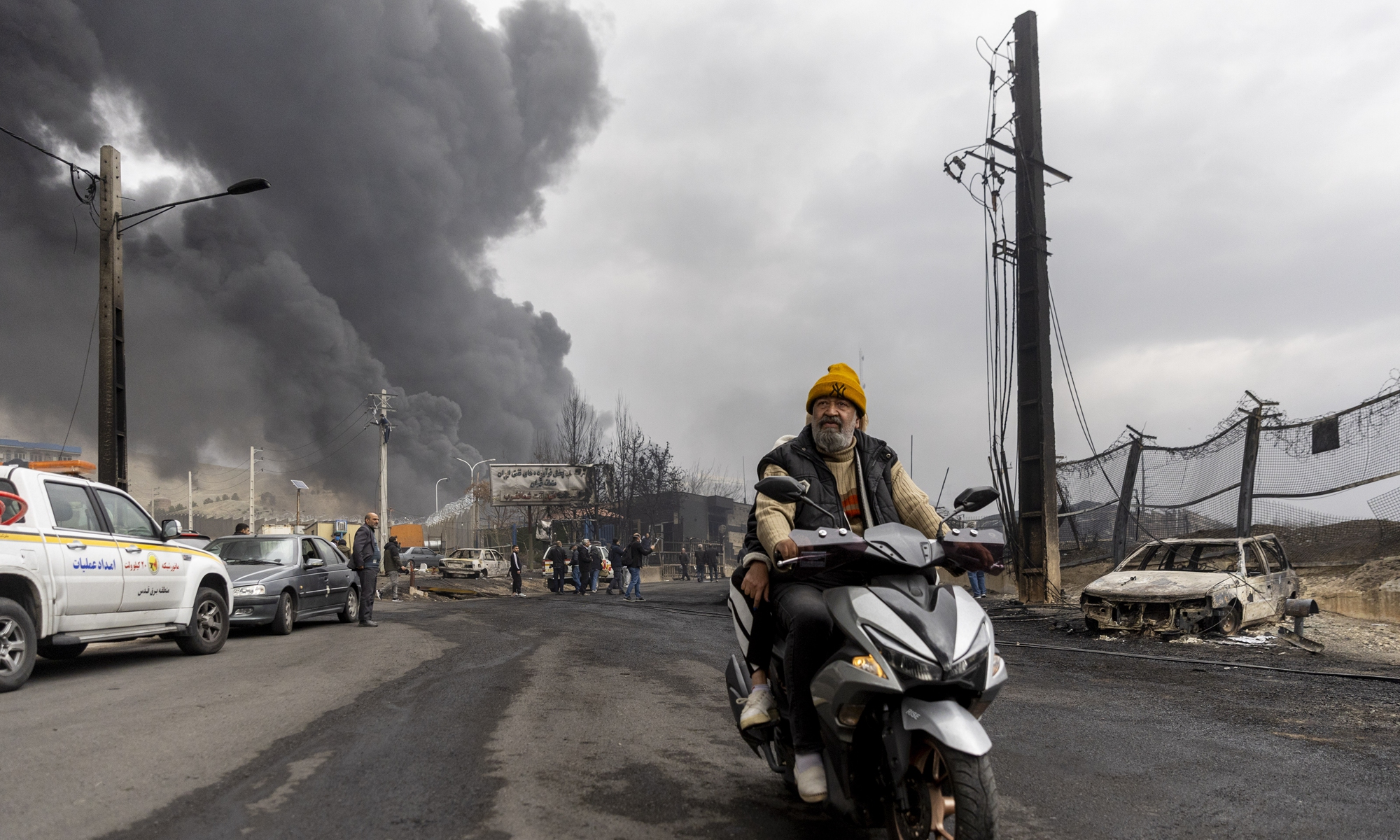
People ride on a motorbike as smoke billows after overnight airstrikes on oil depots on March 8, 2026 in Tehran, Iran. The US and Israel continued their joint attack on Iran while Iran retaliated by firing waves of missiles and drones at Israel, and US bases. Photo: VCG
"Weapons are ominous tools, and should not be used without discretion."
As a US-Israeli military operation against Iran entered its ninth day on Sunday with no de-escalation in sight, Iran's Assembly of Experts has reportedly finalized its decision on a new supreme leader. The spiraling crisis in the Middle East has alarmed many countries, drawing a warning on Sunday from China's top diplomat Wang Yi, who invoked a proverb from ancient Chinese philosopher Han Feizi to caution that war is an "ominous tool" not to be used lightly.
The swift selection of a successor - coming just a week after Supreme Leader Ayatollah Ali Khamenei was confirmed killed in the US-Israeli airstrike - sends a defiant message that Iran's organizational structure remains intact despite hopes from the US and Israel that Iran would fall into internal chaos. Analysts noted that the new supreme leader will have a far-reaching impact on the scope of the war, Iran's future and the balance of power in the Middle East.
Consensus on successor
According to Xinhua, a majority consensus over a successor to the late Iranian Supreme Leader Ayatollah Ali Khamenei has more or less been reached, Ayatollah Mohammadmehdi Mirbaqeri, a member of the Assembly, was quoted as saying by the semi-official Mehr news agency.
But some obstacles remain to be addressed regarding the process, he said, adding that the work must be accurate to avoid controversy.
The name of the new supreme leader has yet to be announced as of press time.
Israel's military on Sunday threated to target the successor of Khamenei and those involved in selecting the leader, CNN reported.
Over Iran's pick of new leader, Trump previously said the US must have a role in choosing Iran's next leader, Axios reported on March 5.
Trump also indicated Thursday that he wants to see Iran's leadership structure fully removed and that he has some names in mind for a "good leader," NBC News reported.
Commenting on the latest development, Ding Long, a professor at the Middle East Studies Institute of Shanghai International Studies University, told the Global Times the decision in just one week showed the Iranian government is operating smoothly, capable of quickly building consensus, and has not fallen into the internal chaos or regime collapse that the US and Israel had hoped for, he said.
Appointing a new supreme leader would help Iran maintain unity and solidarity, stabilize the regime and public morale, and preserve its resilience. The new leader will most likely continue the previous policies and persist in resistance, Ding predicted.
As the war is currently at a stalemate, Iran faces grave danger. Finalizing the appointment of a new Supreme Leader would clearly help stabilize military morale and public sentiment, said Qin Tian, a deputy director of the Institute of Middle East Studies of China Institutes of Contemporary International Relations.
Qin also noted that the specific identity of the new leader, his positional inclinations, and the policy directions he will subsequently adopt are also crucial.
Will he adhere to an even tougher anti-American stance, or will he adopt a more pragmatic approach toward US relations and the ongoing war? This choice will exert a profound and far-reaching impact on Iran's future trajectory, Qin told the Global Times.
War on both fronts
On the battlefield, the skies over Tehran lit up again overnight into Sunday with fresh explosions. US and Israeli forces expanded their bombardment of Iran late Saturday, including with strikes on fuel depots near Tehran, as Iran vowed to continue retaliatory strikes and to make the nation's enemies "pay the price" for attacking it, The New York Times reported on Sunday.
Al Jazeera highlighted that it marked a first of US-Israeli attack against the energy facilities in the Iranian capital.
In retaliation for the attacks, Iran's Revolutionary Guards Corps (IRGC) has launched a new wave of retaliatory strikes against Israel and US assets in the Middle East, according to Iranian state media, Al Jazeera reported.
Kuwait's army said Sunday the country's air defense systems responded to missile and drone attacks. The IRGC said its forces targeted Al-Adiri airbase in Kuwait with drones and missiles, according to the Fars news agency.
The report quoted IRGC as saying that it destroyed US helicopter repair centers, fuel tanks and command center.
Later on Sunday, the IRGC announced that it had launched the 28th wave of the Operation True Promise 4 against American and Israeli targets in the region, hitting targets including Al-Azraq Air Base in Jordan - described as the largest and most active US offensive fighter base, reported Mehr news agency.
Viewed by many observers as a quite surprising development, Iranian President Masoud Pezeshkian, in a pre-recorded address broadcast on state television, delivered a rare and unusual conciliatory message on Saturday. "I must apologize on my own behalf and on behalf of Iran to the neighboring countries that were attacked by Iran," he said.
Pezeshkian said Iran's temporary leadership council had approved suspending attacks on nearby countries unless an assault on Iran originated from those states, per The Guardian.
"We do not intend to invade neighboring countries," he added.
Pezeshkian later said on Sunday that his remarks were "misinterpreted by the enemy that seeks to sow division with neighbors", according to state TV, reported Al Jazeera.
The response came after US President Donald Trump's post on Truth Social on local time Saturday, which claimed Iran's apology as sign of "surrender" to its Gulf neighbors, crediting sustained US-Israeli attacks.
Apologies between states are rare, particularly during active conflict, and the wording stood out. Leaders usually express "regret" or distance themselves from responsibility, the BBC said in its report on Saturday.
Liu Zhongmin, a professor at the Middle East Studies Institute of Shanghai International Studies University, believes that the Iranian president's statement reflects the inherent duality of its military actions. Unable to strike the US mainland, Iran has no choice but to target US bases, embassies, and other assets in the Middle East. However, this approach carries severe negative consequences, namely worsening relations with Gulf countries.
Therefore, Iran has proactively sought understanding from Gulf states through an apology, he told the Global Times. "From Iran's perspective, it must carefully consider its own geopolitical environment. Particularly since restoring ties with Saudi Arabia in 2023, improving relations with Gulf countries has been a key direction in Iranian diplomacy, aimed at optimizing its external surroundings."
Also, in a post on Truth Social, Trump claimed the US does not need UK sending two aircraft carriers to the Middle East any more, while calling out Prime Minister Starmer by saying that "We don't need people that join Wars after we've already won!"
Iran's top national security official said Tehran would not surrender or let up on retaliatory strikes and vowed to hold President Trump responsible for killing Ayatollah Ali Khamenei.
Ali Larijani, the head of Iran's Supreme National Security Council and a close confidant of Ayatollah Khamenei, said Iran was determined to avenge the killing of the leader. Larijani said the US "must pay the price," according to The New York Times on Sunday.
According to the Strategic and International Studies (CSIS), the operation also comes with a hefty price. The first 100 hours of Operation Epic Fury are estimated to have cost $3.7 billion, about $891 million a day, with most of the spending not budgeted for, according to the Center.
And The Washington Post also noted an intelligence report conducted by the US National Intelligence Council found that even a "large-scale" US-led assault on Iran was unlikely to topple the country's government.
The findings raise doubts about the Trump administration's claim that the war can be concluded within four to six weeks, the Post said, citing three unnamed sources familiar with the contents of the intelligence assessment.
"An external attack is more likely to strengthen that apparatus than dissolve it, enabling the IRGC to recast itself as the protector of the nation. In such a scenario, even the most determined regime critics can be swept into nationalist solidarity," read a New York Times opinion article over the weekend, doubting that the most likely outcome of the US-Israeli bombing campaign is not the advent of liberal democracy.
Pointing to this very geopolitical hubris, Chinese Foreign Minister Wang Yi on Sunday invoked a second Chinese adage from over 2,000 years ago in his speech to warn the danger behind Washington's obsession with force. The phrase was quoted from Jia Yi's Guo Qin Lun, or "Faults of Qin," which analyzed why the Qin Dynasty fell so rapidly despite its power.
"When benevolence and justice are not practiced, the position of strength shifts."
RELATED ARTICLES