Spurring consumer demand ‘key priority’
Lawmakers, political advisers call for boosting incomes, targeted support, and new consumption scenarios to unleash spending potential
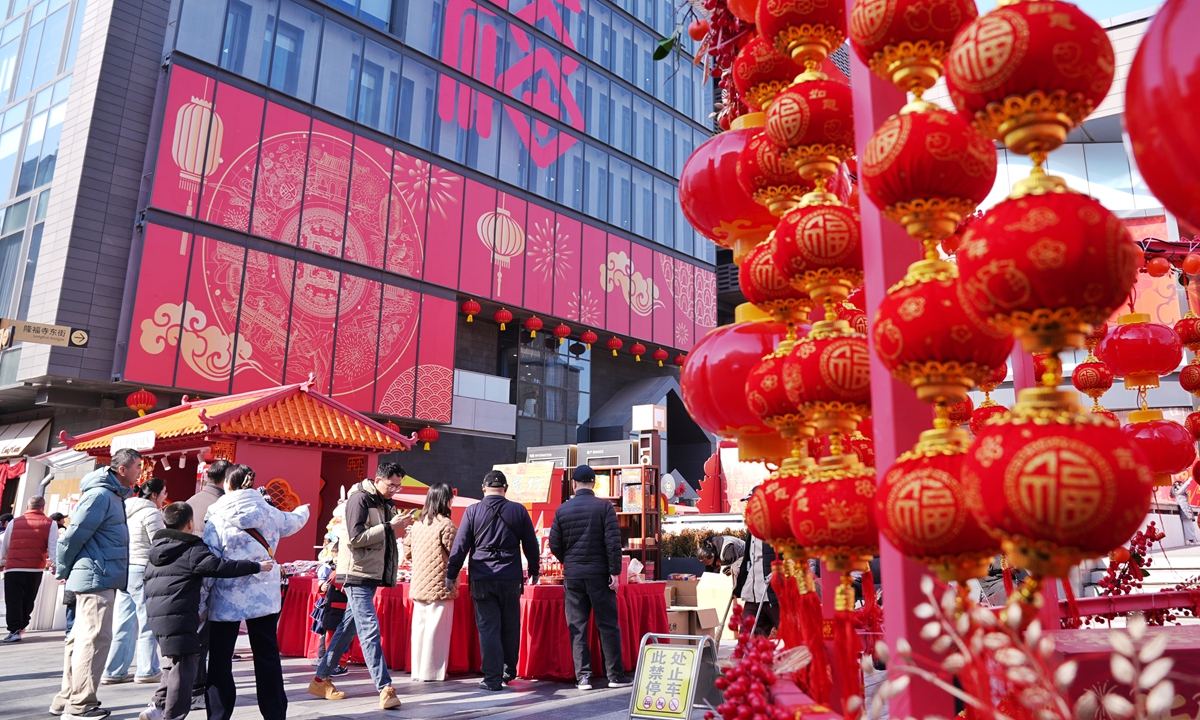
Residents shop at Spring Festival market at the Longfusi commercial area in Dongcheng district, Beijing, on February 12, 2026. Photo: IC
During the ongoing "two sessions" in Beijing, boosting domestic demand has been identified as a key priority in both the government work report and the draft outline of the 15th Five-Year Plan (2026-30), with lawmakers and political advisors highlighting its importance and proposing measures to further stimulate consumption.
Facing a complex and challenging international environment, we must remain committed to the strategy of expanding domestic demand, read the report. Several National People's Congress (NPC) deputies and members of the 14th National Committee of the Chinese People's Political Consultative Conference (CPPCC) said that boosting domestic demand and consumption remains a key economic priority, with rising household incomes widely seen as a crucial foundation for unlocking consumer potential.
Wang Yu, a member of the National Committee of the CPPCC, vice chairman of the All-China Federation of Industry and Commerce and chairman of Spring Airlines, told the Global Times in a statement that China's per capita disposable income has maintained real growth of more than 5 percent, providing a foundation for a systematic income growth plan. However, challenges remain, including weak property income growth, rising living costs and the need to strengthen employment and social security for key groups.
To translate the central policy deployment into tangible gains for the public, based on China's national conditions, and with the aim of doubling urban and rural residents' incomes over about a decade, Wang suggested that local governments be tasked with formulating income growth plans, systematically reducing livelihood-related spending burdens and raising the basic pension level.
Kenneth Fok Kai-kong, an NPC deputy from Hong Kong, told the Global Times that China's middle-income group has surpassed 400 million, but challenges remain, including an imperfect income distribution adjustment mechanism and high rigid household costs.
He called for improving income distribution by linking wage growth with tax incentives for firms that raise pay, adjusting the individual income tax threshold and rate structure, expanding tax exemptions for low- and middle-income groups, and increasing special additional deductions to boost disposable incomes.
He also urged tailored income-support policies for key groups such as skilled workers, researchers, small business owners, high-quality farmers and workers in new forms of employment, and called for advancing integrated urban-rural public services in education, healthcare and eldercare, optimizing resource allocation and regulating related charges to ease households' spending burdens.
China will fully tap and unleash the potential of effective investment. A total of 755 billion yuan ($109 billion) will be earmarked in this year's central government budget for investment. We will also allocate 800 billion yuan raised from ultra-long special treasury bonds to implement major national strategies and enhance security capacity in key areas, according to the government work report.
Policy support for consumption has also been stepped up. To promote the expansion and upgrading of goods consumption, 250 billion yuan in ultra-long special treasury bonds will be earmarked for consumer goods trade-in programs, and refinements will be made to the implementation mechanisms for relevant policies.
Qi Xiangdong, a member of the National Committee of the CPPCC member and chairman of Qi An Xin Technology Group, told the Global Times that demand-side measures should help people "have money to spend and feel confident about spending." He suggested stepping up fiscal and tax reforms, including optimizing the individual income tax threshold and rate structure, exploring regular consumption subsidies for low- and middle-income groups, and improving social security in pensions, healthcare and education to ease households' concerns.
On the supply side, Qi said that the focus should be on creating new consumption scenarios and upgrading services, including accelerating national-level pilots and demonstration zones in frontier areas such as artificial intelligence and developing more immersive, experience-based offerings to meet diversified demand.
Zhang Yi, a member of the National Committee of the CPPCC and senior partner at King & Wood Mallesons, told the Global Times that China should develop the "happiness economy" to create new consumption momentum, describing it as a trillion-yuan market driven by sustained emotional experiences and rising aspirations for a better life. He called for integrating culture, tourism, commerce, sports, exhibitions, and green development to build a new consumption ecosystem.
He also urged stronger policy support to cultivate intellectual property-driven consumption in areas such as animation, gaming, trendy toys and exhibitions, and to create new scenarios through cultural experience centers and themed consumption spaces.
Taking the expansion of domestic demand as our priority, we should make coordinated efforts to boost consumption and expand investment, tap into every potential for growth in domestic demand, and better leverage the strengths of our enormous market, per the government work report.
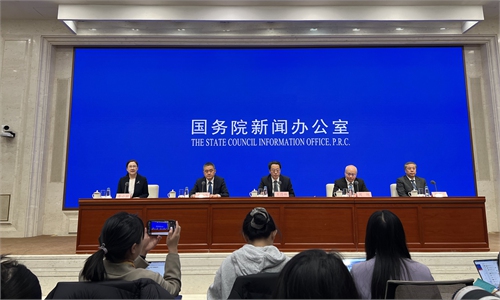
China will actively boost consumption and promote the building of a strong domestic market this year, guided by the strategy of expanding domestic demand, Lou Qinjian, spokesperson for the fourth session of the 14th NPC, said on Wednesday, the Xinhua News Agency said.
Lou said that the country will expand the supply of high-quality consumer goods and services. Efforts will be made to enhance services consumption, optimize the consumer goods trade-in program, and establish an international consumption environment, Xinhua reported.
RELATED ARTICLES