New materials to play more important role in national economy over next five years: Political advisor
By Published: Mar 08, 2026 11:24 PM

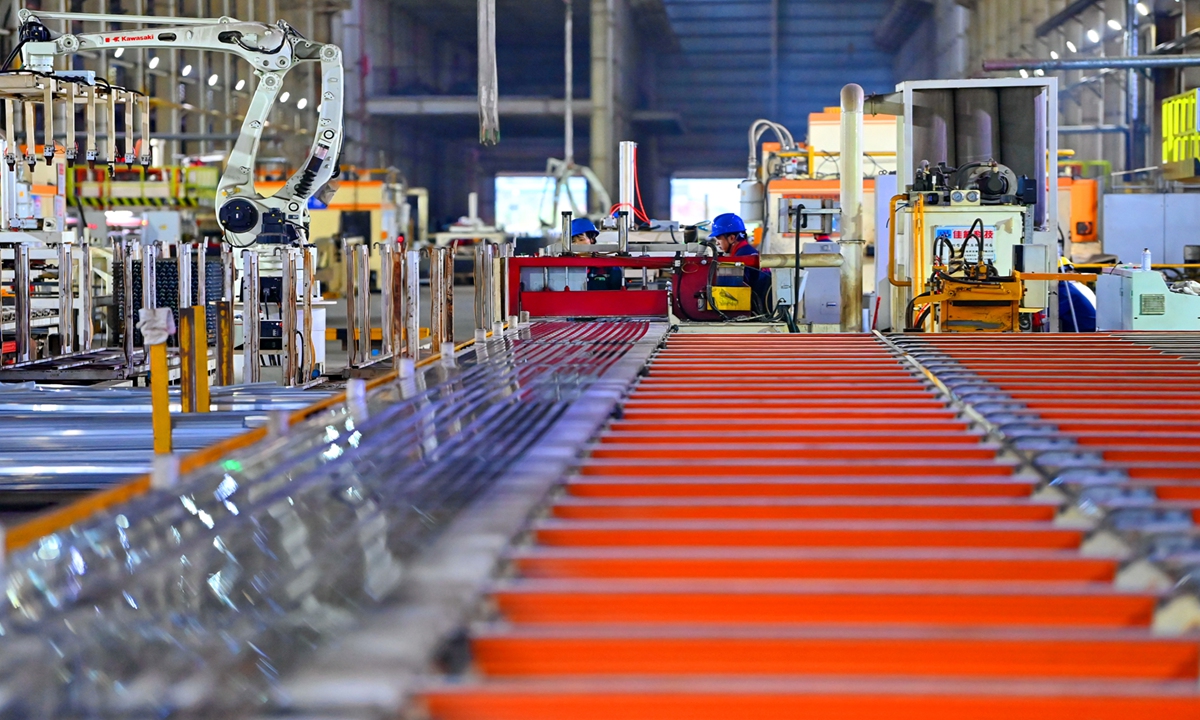
Workers process aluminum products on an intelligent production line at a new material base in Fuzhou, East China's Jiangxi Province on March 2, 2026. Photo: VCG
The inclusion of new materials in the Communist Party of China (CPC) Central Committee's recommendations for the 15th Five-Year Plan (2026-30) marks a strategic shift: They are no longer just a supporting element in China's industrial chain but have become a fundamental pillar of the modern industrial system and new quality productive forces, a national political advisor told the Global Times in an exclusive interview on the sidelines of China's annual "two sessions."
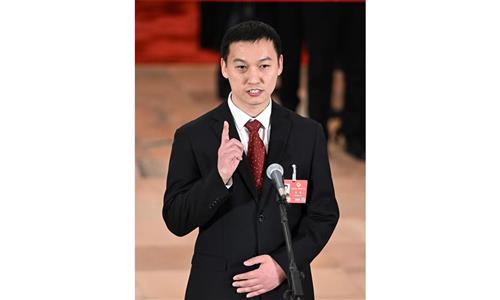
With the inclusion, efforts to tackle key core technologies will be further strengthened, especially in the fields of high-end functional materials and advanced structural materials, said Yang Quanhong, a member of the 14th Chinese People's Political Consultative Conference (CPPCC) National Committee and a professor at Tianjin University, told the Global Times.
In addition, pilot testing, technology transfer and application scenarios will be given more attention, which will help break through the key barrier between the laboratory and the production line, Yang said, adding that a third point would be that the combination of material innovation and industrial innovation will become closer in the next five years.
The remarks by Yang came as a number of national lawmakers and political advisors stressed the importance of sci-tech innovation at the ongoing "two sessions."
Zeng Yuqun, a member of the National Committee of the CPPCC and chairperson of Chinese battery manufacturer CATL, stressed at a group interview at the Great Hall of the People in Beijing last week that homegrown innovation lies at the core of the rise of China's new-energy sector.
As a leading enterprise, CATL will focus more on research and development (R&D) investment and industrial deployment in new materials, new chemical systems, new structural systems, new energy systems and new manufacturing systems in the future, Zeng said, according to the Xinhua News Agency.
The importance of scientific and technological innovation to national economic development is set to be more prominent in 2026, the inaugural year of the 15th Five-Year Plan period, Yang said.
"Today, we not only need to cultivate new growth drivers, but also promote the transformation and upgrading of traditional industries, and enhance the resilience and security of the industrial chain and supply chain at the same time," Yang said.
All these ultimately rely on scientific and technological innovation. "For us, it is not only important to produce results, more importantly, we need to make the results of scientific research enter companies, production lines and real-world applications faster, and form sustainable industrial competitiveness," said Yang, who is an expert in battery technologies.
Commenting on China's progress in the field, Yang said that "the most impressive breakthrough in 2025 for me would be the solid-state batteries' transition from a 'concept craze' to 'problem-oriented' R&D."
In the past, people were more focused on discussing prospects, parameters and potential. However, in 2025, what struck me more deeply was that many teams began to truly target the core bottlenecks of industrialization, such as safety and large-scale production issues, Yang explained.
The national policy orientation last year placed greater emphasis on multi-field application demands, the expansion of application scenarios, and the effective connection between the supply side and the application end. This signals that the entire industry is moving from a laboratory-oriented approach to a scenario-oriented one at a faster pace, Yang said.
RELATED ARTICLES