China’s private firms hail renewed push for sci-tech self-reliance in Government Work Report
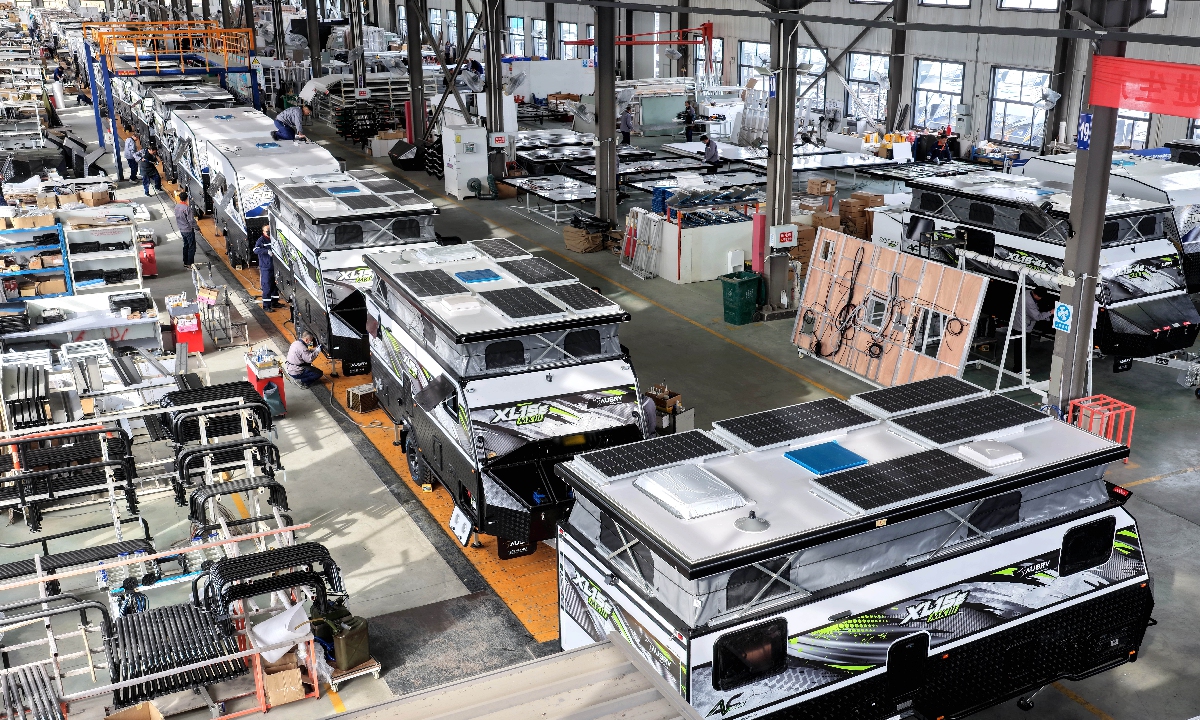
A workshop of a recreational vehicle (RV) manufacturing company is seen in Rongcheng, East China's Shandong Province on November 17, 2025. Local producers are ramping up efforts to seize international market opportunities with technological innovation. Photo: VCG
China will accelerate efforts to achieve greater self-reliance and strength in science and technology in 2026, according to the Government Work Report submitted on Thursday to the country's top legislature for deliberation. The pledge has resonated with the private sector, with multiple Chinese private technology enterprises saying they feel inspired by the report and are ready to seize opportunities for further advancement.
As the 15th Five-Year Plan (2026-30) period begins, the Government Work Report builds on its strong emphasis on technological innovation, signaling a shift from an era of acquring foreign technology through market opening to a new stage centered on independent innovation and open cooperation. This transition, will create new opportunities for private tech firms to participate in the national innovation system, Chen Jing, a vice president of the Technology and Strategy Research Institute, told the Global Times on Thursday.
The Government Work Report noted that the principal role of enterprises in innovation will be reinforced. This is both a mission entrusted by the country and a responsibility the company must shoulder, said Qi Xiangdong, a national political advisor and chairman of cybersecurity company Qi-Anxin, in a statement sent to the Global Times on Thursday.
This year's Government Work Report for the first time proposed that China "will create new forms of smart economy," and stated to "advance and expand the AI Plus Initiative" and "launch new infrastructure projects on hyper scale intelligent computing clusters."
In response to the growing demand for digital application scenarios, Qi-Anxin will increase investment in large-language model security to prevent the misuse of artificial intelligence (AI) and address concerns over data security, said Qi.
Guo Yufeng, a national political advisor and deputy general manager of Chinese chip provider Phytium Technology Co, said that the Government Work Report has made his company's direction clearer and its goals more defined.
Guo said that the company will accelerate the research and development (R&D) of next-generation high-performance server chips and intelligent computing chips, deepen industrial applications, and bring domestically developed chips into core scenarios across various industries.
Nan Cunhui, a national political advisor and chairperson of smart energy solutions provider CHINT Group, said that his company will combine AI with the green energy industry and increase investment in R&D of key technologies such as new-type energy storage and zero-carbon industrial parks.
The Government Work Report also reiterated the need to nurture emerging industries and industries of the future, and foster emerging pillar industries such as integrated circuits, aviation and aerospace, biomedicine, and the low-altitude economy, as well as expediting the development of satellite internet.
Chinese commercial aerospace firm Galaxy Space's co-founder and CTO Zhu Zhengxian said that he was greatly encouraged, noting that technological innovation in the satellite internet sector is expected to accelerate further, application scenarios are likely to expand, and the market scale will continue to grow. The satellite internet industry will become a new engine supporting China's economic development, he said.
China achieved historic milestones in innovation in 2025, marked by breakthroughs in humanoid robots, AI and biotech - fueled by record-high R&D investment that exceeded 3.92 trillion yuan ($569 billion) in 2025, or 2.8 percent of GDP, Minister of Science and Technology Yin Hejun said on Thursday on the sidelines of China's national legislature's annual meeting, the Xinhua News Agency reported.
Moving forward, China will speed up the implementation of major national sci-tech projects, focusing on breakthroughs in areas such as integrated circuits, AI, biomanufacturing, quantum technology, brain-computer interfaces and nuclear fusion to support industrial development, Yin said.
Cong Yi, a professor at the Tianjin School of Administration, told the Global Times on Thursday that China's private enterprises have gradually become the main drivers of market innovation and are playing a leading role, as the "gazelle" firms, unicorns and niche "little giant" enterprises are mostly private-owned and serve as pioneers of innovation-driven development.
Investment in original innovations is largely supported by state-owned enterprises. However, the private sector is closer to the market and plays a key role in transforming scientific and technological achievements into practical applications, Cong said.
"In the future, state-led new infrastructure construction will lay the foundation for strategic emerging industries and future industries, while also providing broad development space for the private economy," said the professor.
RELATED ARTICLES