China’s CPI rises 1.3% in February, hitting highest level in nearly 3 years, as domestic consumption rebounds
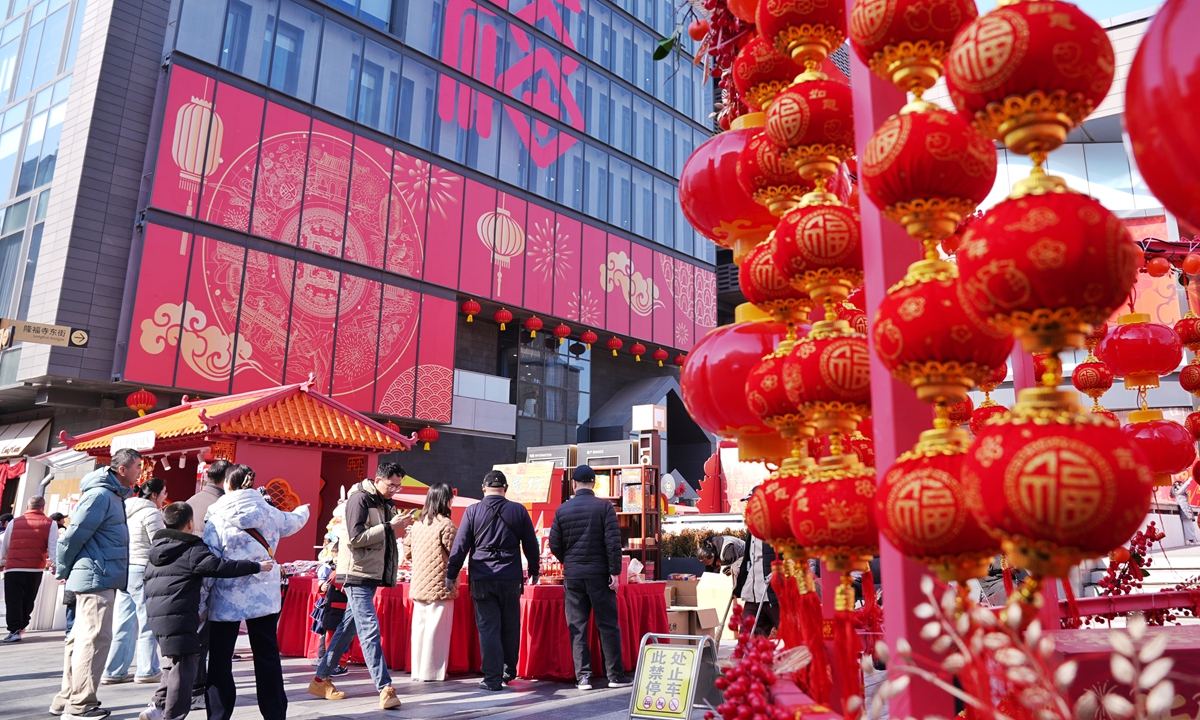
Residents shop at Spring Festival market at the Longfusi commercial area in Dongcheng district, Beijing, on February 12, 2026. Photo: IC
China's consumer price index (CPI) rose 1.3 percent year-on-year in February, rebounding sharply from January, official data released by the National Bureau of Statistics (NBS) showed on Monday, in what analysts said was a sign of recovering domestic consumption.
Explaining the faster CPI growth, Dong Lijuan, chief statistician at the NBS' city department, said that due to the shifting timing of the Spring Festival and the recovery in consumer demand, the CPI tick-up has gained pace, from 0.2 percent rise in January to 1.3 percent growth in February, the highest level in nearly three years.
In the first two months of the year, the CPI rose 0.8 percent year-on-year, the NBS said.
A CPI rise above 1 percent is an important signal of recovering domestic consumption, as a moderate level of inflation often benefits economic growth and job creation, said Li Changan, a professor at the Academy of China Open Economy Studies under the University of International Business and Economics.
The CPI rise also points to a stabilizing economy and suggests that government policies aimed at supporting growth and expanding domestic demand are delivering results, Li told the Global Times on Monday.
The latest data showed that service prices rose 1.6 percent year-on-year in February, up 1.5 percentage points from a month earlier, contributing about 0.75 percentage points to the CPI increase.
Among services, air ticket fares rose 29.1 percent, vehicle rentals increased 19.8 percent, tour service fees climbed 12.5 percent, and hotel accommodations edged up 5.4 percent. Together, they accounted for more than 30 percent of the total price rises, according to NBS.
Meanwhile, food prices rose 1.7 percent in February, compared with a 0.7-percent decline seen in January.
On a month-on-month basis, China's CPI rose 1.0 percent in February, up from 0.2 percent rise in January and the highest level in nearly two years, mainly due to the concentrated release of consumer demand during the extended Spring Festival holiday, which pushed service price growth above the usual seasonal level, Dong said.
Also in February, domestic gold jewelry prices rose 6.2 percent due to rising international gold prices, while domestic gasoline prices climbed 3.1 percent as the impact of international geopolitical conflicts on energy prices was transmitted to the domestic market.
Li said that if the CPI's upward trend is sustained through the year, it will provide a boost to economic growth. He said efforts at all levels of government to stimulate domestic consumption are expected to continue, further consolidating the current recovery momentum.
In this year's Government Work Report delivered at the ongoing national two sessions, China kept its CPI growth target at around 2 percent for this year.
China has rolled out a range of policy measures in response to a period of relatively low prices. "Last year, steps were taken to expand domestic demand, optimize supply and address excessive competition, and these measures are beginning to show results," Chen Changsheng, deputy director of the Development Research Office of the State Council, told a press briefing on Thursday.
If one looks at the overall price trend throughout 2025, it is clear that CPI has been gradually stabilizing, the decline in the producer price index (PPI) has narrowed notably, and the broader GDP deflator has improved, indicating price growth momentum is recovering, Chen said.
"Keeping this year's inflation target at around 2 percent provides a clear policy anchor for governments at all levels to stabilize growth," Li said, adding that it will help improve market expectations, strengthen consumer confidence and in turn better support consumption recovery.
China's PPI fell 0.9 percent year-on-year in February, with the pace of decline narrowing by 0.5 percentage points from January, marking the third straight month of moderation, NBS data showed on Monday.
Dong said the effects of domestic macro policies continued to materialize, bringing positive price changes in some sectors. Prices in emerging industries such as AI, robotics and green manufacturing posted year-on-year increases, while continued improvement in market competition order helped support price stabilization and recovery in some sectors.
RELATED ARTICLES