SPORT / MISCELLANY
Chinese national women’s football team claims group top spot at Asian Cup
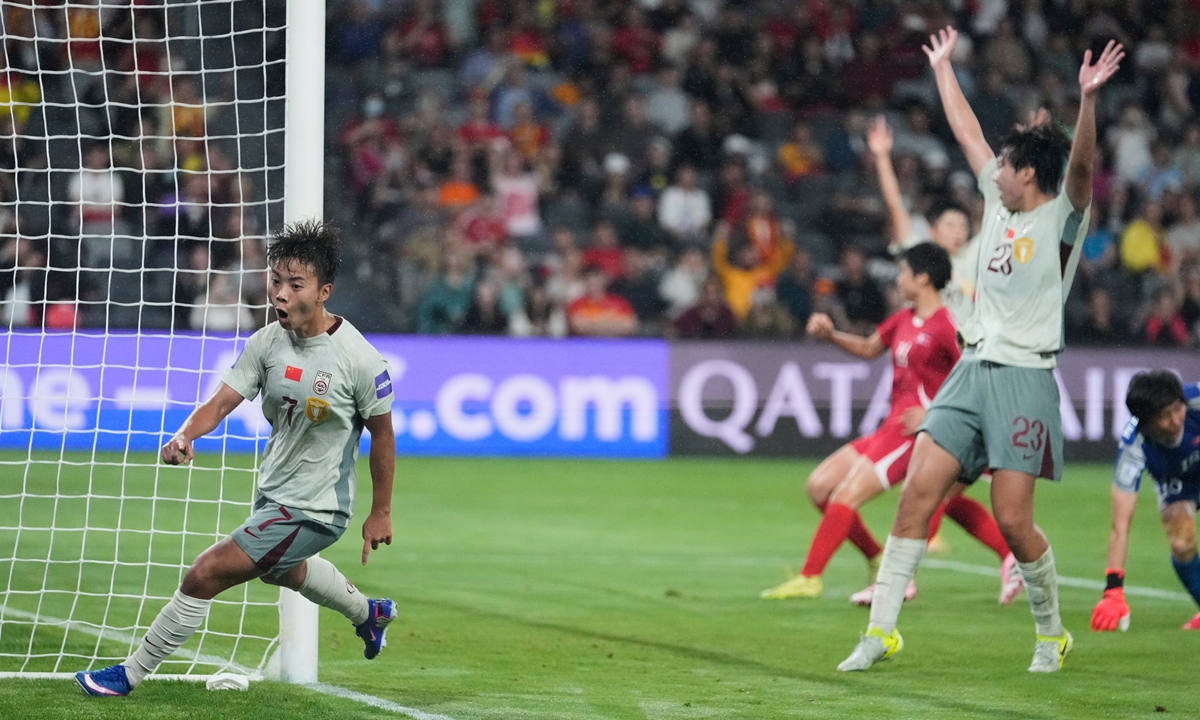
China's Wang Shuang (left) celebrates scoring her team's second goal during the Women's Asian Cup football match against North Korea in Sydney, Australia on March 9, 2026. Photo: VCG
The Chinese women's national football team staged a remarkable comeback to defeat arch-rivals North Korea 2-1 in their final Group B match of the 2026 Women's Asian Cup on Monday.The victory not only secured China's record of three wins from three games but also locked in the top position in the group, setting up a favorable quarterfinal matchup and boosting their prospects for a deep tournament run and qualification for the 2027 FIFA Women's World Cup.
The Steel Roses, as the Chinese team is affectionately known, entered the match as defending champions, having lifted the trophy in 2022 with a dramatic 3-2 final win over South Korea in India.
The Chinese women's national football team has reached the semifinals in all 15 Women's Asian Cup appearances in history and has won the championship nine times.
This edition of the tournament, hosted by Australia, carries extra significance, as the top six teams will earn direct berths to the 2027 Women's World Cup.
China, seeking a record-extending 10th Asian Cup title, had already impressed with convincing victories over Bangladesh with 2-0 and Uzbekistan with 3-0 earlier in the group stage.
Before Monday's victory, the Chinese women's team's most recent triumph over their East Asian neighbors was at the 2018 Asian Games in Jakarta, while their last win at an Asian Cup dates back to 2006.
The breakthrough came in the 32nd minute when North Korea struck first. Han Jin-hong delivered a pinpoint cross from the right flank, finding Kim Kyong-yong unmarked in the box.
But China, under Australian coach Ante Milicic, refused to buckle. Just two minutes later, in the 34th minute, they equalized through defender Chen Qiaozhu. The goal ignited the Chinese bench and shifted the momentum.
As the first half wound down, China capitalized on their resurgence. In the fourth minute of stoppage time, star forward Wang Shuang, China's talismanic No.7, delivered the killer blow.
Latching onto a through ball from midfielder Zhang Linyan, Wang slotted home with composure to make it 2-1, sending her teammates into rapture and ensuring China headed into halftime with the advantage.
The second half saw China adopt a more defensive posture, absorbing North Korean pressure while looking to counter. The scoreboard remained at 2-1 after China weathered the offensive storm from North Korea.
Statistically, the game was evenly matched: China edged possession at 54.5 percent. China had seven shot attempts to North Korea's six, but their clinical finishing proved the difference. This win ended a run of five losses in their last six encounters with North Korea.
Historically, the rivalry has been lopsided, with North Korea's disciplined, high-pressing style often overwhelming China's technical flair.
But under Milicic, appointed in 2024, the team has shown renewed resilience. Players like Wang Shuang and Zhang Linyan have been pivotal, blending experience with youth.
With the group stage wrapped for the Chinese team, they finished atop Group B with nine points, avoiding a quarterfinal clash with hosts Australia. Both the Chinese and North Korean teams now relocate to Perth for the quarterfinals.
RELATED ARTICLES