Is foreign investment ‘massively withdrawing’ from China?: Global Times editorial
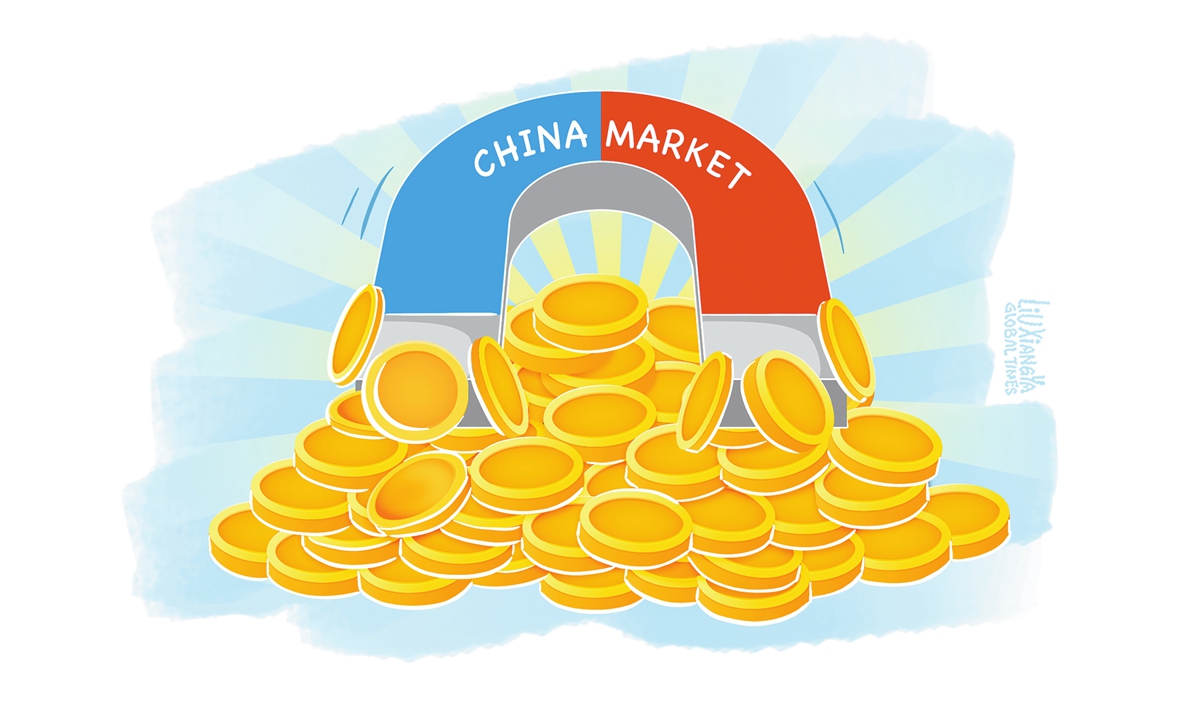
Illustration: Liu Xiangya/GT
Editor's Note:
Currently, China's economy is steadily advancing along the path of high-quality development, even as domestic and international circumstances become increasingly complex. Some Western media, due to misunderstanding or bias, have repeatedly questioned or even distorted China's economic development. Accordingly, the Global Times launches the "Q&A on China's Economy" column to publish opinion pieces to present facts and clarify perceptions.
Recently, some Western narratives have once again revived the old tune of "foreign capital withdrawing from China." Certain foreign media outlets attempt to construct a story of China "losing its appeal" by cherry-picking individual cases of multinational companies adjusting their operations. But is this really the case?
The data tells a very different story. By 2025, the actual use of foreign direct investment (FDI) in the Chinese mainland had exceeded 700 billion yuan ($100 billion) for 16 consecutive years. In the same year, 70,392 new foreign-invested firms were established across China, marking an increase of 19.1 percent year on year. The actual use of FDI in sectors such as e-commerce services, medical device and equipment manufacturing, and aerospace vehicles and equipment manufacturing grew particularly strongly. This aligns with the "four key draws for foreign investors" identified by observers: China's super-large consumer market, the expanding services sector, the innovation ecosystem and new pacesetters of opening-up.
To understand the true situation of foreign investment in China, one cannot focus on isolated cases or be misled by sensational headlines. Walmart provides a good example. While it is true that some of Walmart China's retail stores have been closing in recent years, its Sam's Club outlets are thriving. Over the entire 2026 fiscal year (ending Jan 31, 2026), business in the Chinese market grew rapidly, helping Walmart achieve total annual revenue of $713.2 billion, up 4.7 percent year on year - hardly a sign of "withdrawal."
It is perfectly normal for multinational companies to adjust their operations in China. In the past, some "foreign brands" leveraged their brand halo and early technological advantages to become "pioneers" in the Chinese market, but that era has long passed. As in other mature markets, the Chinese market has grown more competitive. China's economy is like a vast ocean, deeply integrated into the global division of labor, and the movements of multinational capital in China essentially reflect the natural process of the market evolving from a phase of market grabbing to full competition and quality upgrading.
Some in the West are accustomed to viewing Chinese industries as traditional "low-end sectors," but this is a fixed mind-set. With rising national strength and industrial upgrading, China's comparative advantages have shifted. Labor-intensive, low-value-added industries at the bottom of the "smile curve" are relocating overseas as part of China's deliberate strategy to upgrade its value-chain ecological niche. The resources freed up through this process provide higher-dimensional growth space for high-tech, high-value-added foreign investment, a clear sign of the Chinese market's maturation.
Global "smart money" continues to flow into China. Capital has always followed the underlying logic of profit maximization and the embrace of advanced productive forces. Taking 2025 data as an example, among industrial enterprises above the designated size, the total profits of enterprises funded by foreign investors and investors from Hong Kong, Macao and Taiwan saw an increase of 4.2 percent year on year, with the profit rate of business revenue reaching 6.7 percent.
Furthermore, top Wall Street institutions such as Goldman Sachs and BlackRock have continued to increase their holdings in China's technology and new-energy sectors, undeterred by political noise. Switzerland - representing the world's highest standards in manufacturing and precision craftsmanship - saw its actual investment in China surge by a striking 66.8 percent. These facts are sufficient proof that China's macroeconomic efficiency in resource allocation remains among the best in the world, and that foreign capital aligned with China's high-quality development trajectory is still able to generate exceptionally strong returns.
As new quality productive forces accelerate their formation today, the logic driving foreign enterprises to deepen their presence in the Chinese market has evolved from the old paradigm of "in China, for China" to a new one of "in China, for the world." China possesses the world's only super-scale manufacturing network that encompasses every industrial category classified by the United Nations. It provides global innovation resources with the richest possible testing ground for real-world applications, spreading and reducing the marginal costs of innovation - whether "from zero to one," or "from one to a hundred." High-end foreign enterprises in Swiss precision manufacturing, European biopharmaceuticals, and other advanced sectors are flocking to China not merely for short-term commercial profit, but to secure their "ticket" to the next technological revolution. As a Tesla representative told the Global Times, ''there is an enormous consumer market here, along with an innovation ecosystem that keeps breaking through in cutting-edge fields like artificial intelligence,'' adding that they are full of confidence in the ''long-term potential of the Chinese market."
Why do companies like BMW and Mercedes-Benz remain so deeply committed to China, even in the face of political pressure? Recent surveys by several foreign institutions covering multinational corporations show that more than 90 percent of respondent companies intend to continue investing in China, and nearly 70 percent of senior executives are confident about their prospects in China over the next three to five years. China's institutional strengths are a major source of that confidence. Against a backdrop where certain countries arbitrarily wield tariffs as a weapon, China's door to the world continues to open wider - with the 2025 version of the Catalogue of Encouraged Industries for Foreign Investment now in effect, steadily broadening market access and extending national treatment to foreign enterprises. In the current international climate, this kind of policy predictability is especially valuable. Zhang Lei, Vice President of Communications of Bayer Group Greater China & North East Asia, told the Global Times that they are beneficiaries of China's opening-up, and they have been, are, and will continue to be active participants.
Of course, some companies have cooperated with certain countries in overstretching the concept of security and pushing for "decoupling and severing of supply chains," scaling back their operations in China. But this behavior is itself a departure from market logic and does nothing to substantiate the "foreign capital withdrawing from China" narrative. As new quality productive forces continue to accelerate their formation, the space for both China's own development and its international cooperation will expand further. Those global capitals that firmly embrace China's new economic landscape will inevitably share in the rich dividends of the times as China's economy undergoes its transformation and upgrading.
RELATED ARTICLES