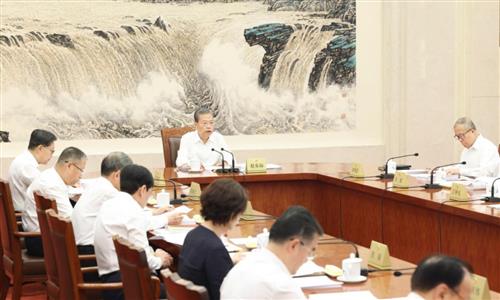
China’s national legislature holds second plenary meeting; high-quality legislation serves reform and development
By Feng Fan and Published: Mar 10, 2026 12:39 AM

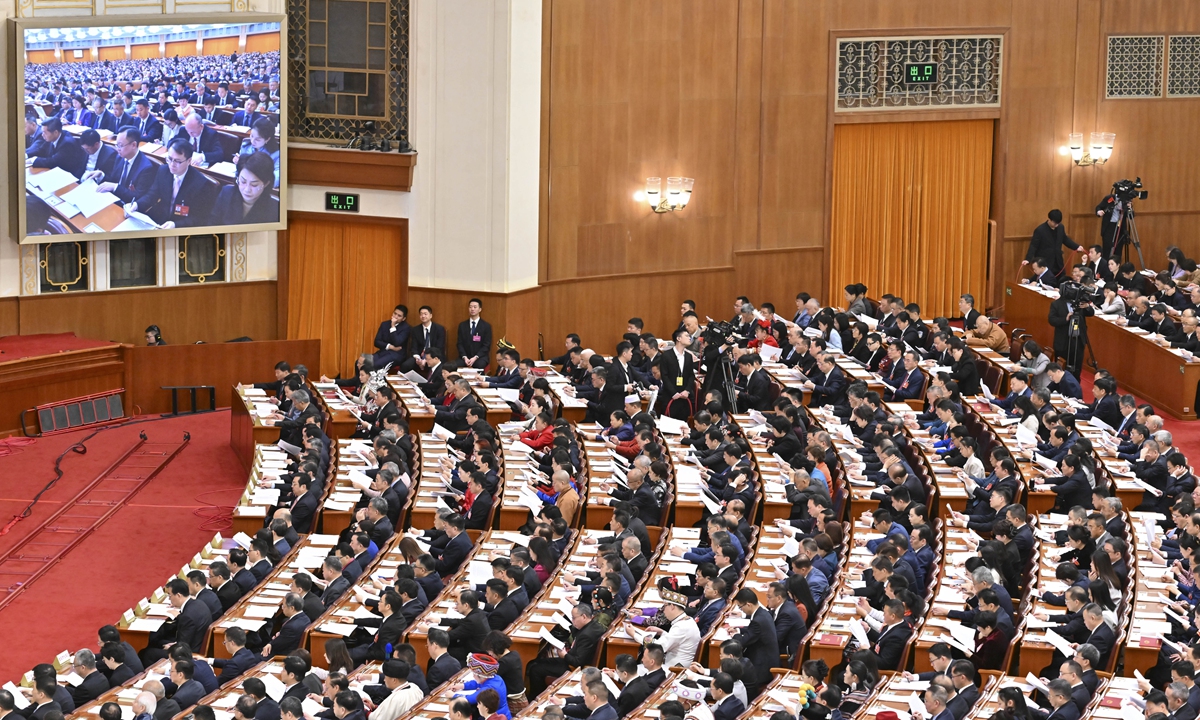
The fourth session of the 14th National People's Congress (NPC) holds its second plenary meeting on March 9, 2026. Photo: Xinhua
The fourth session of the 14th National People's Congress (NPC) held its second plenary meeting on Monday.
Xi Jinping and other Party and state leaders attended the meeting, according to Xinhua News Agency.
Zhao Leji, chairman of the NPC Standing Committee, delivered a work report of the Standing Committee at the meeting. A report of the NPC Standing Committee on the work of the overhaul of laws and the proposed handling of certain laws and decisions was submitted for deliberation at the meeting, per Xinhua.
The work report summarized major achievements in 2025 while specified multiple key areas the Standing Committee will work on in 2026, which will provide crucial legislative guarantee for China's high-quality development amid fast-changing domestic and international environments, according to legal experts and lawmakers.
At the Monday plenary, Zhang Jun, president of the Supreme People's Court, delivered a work report of the top court at the meeting. Ying Yong, procurator-general of the Supreme People's Procuratorate, delivered a work report of the top procuratorate at the meeting.
New situation
The Standing Committee of the NPC, China's top legislature, served and supported reform and development through high-quality legislation in the past year, according to its work report.
Legislative work carried out by the Standing Committee across multiple areas was highlighted. In strengthening economic legislation, the NPC Standing Committee enacted the Private Sector Promotion Law last year, explicitly establishing the principles of impartial treatment, fair competition, equal protection, and common development, according to the work report.
The NPC Standing Committee revised the Unfair Competition Law, which is instrumental in the development of a credit-based economy under the rule of law.
In addition, it also revised the Maritime Law, the Arbitration Law, and the Foreign Trade Law to further align with established international rules, thereby better serving high-standard opening up.
It also enhanced oversight of fiscal and economic affairs and took concrete steps to carry out law enforcement inspections, the work report said.
Zhi Zhenfeng, a research fellow with the Institute of Law at the Chinese Academy of Social Sciences, carefully followed the report and said the legislative role of the NPC Standing Committee will be particularly important in safeguarding China's development during the 15th Five-Year Plan period (2026-2030).
"In the face of new situations and challenges that may arise during development, the legislative work of the NPC Standing Committee will be crucial, especially as the international order continues to evolve and new technologies and industries develop during the 15th Five-Year Plan period," Zhi told the Global Times on Monday.
"As profound adjustments in the international order bring new uncertainties amid great changes unseen in a century, many new issues may emerge. This requires the NPC to adjust in a timely manner and promote legislation in areas such as foreign trade-related laws and cross-border corruption," Zhi said.
He added that in emerging development areas - including the digital economy, maritime governance, artificial intelligence and cybersecurity - legislation will be needed to address issues arising in the course of development.
"On the one hand, through enacting new laws, revising outdated ones, abolishing laws that are no longer suitable, and issuing legal interpretations, legislation is be optimized to support high-quality development," Zhi said.
Over the past year, the top legislature deliberated 40 draft laws, legal interpretations, and decisions and adopted 24 of them, including six new laws, 14 revised laws, one legal interpretation, and three decisions on legal matters and other significant issues. It also made decisions on the ratification of nine treaties and important agreements, per Xinhua.
Key areas
During the plenary meeting on Monday morning, Zhao noted that "we will strengthen research on legislation in Artificial Intelligence (AI) and other sectors."
AI, a buzzword during the "two sessions," is also heatedly discussed among NPC deputies after the plenary meeting. Global Times reporter observed at the Great Hall of the People that questions about AI are frequently raised as journalists surrounded NPC deputies, seeking their thoughts on how China — which is advancing rapidly in AI — will approach legislation in the field.
Li Shiliang, a deputy to the 14th NPC and president of the Sichuan Lawyers Association who proposed the formulation of an "Artificial Intelligence Law" during the "two sessions," told the Global Times on Monday that China has already established an initial governance framework for AI.
This framework is supported by national strategies, foundational laws and specific regulations, but it remains fragmented, consisting largely of point-based responses across various regulations, he said.
"So what is still missing is a foundational 'AI Law'— an overarching piece of legislation to establish general principles, basic institutions, and clear rights and responsibilities to address the systemic legal challenges posed by AI," Li told the Global Times.
"To govern an emerging field like AI, the law cannot just be a reactive shield; it must be a proactive and promotional map. It must strike a balance: mitigating systemic risks while purposefully reserving institutional space to fuel innovation and guide the industry toward high-quality growth," Li said.
Another NPC deputy attending the meeting, Xu Anbiao, a member of the Standing Committee of the 14th National People's Congress, also a member of the Constitution and Law Committee and vice president of the China Law Society, told the Global Times at the Great Hall of the People on Monday that legislation concerning AI has been continuously advancing and remains under study.
Xu said the law "should both regulate and provide safeguards, while also promoting the healthy and stable development of artificial intelligence."
According to the report, to advance national anti-corruption legislation, the top legislature will make a law on combating cross-border corruption.
The move has attracted attention from foreign media outlets. Reuters ran a report on the NPC Standing Committee work report under the headline "China aims deeper fight against corruption with cross-border law", while Singapore's Lianhe Zaobao also noted that China plans to formulate a law targeting cross-border corruption this year.
"Combating corruption is a shared goal and the right direction. Given that many financial assets and investments are now located in Hong Kong, Macao and overseas, Hong Kong should play its role in integrating into and serving the country's overall development," Priscilla Leung, a NPC deputy from Hong Kong SAR, told the Global Times.
As the Hong Kong Special Administrative Region formulates its next five-year development plans, legislation and law enforcement are expected to align more precisely with the country's broader anti-corruption framework, Leung said.
RELATED ARTICLES