CATL and BYD continue global battery market dominance; Experts attribute success to China’s cost‑effective and safe NEV industrial chain

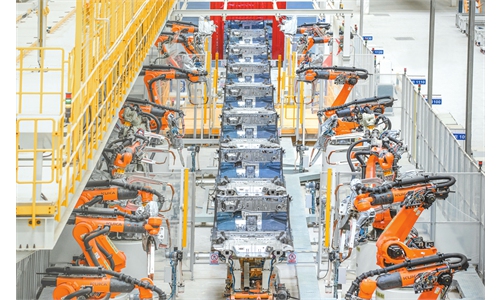
This photo taken on April 24, 2024 shows a new energy vehicle (NEV) assembly line of BYD, China's leading NEV manufacturer, at the plant of BYD in Zhengzhou, central China's Henan Province. Photo:Xinhua
Chinese companies hold leading positions in the global rankings for electric vehicle (EV) power battery market share, according to an analysis by South Korean market research firm SNE Research on Tuesday. CATL, China's battery giant and the world's largest supplier, has further strengthened its dominant global standing.
In January, the battery installation for global EV excluding the Chinese market sold increased 13.7 percent year-on-year to 32.7 gigawatt-hours (GWh), according to a SNE Research's press release.
A Chinese industry expert said China's new energy vehicle (NEV) industry chain balances cost-effectiveness and safety, and has gained broad recognition from major global NEV manufacturers.
According to the SNE Research analysis, China's CATL maintained its top position outside the Chinese domestic market, reaching 11.2 GWh, a 26.5 percent year-on-year increase. Also, BYD secured the third spot with an 86.0 percent surge to 3.7 GWh, which reflects a strategic shift prioritizing international investment and sales over domestic Chinese expansion.
Beyond supplying Chinese original equipment manufacturers expanding internationally, CATL has broadened its installation base by partnering with diverse global players such as Volkswagen and Audi, said the SNE Research's report. Significant growth was observed across Europe and emerging markets (excluding the US), further bolstered by an increase in the average battery capacity of Chinese EVs. While maintaining its lithium-ion-centric portfolio, CATL is also advancing the commercialization of sodium-ion batteries to strengthen its competitiveness in next-generation battery technologies, SNE Research noted.
For BYD's part, the report noted that leveraging its vertical integration (in-house production of both batteries and EVs), BYD is expanding its presence globally through superior price competitiveness across various vehicle segments. Additionally, to further enhance cost leadership, BYD is reportedly investing in sodium-ion battery production with an aim to establish a 30 GWh annual capacity.
The top three South Korean battery makers — LG Energy Solution, SK On, and Samsung SDI — saw a significant decline in their market shares. According to the SNE Research analysis, three major South Korean battery companies recorded a combined global market share of 25.5 percent in battery usage for EV in January. This marks a decline of 10.4 percentage points compared to the same period last year.
Specifically, LG Energy Solution saw a 16.2 percent (4.4 GWh) decline, SK On a 21.3 percent (2.3 GWh) drop, and Samsung SDI a 24.4 percent (1.6 GWh) decrease compared to the same period last year, with all three companies experiencing negative growth.
This downturn is primarily attributed to the sharp contraction in EV sales within the US market, which serves as a key stronghold for Korean battery makers, said the report.
China's Gotion High-tech and CALB ranked seventh and ninth in January with market shares of 3.8 percent and 2.7 percent, respectively. Japan's Panasonic ranked fourth globally in January with an installation volume of 3.1 GWh and a 9.5 percent share.
Among the top 10 companies, most are Chinese and Korean firms. Behind the figures in competitiveness and the ongoing market reshuffling is not just simple capacity expansion, but a comprehensive contest over supply‑chain resilience, choices of technological pathways, and the ability to respond to geopolitical pressures, Sun Xiaohong, secretary-general of the automotive branch of the China Chamber of Commerce for Import and Export of Machinery and Electronic Products, told the Global Times on Tuesday.
SNE Research stated that Chinese battery companies are expected to continue gaining market share in the near term. "Despite the geographical distinction of the 'non-China' market, the rapid expansion of CATL and BYD remains a dominant force. This shift is primarily driven by global OEMs diversifying their supply chains and the intensifying price competition across the industry," said the analysis.
The report specifically noted that CATL and BYD are effortlessly pushing the commercialization of sodium‑ion batteries to strengthen their responsiveness to the next‑generation market. This further indicates that Chinese firms are not content with current cost‑performance advantages; they are actively building future technology reserves in an attempt to remain leaders in next‑generation battery technologies, Sun noted.
However, South Korean firms' growth has slowed as US automakers adjust strategies and sharply scale back their NEV plans. Deep ties to the US market and its policy environment have left Korean companies among the first to suffer heavy losses, Sun said, adding that by contrast, Chinese companies have stuck to developing the lithium‑iron‑phosphate industry chain, balancing cost efficiency and safety, and have won broad recognition from major global new‑energy vehicle manufacturers.
RELATED ARTICLES