Why have Chinese factories become ‘training grounds’ for executives from global automakers?
The power of efficiency
By Ni Hao, Fan Wei, Chen Zishuai, and Published: Mar 03, 2026 12:36 AM


Editor's Note:
In the air, along a 7.69-kilometer track suspended 4 meters above the ground, a continuous stream of sky shuttles swiftly and precisely carries batches of skilled workers to their respective workstations. On the ground, cargo trailers weave through the industrial park, delivering batteries, motors, body structures, and other components to various workshops. When Global Times reporters visited Chinese new-energy vehicle (NEV)-maker BYD's megafactory in Zhengzhou, Central China's Henan Province, this multi-level transportation system was unfolding. The beauty of modern industry, with its efficient flow of various production factors, is truly breathtaking.
The global automotive industry has now spanned more than a century of development. Today, China has achieved leapfrog development in the NEV industry in just more than a decade, fully demonstrating to the world the new accomplishments of Chinese modernization. These impressive achievements have also attracted numerous senior executives from global automakers to visit, observe, and "receive training" firsthand.
The Global Times launches a series of special reports on China's evolution into an automobile powerhouse. This is the second installment.
Redefining the connotation of 'efficiency'
In Western economics, efficiency was once regarded as a concept in opposition to fairness, where one goal could only be achieved at the expense of the other. However, in the development process of China's new-energy vehicles (NEVs), the connotation of "efficiency" has been redefined. It is no longer a one-sided pursuit of speed, blind cost-cutting, or sacrifice of the environment and fairness; instead, it encompasses a systemic efficiency that integrates top-level design, institutional stability, technological innovation, industrial collaboration, and a people-centered approach. "Chinese efficiency" has not only created miracles in manufacturing but has also revealed the profound logic and institutional advantages of Chinese modernization.
Why was BYD able to achieve the miracle of scaling from 1 million to 15 million NEVs rolling off the production line in just five years? Behind this is the vast and comprehensive supply chain system of the NEV-maker. Why was Tesla's Shanghai Gigafactory able to go from groundbreaking to production in the same year, astonishing Elon Musk? Behind this is the deep industrial foundation of the Yangtze River Delta, where all necessary components can be sourced within a 4-hour drive.
Leveraging its efficiency advantages, China has transformed technological innovation from mere "bonsai" confined to laboratories into a tangible, market-visible "landscape" of industry. NEVs have evolved from "luxury goods" to products accessible to ordinary households. In doing so, China has converted the green strengths of its industry into widespread benefits for people's livelihoods, while simultaneously reshaping the global automotive industry's cost curves and technical standards.
More importantly, through the practical development of NEVs, China has contributed an entirely new modernization path to the world - one supported by technological standards, rooted in industrial ecosystems, and centered on green development.
An NEV rolls off the assembly line in less than one minute on average, while a single power battery cell is produced every 3 seconds. This vast and comprehensive supply chain system has fueled the vigorous growth of BYD's NEV production, continuing to redefine the "China speed" in the NEV sector.
Luo Hao, assistant general manager of BYD's brand and public relations department, told the Global Times that in 2021, BYD achieved its 1 millionth NEV rolling off the production line. By the end of 2025, BYD celebrated another milestone with its 15 millionth NEV coming off the line.
'China Speed' born from the supply chain
In 2015, China became the world's largest producer and seller of NEVs for the first time - and the country has maintained that leading position ever since.
"The root cause behind the highly efficient development of China's NEV industry lies in China's full-chain, high-density, and strongly coordinated production and supply chain system," Feng Shiming, a veteran Chinese automotive industry analyst, told the Global Times. He noted that the "China speed" born from the NEV sector does not stem from the superiority of any single piece of equipment, nor is it merely the result of Chinese people's hard work. "It arises from the systemic advantages of the entire industrial chain," Feng stressed.
A broader view across China shows that major NEV industry clusters have taken shape in the Yangtze River Delta, the Pearl River Delta, the Beijing-Tianjin-Hebei region, as well as the Chengdu-Chongqing area in Southwest China. Together, these clusters form a comprehensive national landscape of China's NEV industry.
"It takes less than 20 minutes from the moment we issue an instruction to the time our suppliers adjust their production lines. And thousands of components are supplied daily and can be fully turned over on the same day," Kang Bo, Chinese automaker SERES Group's vice president, told the Global Times.
The SERES super factory is located in the Chengdu-Chongqing NEV industrial cluster, and has established long-term, stable cooperation with numerous leading supply chain partners.
"After more than a century of development in the global automotive industry, China has started from scratch to build a cross-industry production and supply chain ecosystem for NEVs, encompassing batteries, electric motors, and operating systems - which is also highly efficient and remarkably resilient. In today's world, no matter who wants to compete on the same stage with Chinese automakers, integrating into China's production and supply chain is the only viable choice," Feng said.
At a time when protectionist trade policies are proliferating in certain countries, Ford's CEO has paid a visit to Zeekr's factory, and the CEO of Volkswagen Group China also visited BYD's headquarters. In recent years, leaders of major traditional foreign automakers have not only shown great enthusiasm for visiting China's NEV factories, but have also gone against the de-globalization rhetoric by significantly increasing their investments in China - integrating more of their production and R&D into China's production and supply chains, riding the "China express" and sharing in China's opportunities.
"As a result of our localized R&D setup and the new software-defined vehicle (SDV) development process, we have significantly shortened vehicle development cycles," Thomas Ulbrich, Chief Technology Officer (CTO) of Volkswagen Group China, told the Global Times. During the interview, Ulbrich mentioned multiple times that Volkswagen should combine its "German DNA" with "China speed," thereby injecting "Chinese efficiency" into the overall transformation of the Volkswagen Group.
'Seizing a precious strategic opportunity'
A clear and correct top-level design lays the foundation for ensuring the high efficiency of China's NEV development.
"Going forward, we will reduce as soon as possible limits on foreign investment in these industries, automobiles in particular," Xi Jinping, General Secretary of the Communist Party of China Central Committee and Chinese president, said while delivering a keynote speech at the opening ceremony of the Boao Forum for Asia annual conference in the southern island province of Hainan on April 10, 2018.
Three months later, Tesla signed an agreement with the Shanghai municipal government, becoming the first foreign carmaker to build a wholly-owned factory in China. "In hindsight, the 'catfish effect' created by introducing Tesla objectively forced Chinese automakers to confront challenges head-on and adapt proactively, ultimately enabling them to achieve even faster development speed," Fu Yuwu, honorary chairman of the China Society of Automotive Engineers, told the Global Times. Fu noted that "it was only afterward that the industry truly appreciated the foresight of this decision. And the starting point of all those policies was to drive China's NEV industry toward faster and better development."
In an article titled "How China Beat the US in the Great EV Race," Bloomberg noted that "the bigger differences [between China and the US] concern intent and incumbent systems." China has strategic reasons to pursue vehicle electrification, beyond fostering export industries, while Washington has only lately coalesced to a greater degree around the idea of industrial protectionism, the report noted.
In the book "Changing Lanes and Racing: The Chinese Path of NEVs," former Chinese Minister of Industry and Information Technology Miao Wei revealed that throughout the various stages of China's NEV development, there have always been diverse ideas and competing views surrounding the two fundamental questions: "Should we develop it?" and "How should we develop it?"
According to Miao, the ultimate reason for China's NEV achievements lies in the collective leadership of the Communist Party of China and the distinctive advantages of Socialism with Chinese characteristics.
"China's unwavering strategic resolve - 'following a good blueprint through to the end' - in developing NEV has allowed the country to seize a precious strategic opportunity and gain substantial time to catch up with and surpass Western nations," Fu said.
China's NEV production and sales have continuously ranked first in the world for many years. According to Fu, the most critical reason for achieving this success lies in China's unwavering determination to develop NEVs. By never wavering, avoiding detours or reversals, China has realized leapfrog development.
Helga Zepp-LaRouche, founder of the Schiller Institute based in Germany, told the Global Times that compared with car industries in Europe, the US, and other Asian countries, China's policymaking and implementation have been the most resolute. "Since the late 1990s, China has consistently prioritized NEVs as a key strategic industry across successive Five-Year Plans. This has delivered more than two decades of clear, comprehensive, and long-term vision, powerfully driving rapid market expansion and positioning China at the forefront of global technological innovation," she noted.
"In 2002, BYD chose the lithium iron phosphate (LFP) route among the three major global technology pathways for batteries. At that time, Japanese giants such as Panasonic and Sony were heavily focused on the more mature lithium cobalt oxide (LCO) route. While LFP offered superior safety, its key drawback was lower energy density, making it largely ignored by other automakers," Luo told the Global Times. He explained the deeper strategic consideration behind BYD's decision, that is the LFP technology pathway allowed China to more readily achieve full independence and control over the entire industrial chain.
BYD has embarked on intensive technical R&D. By 2020, the company successfully transformed the battery cells into ultra-long, thin strips, and arranged these "blades" tightly side by side. In this way, BYD's Blade Battery was born.
In 2019, ternary lithium batteries - an upgraded version of LCO, dominated the market, while LFP accounted for only 32 percent of installations. By 2025, however, LFP's share of vehicle installations surged to 80.8 percent, establishing it as the world's mainstream high-safety, high-performance NEV power battery.
Since the launch of BYD's blade battery, the power battery, the "heart" of NEVs, has continued to make significant technological breakthroughs. In 2022, CATL officially released the Qilin battery, with a volume utilization rate exceeding 72 percent. This innovation was named one of TIME magazine's Best Inventions of the Year. The magazine commented that "electric vehicle (EV) enthusiasts may find it apt that CATL's new Qilin battery is named after a mythical Chinese creature with a solitary horn sprouting from its forehead."
Feng believes that technology remains the most critical driving force. "It is the rapid breakthroughs in numerous key technologies across the industry that have continuously expanded, improved, and rapidly upgraded China's NEV sector - ultimately enabling it to build an industrial fortress that Western countries cannot surpass," Feng said.
Zepp-LaRouche noted that China holds a clear global leading position in battery technology, software-defined vehicles, intelligent cockpits, advanced driver assistance systems, AI-powered intelligent driving, and manufacturing innovation.
In the future, what is the secret to China's NEV industry maintaining highly efficient development? SERES' answer is: empowering the industry with AI. "This is not an optional choice - it's a mandatory one. Going forward, the key is to transform automobiles into emotional, smarter, safer, and more trustworthy mobile intelligent agents," Kang said.
"Technological innovation is the source of industrial vitality. The fact that NEVs have become one of the representatives of new quality productive forces fundamentally stems from breakthroughs and innovations in core technologies. When facing competition from Western countries, the key lies in efficiency - specifically, speed," Fu said. Both NEVs and intelligent connected vehicles require cross-sector integration, interdisciplinary collaboration, and mutual empowerment, and China has succeeded in these areas.
In the air, along a 7.69-kilometer track suspended 4 meters above the ground, a continuous stream of sky shuttles swiftly and precisely carries batches of skilled workers to their respective workstations. On the ground, cargo trailers weave through the industrial park, delivering batteries, motors, body structures, and other components to various workshops. When Global Times reporters visited Chinese new-energy vehicle (NEV)-maker BYD's megafactory in Zhengzhou, Central China's Henan Province, this multi-level transportation system was unfolding. The beauty of modern industry, with its efficient flow of various production factors, is truly breathtaking.
The global automotive industry has now spanned more than a century of development. Today, China has achieved leapfrog development in the NEV industry in just more than a decade, fully demonstrating to the world the new accomplishments of Chinese modernization. These impressive achievements have also attracted numerous senior executives from global automakers to visit, observe, and "receive training" firsthand.
The Global Times launches a series of special reports on China's evolution into an automobile powerhouse. This is the second installment.
Redefining the connotation of 'efficiency'
In Western economics, efficiency was once regarded as a concept in opposition to fairness, where one goal could only be achieved at the expense of the other. However, in the development process of China's new-energy vehicles (NEVs), the connotation of "efficiency" has been redefined. It is no longer a one-sided pursuit of speed, blind cost-cutting, or sacrifice of the environment and fairness; instead, it encompasses a systemic efficiency that integrates top-level design, institutional stability, technological innovation, industrial collaboration, and a people-centered approach. "Chinese efficiency" has not only created miracles in manufacturing but has also revealed the profound logic and institutional advantages of Chinese modernization.
Why was BYD able to achieve the miracle of scaling from 1 million to 15 million NEVs rolling off the production line in just five years? Behind this is the vast and comprehensive supply chain system of the NEV-maker. Why was Tesla's Shanghai Gigafactory able to go from groundbreaking to production in the same year, astonishing Elon Musk? Behind this is the deep industrial foundation of the Yangtze River Delta, where all necessary components can be sourced within a 4-hour drive.
Leveraging its efficiency advantages, China has transformed technological innovation from mere "bonsai" confined to laboratories into a tangible, market-visible "landscape" of industry. NEVs have evolved from "luxury goods" to products accessible to ordinary households. In doing so, China has converted the green strengths of its industry into widespread benefits for people's livelihoods, while simultaneously reshaping the global automotive industry's cost curves and technical standards.
More importantly, through the practical development of NEVs, China has contributed an entirely new modernization path to the world - one supported by technological standards, rooted in industrial ecosystems, and centered on green development.
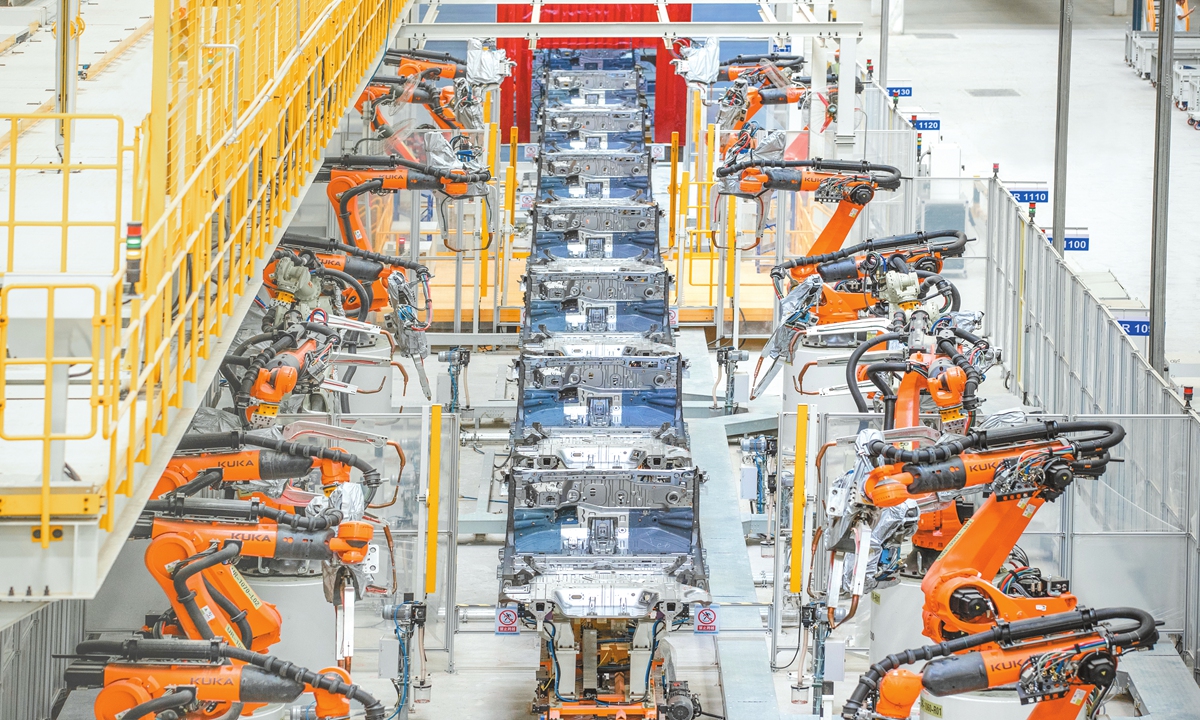
Production line at the welding workshop of BYD's megafactory in Zhengzhou, Central China's Henan Province. Photo: Courtesy of BYD
The Zhengzhou megafactory is BYD's largest domestic production base, boasting the most comprehensive industrial chain and the largest contiguous footprint. Inside the facility, a complete NEV ecosystem has been built, integrating full vehicle assembly, batteries and automotive components, among others.An NEV rolls off the assembly line in less than one minute on average, while a single power battery cell is produced every 3 seconds. This vast and comprehensive supply chain system has fueled the vigorous growth of BYD's NEV production, continuing to redefine the "China speed" in the NEV sector.
Luo Hao, assistant general manager of BYD's brand and public relations department, told the Global Times that in 2021, BYD achieved its 1 millionth NEV rolling off the production line. By the end of 2025, BYD celebrated another milestone with its 15 millionth NEV coming off the line.
'China Speed' born from the supply chain
In 2015, China became the world's largest producer and seller of NEVs for the first time - and the country has maintained that leading position ever since.
"The root cause behind the highly efficient development of China's NEV industry lies in China's full-chain, high-density, and strongly coordinated production and supply chain system," Feng Shiming, a veteran Chinese automotive industry analyst, told the Global Times. He noted that the "China speed" born from the NEV sector does not stem from the superiority of any single piece of equipment, nor is it merely the result of Chinese people's hard work. "It arises from the systemic advantages of the entire industrial chain," Feng stressed.
A broader view across China shows that major NEV industry clusters have taken shape in the Yangtze River Delta, the Pearl River Delta, the Beijing-Tianjin-Hebei region, as well as the Chengdu-Chongqing area in Southwest China. Together, these clusters form a comprehensive national landscape of China's NEV industry.
"It takes less than 20 minutes from the moment we issue an instruction to the time our suppliers adjust their production lines. And thousands of components are supplied daily and can be fully turned over on the same day," Kang Bo, Chinese automaker SERES Group's vice president, told the Global Times.
The SERES super factory is located in the Chengdu-Chongqing NEV industrial cluster, and has established long-term, stable cooperation with numerous leading supply chain partners.
"After more than a century of development in the global automotive industry, China has started from scratch to build a cross-industry production and supply chain ecosystem for NEVs, encompassing batteries, electric motors, and operating systems - which is also highly efficient and remarkably resilient. In today's world, no matter who wants to compete on the same stage with Chinese automakers, integrating into China's production and supply chain is the only viable choice," Feng said.
At a time when protectionist trade policies are proliferating in certain countries, Ford's CEO has paid a visit to Zeekr's factory, and the CEO of Volkswagen Group China also visited BYD's headquarters. In recent years, leaders of major traditional foreign automakers have not only shown great enthusiasm for visiting China's NEV factories, but have also gone against the de-globalization rhetoric by significantly increasing their investments in China - integrating more of their production and R&D into China's production and supply chains, riding the "China express" and sharing in China's opportunities.
"As a result of our localized R&D setup and the new software-defined vehicle (SDV) development process, we have significantly shortened vehicle development cycles," Thomas Ulbrich, Chief Technology Officer (CTO) of Volkswagen Group China, told the Global Times. During the interview, Ulbrich mentioned multiple times that Volkswagen should combine its "German DNA" with "China speed," thereby injecting "Chinese efficiency" into the overall transformation of the Volkswagen Group.
'Seizing a precious strategic opportunity'
A clear and correct top-level design lays the foundation for ensuring the high efficiency of China's NEV development.
"Going forward, we will reduce as soon as possible limits on foreign investment in these industries, automobiles in particular," Xi Jinping, General Secretary of the Communist Party of China Central Committee and Chinese president, said while delivering a keynote speech at the opening ceremony of the Boao Forum for Asia annual conference in the southern island province of Hainan on April 10, 2018.
Three months later, Tesla signed an agreement with the Shanghai municipal government, becoming the first foreign carmaker to build a wholly-owned factory in China. "In hindsight, the 'catfish effect' created by introducing Tesla objectively forced Chinese automakers to confront challenges head-on and adapt proactively, ultimately enabling them to achieve even faster development speed," Fu Yuwu, honorary chairman of the China Society of Automotive Engineers, told the Global Times. Fu noted that "it was only afterward that the industry truly appreciated the foresight of this decision. And the starting point of all those policies was to drive China's NEV industry toward faster and better development."
In an article titled "How China Beat the US in the Great EV Race," Bloomberg noted that "the bigger differences [between China and the US] concern intent and incumbent systems." China has strategic reasons to pursue vehicle electrification, beyond fostering export industries, while Washington has only lately coalesced to a greater degree around the idea of industrial protectionism, the report noted.
In the book "Changing Lanes and Racing: The Chinese Path of NEVs," former Chinese Minister of Industry and Information Technology Miao Wei revealed that throughout the various stages of China's NEV development, there have always been diverse ideas and competing views surrounding the two fundamental questions: "Should we develop it?" and "How should we develop it?"
According to Miao, the ultimate reason for China's NEV achievements lies in the collective leadership of the Communist Party of China and the distinctive advantages of Socialism with Chinese characteristics.
"China's unwavering strategic resolve - 'following a good blueprint through to the end' - in developing NEV has allowed the country to seize a precious strategic opportunity and gain substantial time to catch up with and surpass Western nations," Fu said.
China's NEV production and sales have continuously ranked first in the world for many years. According to Fu, the most critical reason for achieving this success lies in China's unwavering determination to develop NEVs. By never wavering, avoiding detours or reversals, China has realized leapfrog development.
Helga Zepp-LaRouche, founder of the Schiller Institute based in Germany, told the Global Times that compared with car industries in Europe, the US, and other Asian countries, China's policymaking and implementation have been the most resolute. "Since the late 1990s, China has consistently prioritized NEVs as a key strategic industry across successive Five-Year Plans. This has delivered more than two decades of clear, comprehensive, and long-term vision, powerfully driving rapid market expansion and positioning China at the forefront of global technological innovation," she noted.
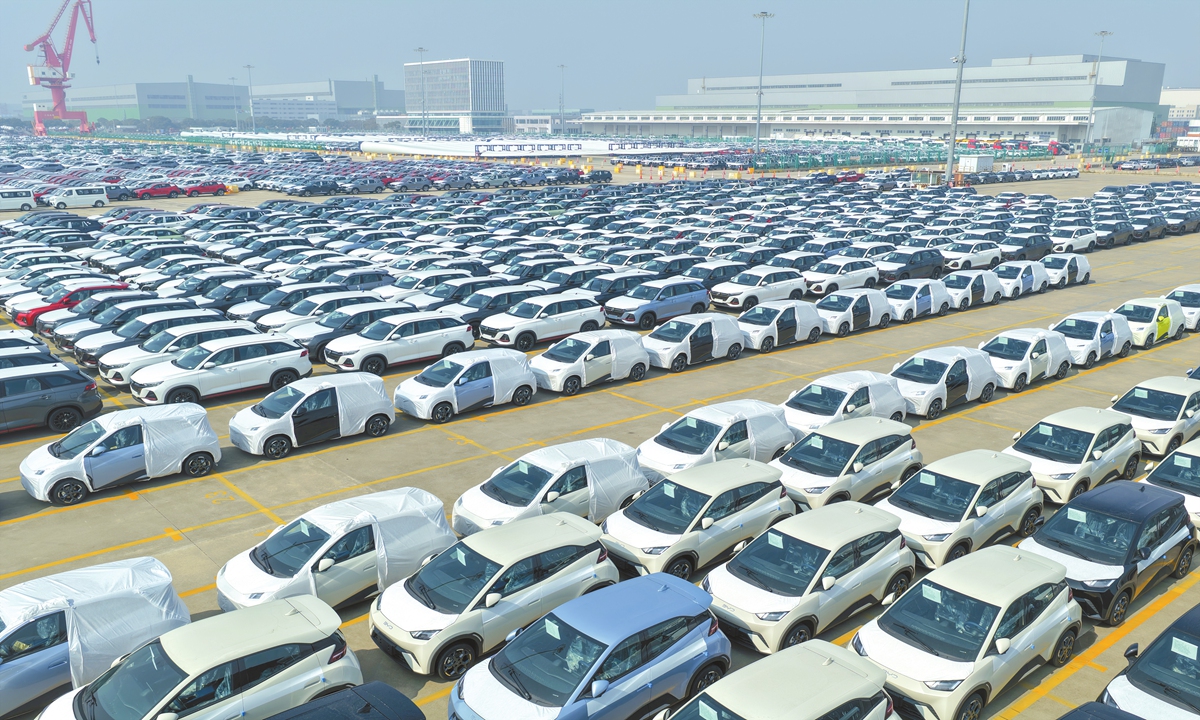
China-produced NEVs of various brands are parked at Shanghai Nangang Port awaiting export on February 12, 2026. Photo: VCG
'Chinese efficiency' giving birth to new momentum"In 2002, BYD chose the lithium iron phosphate (LFP) route among the three major global technology pathways for batteries. At that time, Japanese giants such as Panasonic and Sony were heavily focused on the more mature lithium cobalt oxide (LCO) route. While LFP offered superior safety, its key drawback was lower energy density, making it largely ignored by other automakers," Luo told the Global Times. He explained the deeper strategic consideration behind BYD's decision, that is the LFP technology pathway allowed China to more readily achieve full independence and control over the entire industrial chain.
BYD has embarked on intensive technical R&D. By 2020, the company successfully transformed the battery cells into ultra-long, thin strips, and arranged these "blades" tightly side by side. In this way, BYD's Blade Battery was born.
In 2019, ternary lithium batteries - an upgraded version of LCO, dominated the market, while LFP accounted for only 32 percent of installations. By 2025, however, LFP's share of vehicle installations surged to 80.8 percent, establishing it as the world's mainstream high-safety, high-performance NEV power battery.
Since the launch of BYD's blade battery, the power battery, the "heart" of NEVs, has continued to make significant technological breakthroughs. In 2022, CATL officially released the Qilin battery, with a volume utilization rate exceeding 72 percent. This innovation was named one of TIME magazine's Best Inventions of the Year. The magazine commented that "electric vehicle (EV) enthusiasts may find it apt that CATL's new Qilin battery is named after a mythical Chinese creature with a solitary horn sprouting from its forehead."
Feng believes that technology remains the most critical driving force. "It is the rapid breakthroughs in numerous key technologies across the industry that have continuously expanded, improved, and rapidly upgraded China's NEV sector - ultimately enabling it to build an industrial fortress that Western countries cannot surpass," Feng said.
Zepp-LaRouche noted that China holds a clear global leading position in battery technology, software-defined vehicles, intelligent cockpits, advanced driver assistance systems, AI-powered intelligent driving, and manufacturing innovation.
In the future, what is the secret to China's NEV industry maintaining highly efficient development? SERES' answer is: empowering the industry with AI. "This is not an optional choice - it's a mandatory one. Going forward, the key is to transform automobiles into emotional, smarter, safer, and more trustworthy mobile intelligent agents," Kang said.
"Technological innovation is the source of industrial vitality. The fact that NEVs have become one of the representatives of new quality productive forces fundamentally stems from breakthroughs and innovations in core technologies. When facing competition from Western countries, the key lies in efficiency - specifically, speed," Fu said. Both NEVs and intelligent connected vehicles require cross-sector integration, interdisciplinary collaboration, and mutual empowerment, and China has succeeded in these areas.
RELATED ARTICLES