Renowned scholar and political advisor expresses confidence in China's AI development, computing power
By and Chen Zishuai Published: Mar 10, 2026 10:55 PM

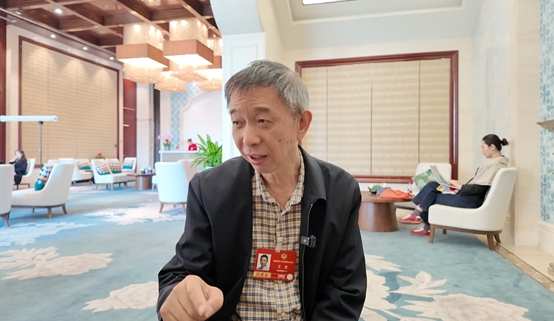
Wang Jian, a member of the 14th National Committee of the Chinese People's Political Consultative Conference, who is also an academician of the Chinese Academy of Engineering, speaks with the Global Times on March 9, 2026. Photo: Chen Qingqing/GT
Renowned Chinese cloud computing and AI scholar Wang Jian, interviewed by the Global Times during the ongoing "two sessions," discussed the US power grid in the AI era and the competition between China and the US on AI.
Recently, a video clip of Wang has gone viral on Chinese social media platforms. In the video, he said US power grid is "simply too outdated." He continued that what frustrates Elon Musk the most is that, starting from transformers, much of the manufacturing for core electrical infrastructure is concentrated in China.
"For Musk to solve the electricity problem, it may be even more difficult than sending things into space," Wang said. His remarks have drawn heated discussions among Chinese netizens.
Expounding on his viral interview, Wang, who is a member of the 14th National Committee of the Chinese People's Political Consultative Conference, and also an academician of the Chinese Academy of Engineering, told the Global Times on Monday that he merely wanted to make a point that the US is currently very anxious about the electricity issue.
The US power grid is fragmented into three largely unconnected systems—the Eastern Interconnection, the Western Interconnection, and the Texas grid. As a result, electricity is often available but cannot be transmitted where it is needed, while areas facing shortages cannot easily receive power from elsewhere. The grid's stability, load capacity, and the speed of infrastructure development all struggle to keep pace with growing demand, People's Daily reported.
"Technology like AI is not something owned by any single country. It is a field in which the entire world is working to advance and striving for progress," said Wang.
"More than two years ago, I proposed that, the capabilities demonstrated by today's AI models have not yet fully utilized the computing power that we already possess. In other words, given the level of computing power we currently have, models could have performed better," Wang said.
Wang noted that if we compare computing power with electricity supply, and given the current scale of computing power we have, China's existing electricity supply is in fact quite sufficient. "In other words, at the current level of computing power, electricity is not an urgent bottleneck," he said.
The scholar expressed confidence about China's future AI development, including computing power.
"For example, China has made very substantial investments in power infrastructure. Of course, computing power still involves issues such as chips, but overall the country attaches great importance to these areas," Wang said, noting that as long as we do not expect all problems to be solved at once today, and instead view them from a developmental perspective, we are still in a process of continuously solving problems and steadily moving forward.
When asked about the gap in AI technology between the two countries, Wang said it is encouraging that China has done a great deal in the area of open source in recent years, and the benefits brought by open source are actually very clear.
"I can now say that when it comes to AI, both China and the US are essentially looking at the same 'ocean.' In the past, what I worried about was that they might be looking at an ocean while we were only looking at a swimming pool. Now that we are seeing the same ocean, what really matters next is who can run faster," Wang said.
Today, the whole world attaches great importance to the development of AI. Both China and the US are making tremendous efforts, and both possess the fundamental foundations for development, Wang noted.
"One could say that each side may have certain advantages in specific areas, but such advantages do not amount to comprehensive or overall superiority. At this stage, interaction between the two sides has therefore become very important," he said.
More importantly, the pace of development in this field may far exceed what we can imagine today. This domain is extremely dynamic, Wang said, adding that people must recognize that AI is a profoundly transformative technology.
"A transformative technology means that its development process is inherently highly dynamic and constantly evolving. Once a particular path becomes fully fixed and conclusions appear settled, it may actually indicate that the opportunities are already limited. Precisely because the field is still changing so rapidly, it means there remains enormous space for innovation and many possibilities lie ahead."
RELATED ARTICLES