China schedules next moonshot this year: developer
Tianwen-3 targets Mars sample return while Tianwen-4 aims for Jupiter exploration, says lawmaker from space giant
By Published: Mar 11, 2026 10:59 PM

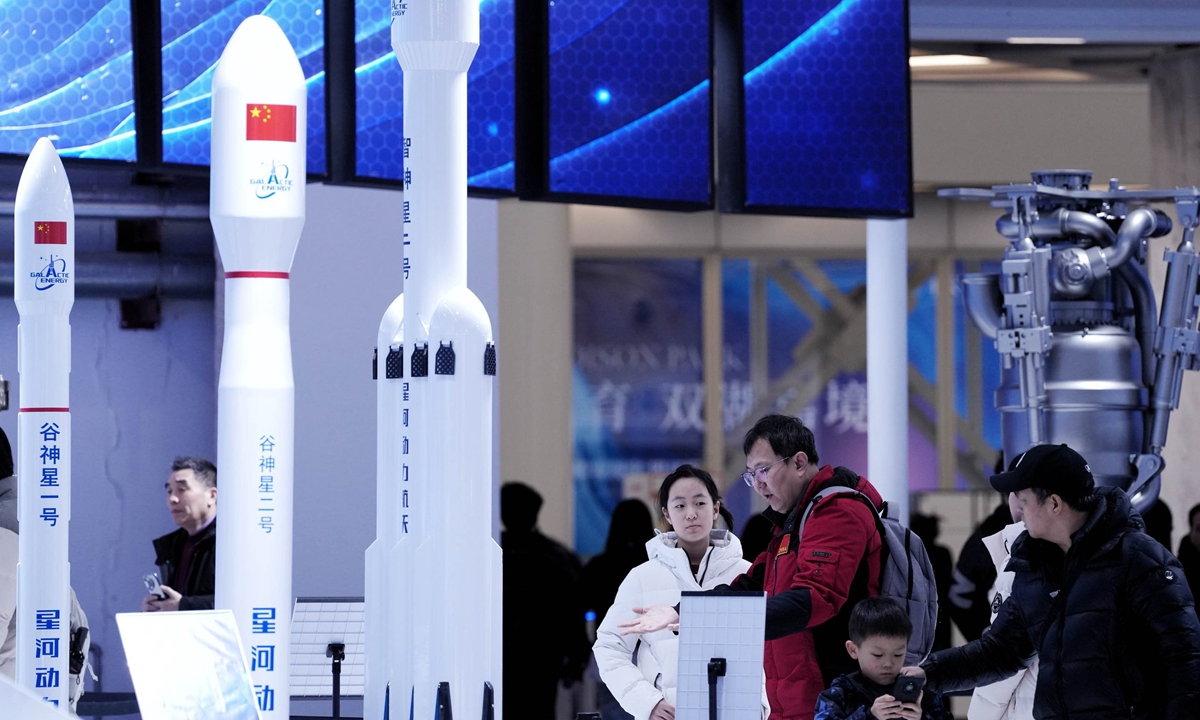
People visit the 2026 Beijing International Commercial Space Exhibition in Beijing, capital of China, January 23, 2026. The exhibition kicked off here on the day. Photo: VCG
China's robust development in the domain of deep-space exploration will see new advancement, as the country schedules the launch of its Chang'e-7 lunar probe this year to target the Moon's south pole in search of water ice - a critical resource for future sustained human presence and base construction on the Moon, the Global Times learned from the state-owned space program contractor China Aerospace Science and Technology Corporation (CASC) on Wednesday.
Speaking to media on the sidelines of the ongoing national "two sessions," Sun Zezhou, a deputy to the 14th National People's Congress and a leading engineer of the country's lunar exploration program with the CASC' China Academy of Spacecraft Technology, revealed that the Phase 4 of China's lunar exploration program is progressing steadily and the Chang'e-7 will focus on detailed surveying of the south polar surface environment, lunar regolith water ice deposits, and conduct high-precision studies of lunar topography, material composition, and geological structure.
Looking ahead, Sun highlighted the country's interplanetary exploration ambitions, saying that Tianwen-3 will pursue Mars sample return to analyze the Red Planet's environment, while Tianwen-4 targets Jupiter and its moons for studies of the gas giant's magnetosphere and interior.
Besides the robotic deep-space missions, China's manned lunar exploration program also continues to make steady strides toward the ambitious goal of landing Chinese astronauts on the Moon before 2030, with development work advancing smoothly and a series of critical milestones achieved in recent months, according to the CASC.
Currently, the development of major flight products, including the Long March-10 carrier rocket, the Mengzhou new-generation crewed spacecraft, and the Lanyue lunar lander, is progressing smoothly, the CASC disclosed in a statement sent to the Global Times.
A series of large-scale tests in the prototype phase have been successively completed, such as the Mengzhou crewed spacecraft zero-altitude escape flight, the Lanyue lander landing and liftoff verification, the Long March-10 carrier rocket tethered ignition, electrical assembly testing of the lunar spacesuit components, thermal-vacuum and force tests on the crewed lunar rover, the Long March-10 carrier rocket system low-altitude demonstration verification, and the Mengzhou crewed spacecraft system maximum dynamic pressure escape flight.
Subsequently, the program will transition as planned to the formal sample development phase, said the space giant.
These are sectors expected to become foundational drivers of economic growth, likely meaning they will benefit from strong policy support, state financing and industrial development programs, Andrew Jones, a Finland-based China space observer and journalist, wrote in his opinion piece published on spacenews.com.
The move suggests Beijing intends to expand the space sector beyond strategic state programs toward a larger industrial ecosystem encompassing launch services, satellites and downstream data applications, he said.
The China Central Television (CCTV) noted in a special program aired on Wednesday decoding China's deep-space exploration guided in the government work report that Chang'e-7 probe will target landing at the South Pole-Aitken Basin above 85 degrees south latitude on the Moon. China is hopefully to become the world's first country to discover water on the Moon, CCTV said.
Ye Peijian, an academician of the Chinese Academy of Sciences and one of the foundational figures in China's deep-space exploration, told the CCTV that scientists around the world all believe there is water on the Moon, but no one has ever obtained any water.
"The Chinese people are going to go find this water. To find the water, many methods are being employed: searching on the surface, and even going inside the pits to search," said Ye who is also chief commander and chief designer advisor for the Chang'e lunar series and Mars probes.
RELATED ARTICLES

