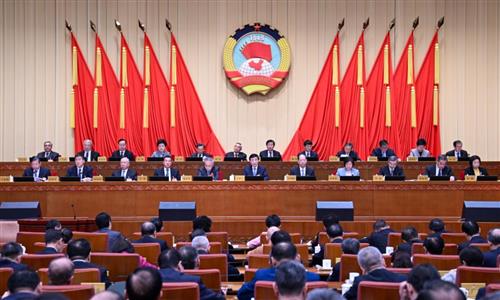
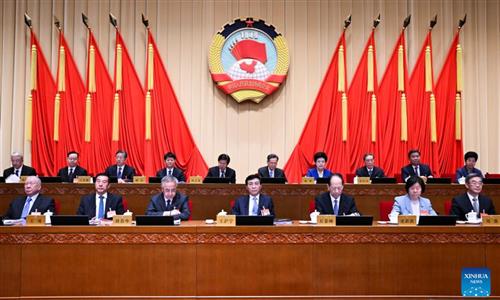
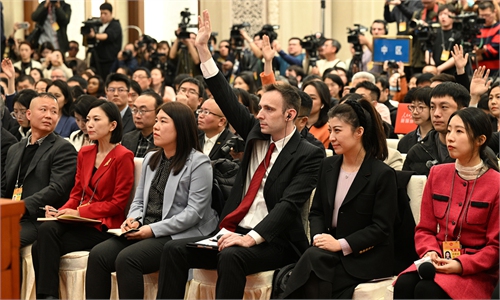
The fourth session of the 14th National Committee of the Chinese People's Political Consultative Conference (CPPCC) holds its closing meeting at the Great Hall of the People in Beijing on March 11, 2026. Photo: Xinhua
The 14th National Committee of the Chinese People's Political Consultative Conference (CPPCC), China's top political advisory body, concluded its annual session on Wednesday morning, Xinhua News Agency reported.
Xi Jinping and other Party and state leaders, including Li Qiang, Zhao Leji, Cai Qi, Ding Xuexiang, Li Xi and Han Zheng, attended the meeting at the Great Hall of the People in Beijing.
Presiding over the meeting, Wang Huning, chairman of the CPPCC National Committee, said the top political advisory body's annual session had yielded fruitful results.
Far-reaching meeting
The annual session of China's top political advisory body closed on Wednesday amid clear skies and a warm spring breeze. Members stepped out of the Great Hall of the People to embrace the sunshine, as the two sessions is drawing to a close and the country is prepared for a vibrant new journey.
A resolution on the work report of the Standing Committee of the CPPCC National Committee, a resolution on the report on how the proposals from political advisors have been handled since the previous annual session, a report on the examination of new proposals, and a political resolution of the fourth session of the 14th CPPCC National Committee were approved at the meeting, per Xinhua.
A total of 2,059 members were in attendance of the closing meeting. They on Wednesday approved the work report of the Standing Committee of the CPPCC National Committee and a work report on proposals and suggestions. During the past eight days, political advisors discussed the draft outline of the 15th Five-Year Plan (2026-2030) for national economic and social development, listened to and discussed work reports of key government bodies, as well as draft laws, according to Xinhua.
Junius Ho Kwan-yiu, a member of the CPPCC National Committee and Deputy Chairman of the House Committee of the Legislative Council of the Hong Kong Special Administrative Region, told the Global Times after the closing meeting that despite a complex international geopolitical landscape, China has continued to achieve remarkable development progress, which he found deeply encouraging. In the inaugural year of China's 15th Five-Year Plan, he expressed confidence in further accomplishments in the years to come.
During the CPPCC annual session, political advisors from across the country put forward a wide range of suggestions that touch on both the nation's long-term development and everyday concerns of ordinary people. Discussions ranged from macroeconomic policy and cutting-edge sectors such as aerospace information technology and artificial intelligence (AI), to better support for the aging population and children.
These practical questions, often raised by advisors based on feedback from sectors they represent, also became key topics of discussion during the session, and many will be submitted to relevant authorities for further response.
Given the breadth and forward-looking nature of these topics, the "two sessions" also attracted attention from international media outlets.
Reuters noted that signals emerging from the "two sessions" indicate that China is seeking an AI push to add jobs and rejuvenate economy. While the report expressed concerns over global fears that the technology could stunt employment, it cited Wei Sun, principal AI analyst at Counterpoint Research, as saying that China is focusing on reskilling programs and talent development to adapt to shifting industry dynamics, rather than framing AI and labor as a "zero-sum" trade-off.
With AI agent OpenClaw becoming a buzzword during the "two sessions," Wall Street Journal noted the trend and wrote that China has been focusing on wiring AI into all industries and fields to create an "intelligent economy." Localities including Shenzhen and Wuxi have made policies to promote the application of AI.
German media outlet Deutsche Welle (DW) reported that together the "two sessions" provide early signals about potential shifts in China's policy, particularly on the economy, security and foreign affairs.
"Beijing is doubling down on advanced technology and boosting domestic demand," DW reported, adding that this year's "two sessions" suggest preparation for a more complex era while attempting to balance slower economic growth, technological competition and geopolitical tensions.
Whole-process people's democracy
Presiding over the closing meeting, Wang said political advisors across the board have strengthened their resolve to contribute to advancing Chinese modernization and sustaining China's rapid economic growth and long-term social stability, Wang said.
Noting that 2026 marks the first year of the 15th Five-Year Plan period, Wang said the CPPCC must uphold the leadership of the CPC, better play its role as a political organization, actively provide suggestions on state affairs, and pool strength and wisdom to ensure a good start to the 15th Five-Year Plan.
Wang called on political advisors to put forward more proposals beneficial to the people, do more practical things for their well-being, and help ensure the fruits of modernization benefit all people.
More than 2,000 national political advisors from 34 sectors - ranging from the ruling Communist Party of China to other participating political parties, as well as representatives from culture and the arts, science and technology, social welfare and religious circles - gathered in Beijing to seek the broadest consensus for Chinese society.
According to official figures released during the meeting, CPPCC members submitted 5,992 proposals over the past year, of which 5,061 were filed for handling, with a response rate of 99.9 percent.
Over the past year, CPPCC members carried out 6,778 events fulfilling their duties, organized 11,115 events connecting with people from their respective sectors, benefiting more than 4 million people, according to Xinhua.
Wang Chuanli, a professor at the School of Marxism at Tsinghua University, told the Global Times on Wednesday that the CPPCC session brings together wisdom from across Chinese society, including members from different political parties, non-affiliated individuals and representatives from various sectors, to contribute ideas for the country's development.
"The discussions cover a wide spectrum of issues and the CPPCC serves as an important platform, channel and mechanism for building national consensus as China advances into the 15th Five-Year Plan," Wang Chuanli said.
"People have aspirations and expectations for development, and these demands are reflected in the discussions at the 'two sessions,' ultimately translating into concrete policy goals," Wang Chuanli said.
RELATED ARTICLES