Scientists use planetary atmosphere as brakes to explore aerobraking in deep-space missions
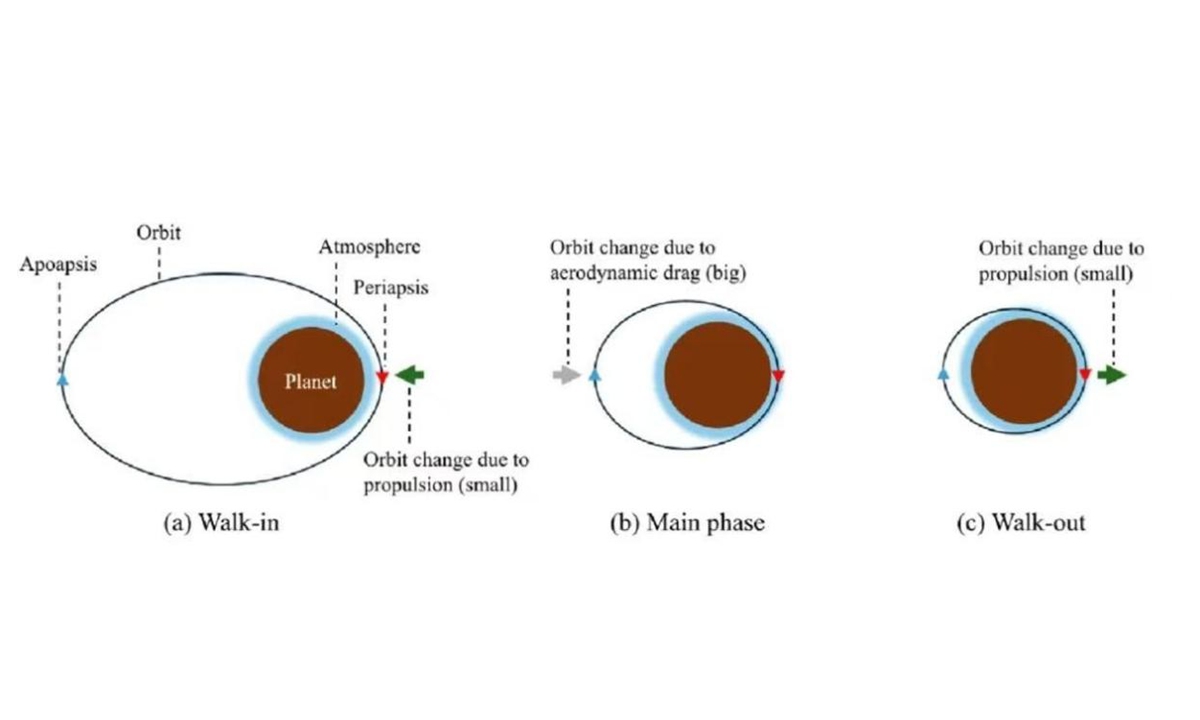
The process of aerobraking Photo: Courtesy of Advances in Space Research
China is exploring the use of planetary atmospheres as a natural "braking system" for future deep-space exploration missions, a technology that could significantly reduce fuel consumption and expand spacecraft payload capacity, according to Science & Technology Review.
According to the report, Chinese scientists analyzed how the method, known as aerobraking, may be applied in the country's planned Mars sample-return mission, Tianwen-3.
Sun Zezhou, an expert from the Beijing Institute of Spacecraft System Engineering, noted that the technology could help a spacecraft transition from a large elliptical orbit into a lower near-circular orbit for relay and rendezvous operations, helping address limitations in current launch capacity.
For a long time, one of the key challenges in planetary exploration missions has been how to achieve large-scale orbital adjustments without significantly increasing the spacecraft's mass.
Aerobraking offers an alternative approach to this challenge. During repeated close passes, a spacecraft dips into the thin upper atmosphere of a planet. The atmospheric drag gradually converts orbital kinetic energy into heat, lowering the spacecraft's orbit over time, according to the report.
Compared with propulsion-only braking, aerobraking can achieve more than 1,000 meters per second of velocity reduction while requiring only minimal propellant use.
However, engineers must keep the spacecraft within a narrow "aerobraking corridor." Flying too low could expose it to excessive heat and aerodynamic forces, while flying too high would reduce braking effectiveness.
The technology has already been used in missions around Earth, Venus and Mars, and could support future exploration of planets with atmospheres, including Jupiter and Saturn. The report said that advances in autonomous control and atmospheric modeling may allow aerobraking to play a greater role in future deep-space exploration.
Global Times
RELATED ARTICLES