Embodied intelligence powers China’s logistics in 2025: report
Lower costs, smarter chain ‘fuel high-quality development’
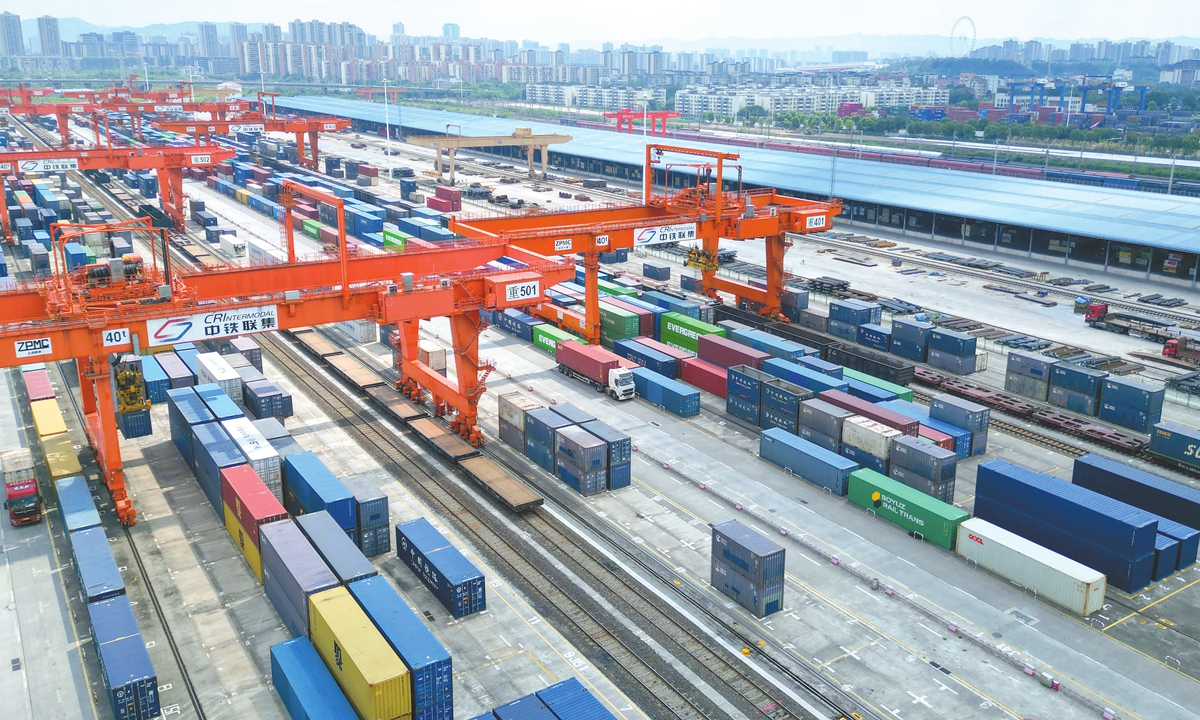
A view of the Chongqing International Logistics Hub park on July 22, 2025 Photo: VCG
In 2025, hotspots in China's logistics technology development emerged frequently, with new types of equipment achieving large-scale application. In particular, "AI Plus" has been deeply integrated into logistics, effectively helping reduce overall social logistics costs while significantly improving operational efficiency, China Media Group (CMG) reported on Thursday, citing a report by the China Federation of Logistics and Purchasing.
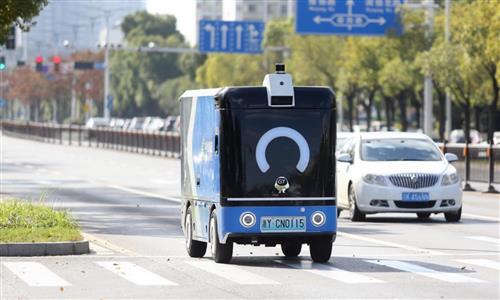
According to the report, China's logistics demand continued to expand steadily in scale last year, while its structure was constantly optimized. With the large-scale application of new types of logistics equipment, such as mobile collaborative robots, intelligent sorting devices, and unmanned delivery systems, the supporting role of logistics in economic development has been further strengthened.
In 2025, the ratio of total social logistics costs to GDP fell to 13.9 percent, the lowest level on record. This means that the logistics costs required per unit of GDP continued to decline, according to the report.
The report said that the innovative application of logistics equipment has become a core pillar for cost reduction and efficiency improvement, with frontier technologies such as embodied intelligence, large-scale logistics models, and low-altitude logistics flourishing.
In particular, China has made significant progress in the end-to-end technical pathway for embodied intelligence in logistics scenarios. Embodied robots have begun to enter warehouses and factories, achieving a leap from "automated guided vehicles" to intelligent agents that can "perceive, think, and act," said the report.
Chinese robotics company Leju Robotics said in a statement sent to the Global Times on Thursday that it has established a joint venture company with HICHAIN Logistics Co, focusing on the production logistics segment in the high-end manufacturing sector and providing humanoid robot production logistics solutions.
It has achieved 24-hour uninterrupted normalized operation of robots. The robots can maintain a success rate of more than 95 percent in removing boxes from pallets, even under variable interference conditions, ensuring continuous production, said the company.
Another humanoid robotics producer — UBTECH Robotics — told the Global Times that in addition to the application of its products in the vehicle and electronics manufacturing sectors, it is cooperating with logistics industry company SF Express to carry out training on intelligent material handling and sorting through its robotics product Walker S.
"New types of logistics equipment such as robots and unmanned delivery systems are evolving from isolated technical tools into a key force that is fundamentally reshaping the logic of the logistics industry," Wang Peng, an associate research fellow at the Beijing Academy of Social Sciences, told the Global Times on Thursday.
Wang said that logistics serves as the "meridians and collaterals" of the real economy, connecting production and consumption, as well as domestic and international trade, noting that once costs are reduced, supply chains will become more efficient and responsive, providing stronger support for high-quality economic development.
According to the CMG, experts in the sector said that China's logistics equipment exports are transitioning from mere "product exports" to an integrated model of "technology + standards + services" output.
China maintains trade relations with more than 240 countries and regions, with countries participating in the Belt and Road Initiative serving as the core market for the overseas expansion of logistics equipment.
Also on Thursday, Cainiao, the logistics arm of Chinese e-commerce giant Alibaba, announced plans to establish a large-scale robotic warehouse network in key markets such as Hong Kong of China, the US, and Europe this year to support local fulfillment and delivery for multiple global cross-border e-commerce platforms and cross-border merchants.
According to the company, these automated warehouses will be located in countries and regions including Hong Kong, the Netherlands, Spain, France, Germany, and the US. They will primarily utilize Cainiao's self-developed next-generation warehousing robots and artificial intelligence scheduling systems. Unlike traditional automated warehouses, the new robotic warehouses will feature higher storage density while significantly improving operational efficiency and throughput times.
Wang said that Chinese intelligent equipment is emerging as a universally accessible infrastructure solution.
"Leveraging mature implementation experience and cost-performance advantages, it enables overseas markets to rapidly establish modern logistics networks tailored to local needs, thereby driving an overall upgrade in global logistics service capabilities," the expert said.
This year's Government Work Report highlighted the development of modern logistics, the construction of intelligent supply chains as well as the development of logistics services for international delivery.
Wang said that logistics equipment will focus on areas such as the deep penetration of embodied intelligence and other emerging industries into the manufacturing sector. "Driven by technological innovation, these advancements will continue to drive down overall social logistics costs, providing strong and sustained momentum for cultivating new quality productive forces," the expert noted.
RELATED ARTICLES