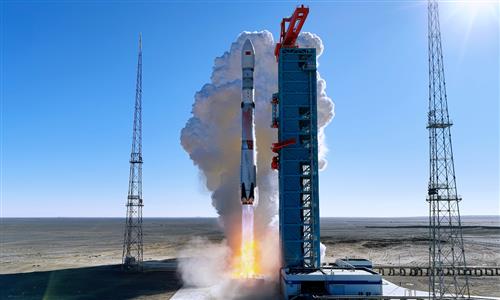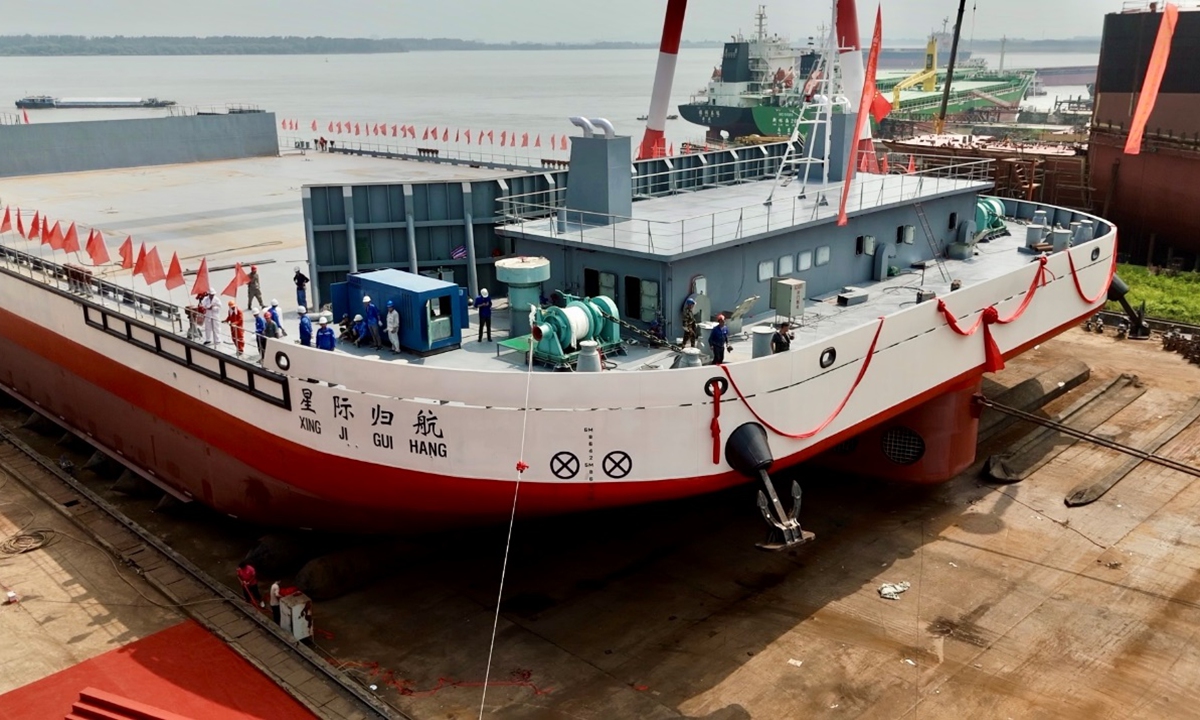
The launch ceremony of the Xingji Guihang, which is China's first carrier rocket maritime recovery ship Photo: Courtesy of iSpace
China's commercial aerospace company iSPACE announced on Thursday that its self-developed SQX-3 carrier rocket is scheduled to conduct its maiden launch in 2026, the Global Times learned from the company.
The mission will conduct a first orbital insertion combined with a sea-recovery flight test from South China's Hainan Province, according to the company. The rocket is expected to perform vertical takeoff and landing recovery on a dedicated rocket recovery vessel designed by the company.
The vessel is China's first and the world's fifth maritime rocket recovery ship, meaning China has become the second country after the US to possess such capability, the company said.
Sea-based launch and recovery operations offer greater flexibility in selecting launch locations, which can improve mission adaptability, compensate for limited launch capacity, and enable rockets to carry heavier payloads, Wang Yanan, editor-in-chief of Aerospace Knowledge magazine, told the Global Times on Thursday.
The SQX-3 rocket, powered by liquid oxygen-methane propellant, has a length of 77.8 meters and a liftoff mass of 608.4 tons. It is capable of delivering 8.5 tons to a 200-kilometer low-Earth orbit trajectory with stage recovery, or 14 tons in expendable mode, according to the company's official website.
The rocket is designed to support high-frequency and large-scale space transportation missions, including satellite constellation deployment and cargo delivery for space stations, enabling lower launch costs and faster launch cadence, the website shows.
The growing number of sea-based launches suggests that China is building a repeatable, schedule-based, and scalable launch-service capability - something that matters for commercialization far more than any single technical breakthrough, Yang Kewei, executive deputy director of the Commercial Space Research Center, China Center for Information Industry Development, told the Global Times on Thursday.
Sea-based launches can drive end-to-end coordination across the value chain, shifting launches from one-off project delivery to standardized, process-driven service provision and accelerating the industrialization and scaling-up of China's commercial space sector, Yang said.
The scheduled launch attempt by iSpace follows a series of developments in China's commercial space sector. In 2025, China's commercial space industry maintained rapid growth, completing 50 launches, accounting for 54 percent of the country's total launch missions that year, according to the China National Space Administration.
China also made initial attempts in reusable rocket recovery. On December 3, 2025, Chinese commercial aerospace firm LandSpace launched its Zhuque-3 reusable rocket. While the rocket's second stage successfully entered the designated orbit, recovery of the first stage was unsuccessful, according to the Xinhua News Agency.
Then on December 23, China launched the Long March-12A Y1 carrier rocket. Its second stage also reached the designated orbit, though the recovery of the first stage did not succeed, Xinhua reported. Analysts said that although both missions fell short of achieving full recovery, they represent important technological experiments in China's pursuit of reusable launch systems.
The 2026 Government Work Report said that China will foster new growth drivers at a faster pace, and defined aviation and aerospace as emerging pillar industries. Meanwhile, LandSpace has announced plans to conduct another recovery test of the Zhuque-3 rocket in the second quarter of 2026, even after its maiden flight encountered anomalies.
Wang said that China's commercial space sector is expected to maintain strong momentum in 2026, with higher launch frequency and growing mission volumes. Breakthroughs in key reusable technologies are also anticipated, while new recovery concepts such as soft-landing systems and net-capture recovery could achieve their first successful demonstrations, he said.
"With the global commercial space market expanding rapidly, and Western companies such as SpaceX demonstrating strong commercial performances, Chinese firms are seeking to enter the market quickly by advancing cutting-edge launch and recovery technologies," Wang said.
RELATED ARTICLES