Aerospace information sector sets 3 priorities
Nation accelerates push to become space power, key task in 5-year plan
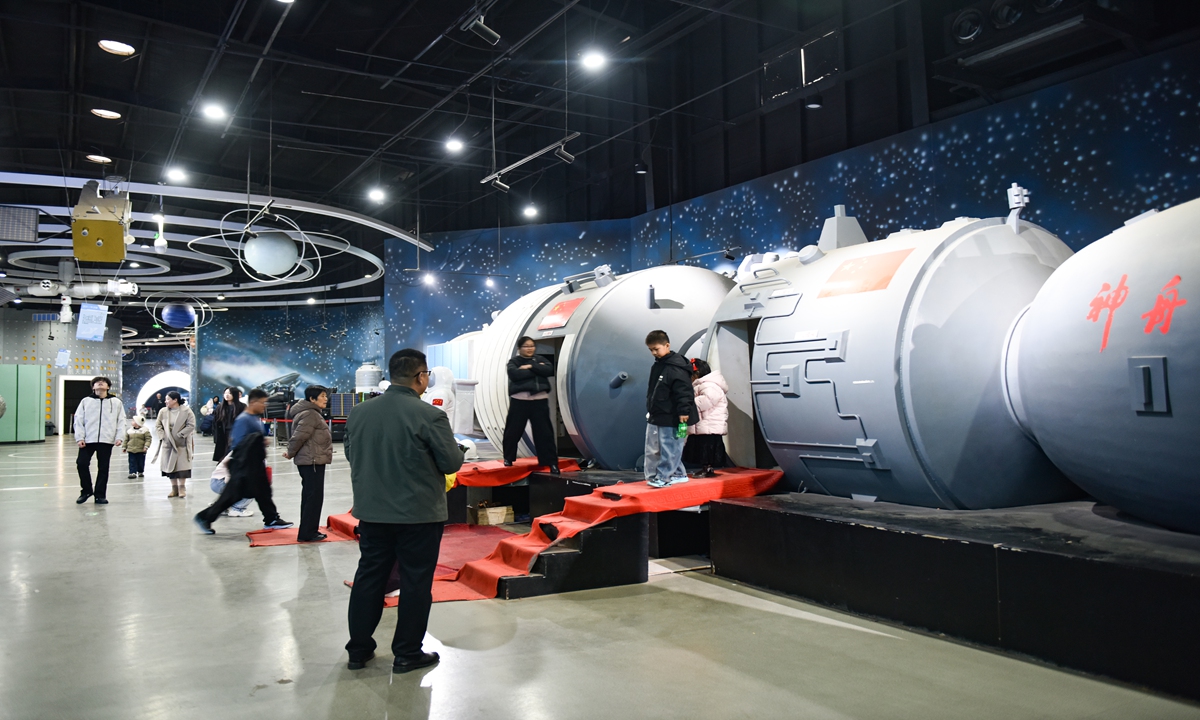
Families visit a space science museum in Rizhao, East China's Shandong Province, on Feb 17, 2026, during the Spring Festival holiday, as children explore China's space technology and experience the fascination of aerospace science. Photo: VCG
China's aerospace information sector has three priority development directions during the 15th Five-Year Plan (2026-30) period, focusing on three major goals of self-reliance, security and efficiency, and integration-driven empowerment, Wu Aiqun, a member of the 14th National Committee of the Chinese People's Political Consultative Conference (CPPCC) and president of the Shanghai Aerospace Information Technology Research Institute, told the Global Times.Wu's remarks came as China presses the accelerator on its push to become a space power. The draft outline of the 15th Five-Year Plan (2026-2030) calls for building a modern industrial system and accelerating efforts to develop China into a space power, marking the first time the goal of becoming a "space power" has been included as a key task in a national five-year plan, according to China Media Group (CMG).
The first goal focuses on breakthroughs in aerospace communication and networking technologies to build a self-reliant "space-ground integrated" communication network, Wu said.
Key efforts will be directed toward technologies including low-Earth orbit satellite constellation networking and integrated sensing and communication satellites so as to achieve self-reliance in core components, and promoting the integration of satellite internet with 5G and 6G technologies to meet the demands of scenarios such as oceangoing shipping and emergency rescue, the expert said.
The second goal is the construction of an aerospace security and governance system to strengthen the safeguards for space security, Wu said, stressing that "as competition in the aerospace domain is now intensifying, issues such as space debris and the management of low-altitude flight vehicles cannot be ignored."
He suggested that the country build a space debris monitoring network with global coverage and achieve real-time tracking of centimeter-level fragments, improve the security management mechanisms for the low-altitude economy, leverage technologies such as BeiDou high-precision positioning to ensure precise oversight of low-altitude flight vehicles, and strengthen the security of the aerospace supply chain.
The third goal is tech commercialization and integrated industrial integration for the benefit of both national defense and people's livelihoods, Wu said.
Regarding people's livelihoods, the application scenarios of satellite remote sensing and communication will be expanded to monitor urban waterlogging and crop growth, improve public services in remote areas, and bridge the digital divide, he said.
As for industrial integration, the integration of aerospace technology with the low-altitude economy and the digital economy will be facilitated to foster new business models such as space tourism and space breeding, driving the transformation and upgrading of traditional industries, the expert said.
"The development of aerospace information has never been a solo journey; rather, it is the result of synergy among manufacturing, academia, research, and application, with the participation of the entire society," Wu said.
He expressed his commitment to fulfilling his duties by focusing on national strategic needs to continue working for breakthroughs in aerospace information, tech innovation and commercialization, and ensuring that aerospace information becomes a pillar for building China into a strong aerospace power.
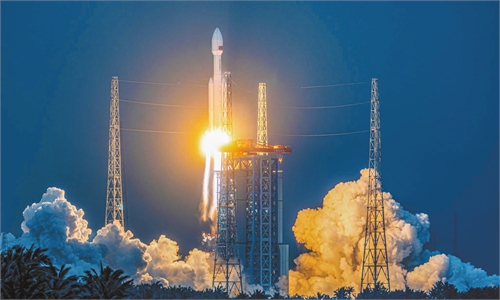
China made significant progress in the aerospace sector in 2025. Data from the National Bureau of Statistics showed that 92 space launch missions were completed that year, including 50 commercial launches. Meanwhile, breakthroughs in reusable launch vehicle technology accelerated.
China's 2026 Government Work Report highlighted that the nation will nurture emerging industries and industries of the future, with aerospace specifically emphasized among them. In addition, the report explicitly called for the development of satellite internet.
Notably, as a key component of this push, commercial aerospace has in recent years received unprecedented attention, from national top-level planning to local industry settlement, according to another CMG report.
At the policy level, the China National Space Administration established a dedicated department for commercial aerospace last year, according to the Xinhua News Agency. The administration also released the first national-level guiding document for the sector, according to the administration's official website.
Regions such as Beijing, Shanghai, and South China's Hainan Province have also rolled out supportive policies aimed at fostering a more open and well-regulated market environment for commercial aerospace, according to CMG.
China now has more than 600 commercial aerospace enterprises, with efforts underway to gradually unlock the sector's development potential while ensuring safety, according to Xinhua.
RELATED ARTICLES