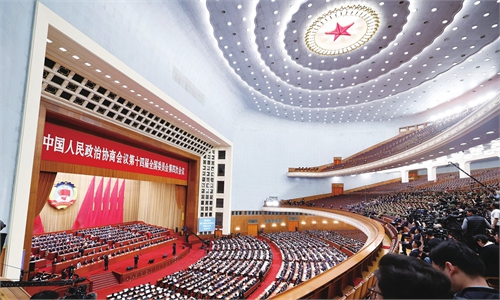
China’s national legislature concludes annual session; 'effort to project stability, policy continuity carries international significance'
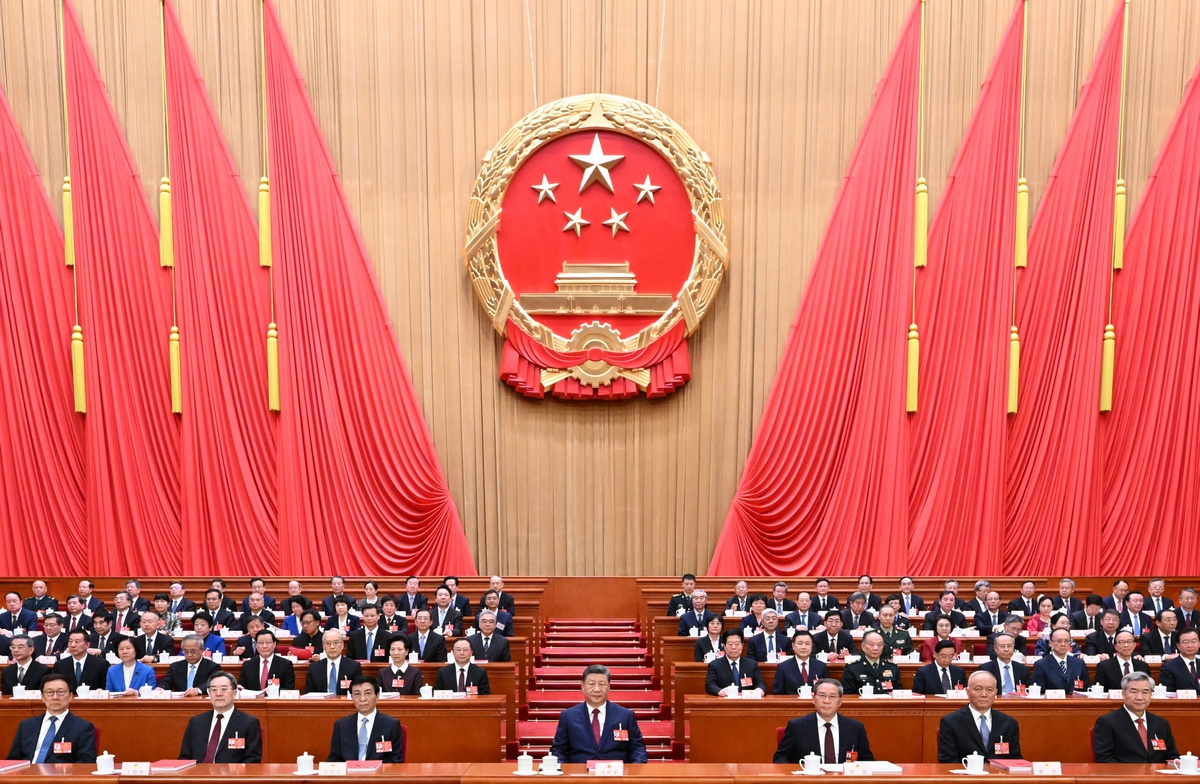
The 14th National People's Congress (NPC) holds the closing meeting of its fourth session at the Great Hall of the People in Beijing, capital of China, March 12, 2026. Chinese President Xi Jinping and other leaders including Li Qiang, Wang Huning, Cai Qi, Ding Xuexiang, Li Xi and Han Zheng attended the meeting. (Photo: Xinhua)
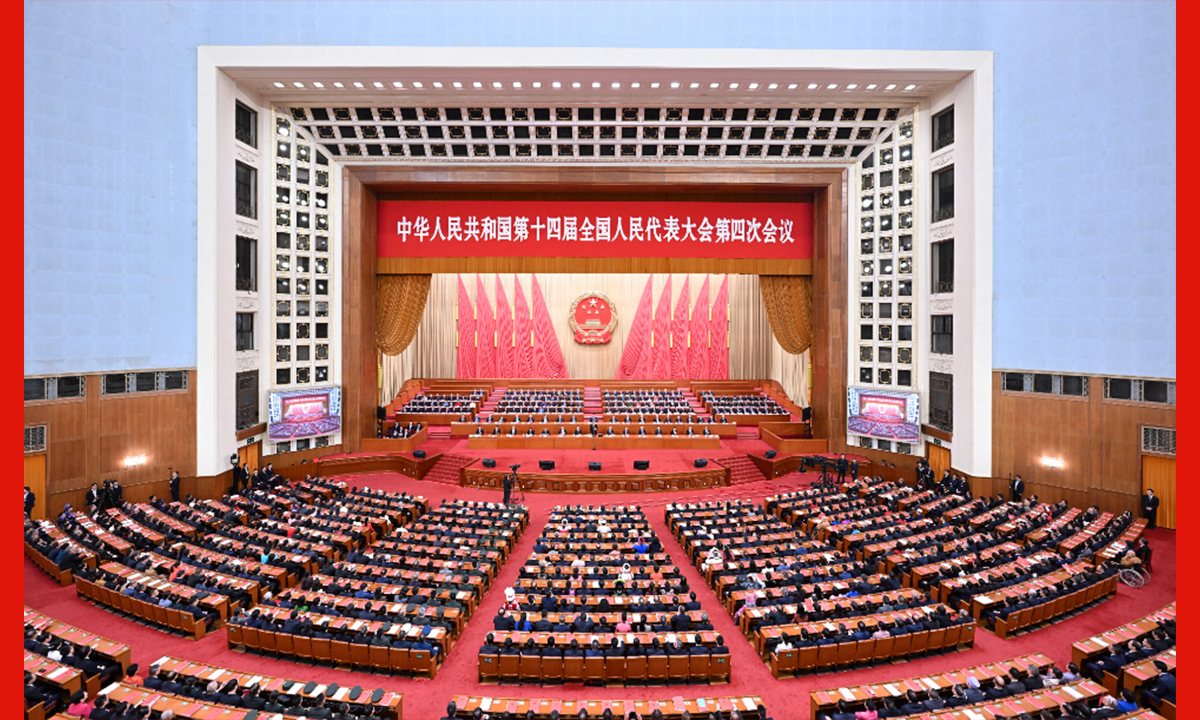
The closing meeting of the fourth session of the 14th National People's Congress (NPC) is held at the Great Hall of the People in Beijing, capital of China, March 12, 2026. (Xinhua/Zhang Ling)
The 14th National People's Congress (NPC), China's national legislature, held the closing meeting of its fourth session on Thursday.
Xi Jinping and other Party and state leaders attended the meeting at the Great Hall of the People in Beijing, Xinhua News Agency reported. Chairman of the NPC Standing Committee Zhao Leji delivered a speech at the closing meeting.
At the closing meeting, lawmakers approved the government work report and the outline of the 15th Five-Year Plan (2026-2030) for national economic and social development, which is seen by many observers and foreign media as the most important agenda of this year's "two sessions."
The whole world is watching China at the moment - data from the Global Times Institute shows the number of foreign media reports on the "two sessions" has surged significantly for two consecutive years - and now, with the newly approved blueprint, China is making its voice clear to the world, that is a call for peace, development and shared opportunities, observers said.
Ready for new journey
Deputies on Thursday voted to adopt the Ecological and Environmental Code, which signifies that China created a solid legal foundation for a sustainable future and set a pioneering precedent in environmental governance. This historic legislation comes at a time when the country is advancing Chinese modernization on all fronts, with harmony between humanity and nature being a distinct feature, analysts said.
The Ethnic Unity and Progress Promotion Law was also adopted, reinforcing the legal foundation for national cohesion and common prosperity among 56 ethnic groups as the country enters the final decade in its drive to basically achieve modernization by 2035, Xinhua reported.
Lawmakers also voted to adopt the National Development Planning Law, and pass a resolution on the implementation of the 2025 plan for national economic and social development and on the 2026 plan for national economic and social development, and approved the 2026 plan.
As the meeting concluded and deputies began leaving the venue, many shared their impressions of the session.
Sun Xianzhong, a deputy to the NPC and a member of the NPC Constitution and Law Committee, told the Global Times on Thursday that this year's agenda was particularly extensive.
Sun, who has attended the "two sessions" three times, said that this year's meeting reviewed and approved the 15th Five-Year Plan while deliberating a code and two major laws related to the national economy and people's livelihoods, making the session particularly significant compared with previous years.
This year's session was also more streamlined and efficient, while the topics discussed closely aligned with the change of the times, said Zhang Qiongli, a deputy to the NPC and political teacher at a senior high school in Enshi Tujia and Miao Autonomous Prefecture, Central China's Hubei Province. Issues such as technological innovation and education, she noted, are closely connected with the needs of the people.
The "two sessions" also drew international media attention. BBC reported on Thursday that the NPC annual meetings are watched closely as they signal the priorities of the world's second-largest economy.
The meeting in the Great Hall of the People "stands in contrast to a fiery White House which has rattled allies and shaken markets with its strikes on Iran." BBC wrote, adding that China is trying to show that it is a beacon of stability that is in the business of fixing its economy and future.
The Associated Press reported on Thursday that during "the nation's biggest political event of the year" - NPC annual meeting - "China is doubling down on a push to transform its economy and be at the forefront of technology."
The "two sessions" highlight that China will focus on environment protection, green economy transition, and carbon emission control in the next five years, Teh-han Chow, Greater China CEO of New Zealand-based dairy giant Fonterra, told the Global Times.
Innovation is a core engine for China's high-quality development and new quality productive force. This year, we will further invest in our application and innovation centers to enhance innovation capabilities across this country, Chow said.
Shared opportunities
Among the key agenda deliberated at this year's NPC annual meeting, the most closely watched issue was China's outline for its 15th Five-Year Plan. As the outline was approved on Thursday afternoon, it is creating opportunities for cooperation not only in China, but also for countries around the world, with voices from the Global South expressing expectations for stronger collaboration in the coming years.
Vietnamese Ambassador to China Pham Thanh Binh told the Global Times on Thursday that both countries attach great attention to high quality development, driving the development through technological innovation, and cooperate in emerging fields. "We believe these areas offer significant and substantial opportunities for cooperation between friendly and neighboring China and Vietnam," the ambassador said.
Pakistan's Ambassador to China Khalil Hashmi said in a written reply to the Global Times on Thursday that China's 15th Five Year Plan aims at establishing resilient supply chains, technological upgrading, and regional economic linkages. Pakistan can position itself both as a large market but even more importantly as a production, processing, and connectivity partner. "That is where the biggest opportunity lies," he wrote.
At a time of fragmented supply chains, trade tensions, debt stress, and uneven global growth, China's effort to project stability, policy continuity, and long-horizon planning carries real international significance, Hashmi wrote, adding that when China signals continued opening-up, industrial upgrading, and investment in new growth drivers, it provides companies and partner countries with a framework for planning beyond immediate volatility.
Indonesia's ambassador also noted that the concept of new quality productive forces in the 15th Five-Year Plan, which brings broader opportunities for the country. Ambassador Djauhari Oratmangun said in an interview with the Global Times that "Indonesia is a natural partner for China's new quality productive forces."
He noted that Indonesia is the world's largest producer of nickel, a critical resource for electric vehicle batteries, while China leads in EV manufacturing and battery technology. The alignment is strategic: Indonesia provides critical minerals, while China contributes capital, technology and industrial depth.
Kenya's ambassador to China Willy Bett said China's development is creating opportunities for the world. "By focusing on quality productive forces, China is upgrading its industrial base, meaning foreign investors gain access to more efficient supply chains, advanced manufacturing ecosystems, and higher-value innovation hubs," he wrote, adding that "this raises productivity and lowers operational costs for companies operating in China."
China's push for high-standard opening-up signals wider market access, especially in services, digital industries, finance, and green technologies. Foreign firms can expect clearer entry channels, improved IP protections, and opportunities to collaborate in frontier sectors, the ambassador added.
The goals and tasks China aims to achieve during the 15th Five-Year Plan period are, in essence, a "list of opportunities" for the world.
RELATED ARTICLES