‘This is how we expect governance to work’: China’s two sessions in the eyes of global Gen Z
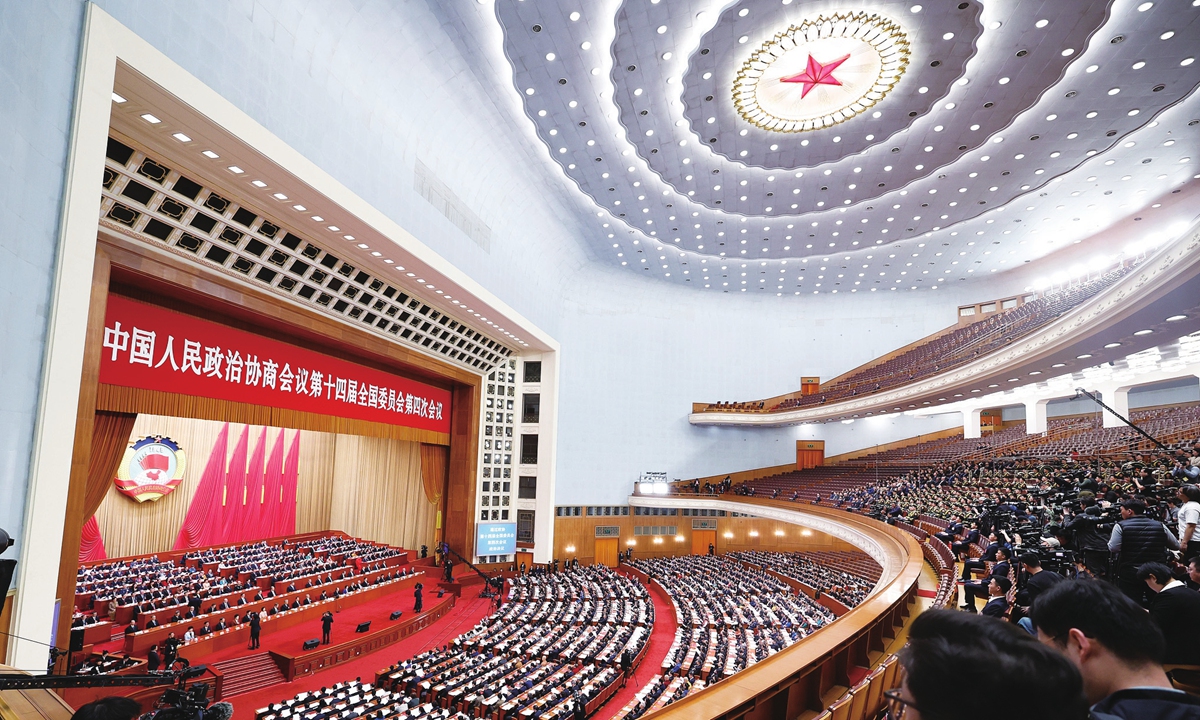
The fourth session of the 14th National Committee of the Chinese People's Political Consultative Conference holds its closing meeting at the Great Hall of the People in Beijing on March 11, 2026. Photo: VCG
Editor's Note:China's 2026 two sessions offer an important window into the country's governance and development priorities. The Global Times invited three young international observers, including students and journalists from different parts of the world, to share their observations on this year's meetings. Through the unique lens of global Gen Z, they talk about their interest in China and its governance model, as well as what the two sessions reveal about the country's policy direction and global significance. Their perspectives provide valuable glimpses into the views of global youth.
Austin Hicks, a graduate student in the School of Politics and International Relations at East China Normal University
We in the US are almost never taught about China's two sessions. Institutions such as the National People's Congress (NPC), the Chinese People's Political Consultative Conference (CPPCC), and the five-year planning system are a complete mystery to most Americans. After coming to China, this was the first year I followed the two sessions closely by reading relevant reports and related materials.
What struck me most was how concrete and people-centered many of the policies were. Recommendations of the Central Committee of the Communist Party of China for Formulating the 15th Five-Year Plan for National Economic and Social Development has pledged support for the development of self-employed individuals. Another impressive initiative is the large-scale consumer trade-in program, which encouraged people to replace old appliances with modern ones at low cost. Through this government program - something we simply do not have in my country - Chinese people gain affordable access to higher-quality goods and, ultimately, to a better standard of living.
Reading through the pages of relevant reports, I can clearly perceive the spirit of China's relentless pursuit of social well-being. It goes beyond economic metrics; it's about a profound recognition of human needs - from ensuring dignity in elder care to fortifying the bond between school and family.
The two sessions present an image of a very "democratic" China - one that goes beyond the Western notion of liberal democracy. In China, the system of whole-process people's democracy is on full display. The consultative system represented by the CPPCC is collaborative rather than competitive. Proposals and laws are constantly evolving with multiple mechanisms of democratic input, yet dialectical materialism as an analytical method and the goal of common prosperity on the socialist road are immutable. Chinese society is structured like any sports team. The Communist Party of China studies strategy, utilizes a scientific method, is integrated at each level of society, and provides necessary leadership. The other political parties and mass organizations contribute their own input, experiences, and perspectives in order to compete against poverty and the common problems faced on the road to modernization. This process is stable and provides national unity in collaborative problem-solving rather than public spectacle and the chaotic competition for political power in Western "democracies."
The two sessions show the world that this is how we expect governance to work. In other words, this is how we might imagine governance should function and how things should be done. As a member of the global Gen Z community, I would say that many of us are increasingly tired of the traditional Western dichotomy that categorizes political systems simply as "democracy" vs "authoritarianism." Instead, we tend to place greater emphasis on the value of "democratic outcomes" when evaluating a country's political system. In this sense, democracy is not only about voting in elections, but also about whether people have the ability to shape the direction of their society and their own lives. China offers a compelling example of this.
Elliot Frennstedt, a Swedish international student in the School of International Studies at Renmin University of China
The two sessions offer me a vivid, real-time look into China's governance. What I see is a political system highly structured, organized and peaceful. Seeing this firsthand bridges the gap between textbook theory and political reality: concepts like whole-process people's democracy, which I first encountered in class, feel more concrete when you see how the system operates in practice. China's two sessions bring together NPC deputies and CPPCC members from different social groups and sectors. These representatives participate in discussions and contribute policy proposals reflecting the concerns of their communities. This reflects the country's resolve to mirror the broader composition of society.
Two points from this year's government work report particularly caught my attention.
The first is the development of emerging pillar industries, particularly artificial intelligence and other cutting-edge technologies. China is not only encouraging these industries to grow rapidly themselves, but also expecting them to drive the digital transformation of traditional industries. In other words, the most advanced sectors are supposed to help upgrade the rest of the economy.
Another point is the proposal to expand social insurance coverage to people in flexible employment and new forms of work. Seeing China prioritize social insurance for workers in jobs like food delivery is deeply impressive. This commitment to collective prosperity is, frankly, very cool in the eyes of young people who value social justice.
China's two sessions offer global youth an opportunity to better understand the country. For international students like me who study in China, this understanding comes from firsthand experience. But even beyond that, China has increasingly become trendy among young people across Western social media platforms like Instagram and TikTok. While much of this initial interest often begins with culture, it frequently develops into a deeper curiosity about Chinese society and politics. From what I can see, many Western youths today are becoming more open to China and more eager to understand it beyond headlines - seeking a more direct, less filtered, and less stereotyped perspective on the country.
Mazen Eslam Afify Ahmed, a young Egyptian journalist and head of China affairs at the Alqahera News website
During China's two sessions, attention from both domestic and international observers turned to the policies that would shape the next stage of its economic and social development. For members of Generation Z who closely follow global economic trends, these gatherings are not merely political events, but an important window into how the world's second-largest economy plans and manages its future amid an increasingly uncertain international environment.
Among the issues that stand out in the discussions, economic stability, high-quality development, and economic openness remain at the forefront. Today, China is no longer just a large national economy; it has become one of the key pillars supporting global economic stability. At a time when geopolitical tensions are rising and international trade faces various challenges, the importance of policies that maintain a delicate balance between growth and stability has become increasingly evident.
What is particularly noteworthy is that Chinese policymakers are not only seeking higher growth rates, but are also placing greater emphasis on the sustainability and quality of that growth. In a world where some economies are turning inward due to political and economic pressures, China is presenting a different approach - one that focuses on expanding economic openness and strengthening international cooperation. This approach reflects a strategic vision that views economic connectivity and trade integration as key drivers of global stability.
By observing the discussions taking place during the two sessions, a clearer picture of China's governance model also emerges. The event reflects a system characterized by long-term planning and institutional stability, where economic, technological, and social policies are discussed within a strategic framework that looks years into the future. At the same time, the system demonstrates a notable ability to adapt to global changes, enabling China to maintain flexibility in responding to international challenges. This approach combines political stability with economic adaptability, reinforcing China's image as a reliable economic partner on the global stage.
From this perspective, the two sessions are not merely domestic political meetings but also a strategic compass for China's economic direction. For many young people around the world, China's economic stability serves as an important factor supporting broader global employment prospects. The stability of the Chinese economy means sustained demand for energy and raw materials, as well as expanding investments in infrastructure, technology, and logistics. This directly influences employment opportunities for youth worldwide, as stronger demand in sectors such as manufacturing, technology, and infrastructure contributes to job creation and reduces economic uncertainty. As a young Arab observer, I also look to the two sessions to better understand how China envisions its future and how that vision may intersect with the trajectory of the global economy, including the deepening economic partnership between China and the Arab world.
RELATED ARTICLES