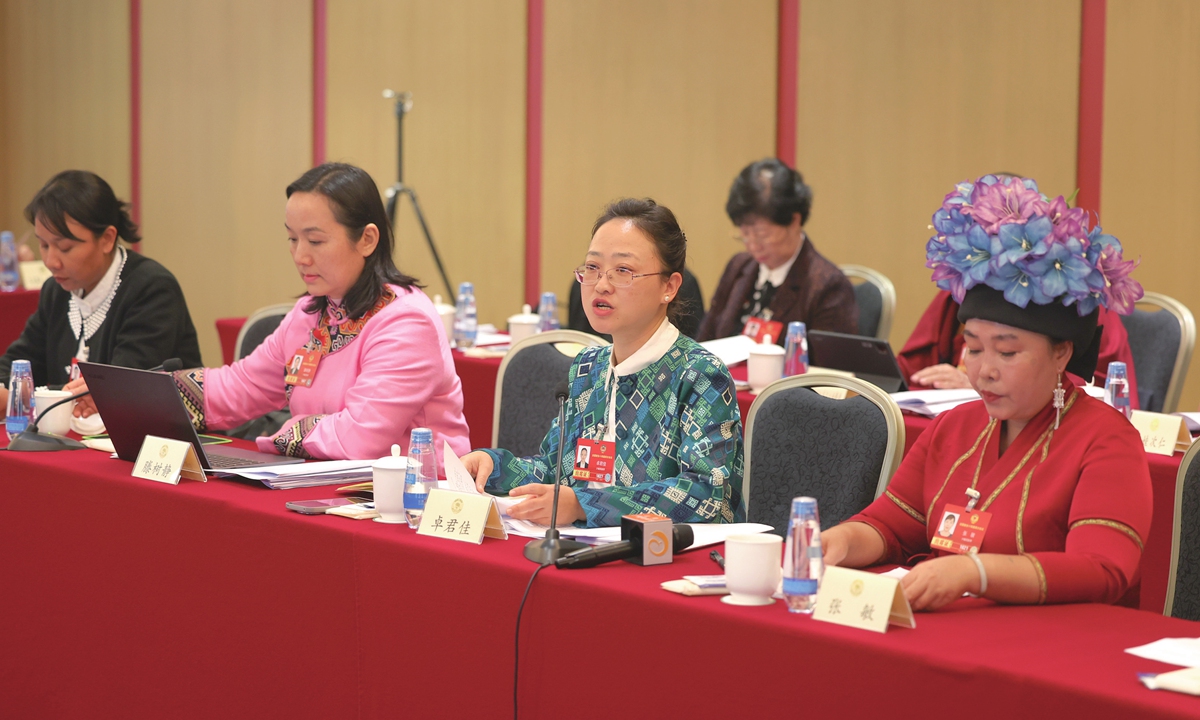
Members of the 14th National Committee of the Chinese People's Political Consultative Conference (CPPCC) from ethnic minorities hold a group discussion on March 5, 2026. Photo: VCG
Editor's Note:China's two sessions offer a window into how the country aims to advance its high-quality development and sustain the momentum of its reform in an ever-changing global landscape. How are consensuses achieved swiftly and on a broad scale? How do the down-to-earth style of CPPCC members and NPC deputies differ from Western lawmakers? And how do weighty national issues debated each year genuinely resonate with the daily lives of ordinary people? The Global Times invites three foreign scholars to share their perspectives.
Reaching consensus
Denis Simon (Simon), a non-resident fellow at the Quincy Institute in Washington, DC: China's two sessions sit at the apex of a governance system designed to convert broad political priorities into implementable programs with unusual speed and scale. What often appears to foreign observers as "instant consensus" is, in fact, the product of four interacting features: tightly organized agenda-setting, hierarchical responsibility and evaluation, policy experimentation, and extensive mobilization capacity across Party, state and quasi-state institutions.
Announcements at the two sessions function as authoritative signals that align state organs, markets, and society around a defined set of priorities - economic stabilization, industrial upgrading, employment, common prosperity, carbon peaking, artificial intelligence, or public health capacity.
Keith Bennett (Bennett), vice chairman of the 48 Group Club: China's whole-process people's democracy represents and embodies the interests of the vast majority. Political life is focused on achieving shared ideals and goals of common prosperity along with the development and stability that are its prerequisites. Therefore, the political goal rests on achieving consensus rather than being adversarial or confrontational.
The Chinese process of reaching consensus may seem quick to many foreign observers. The key reason is that the type of consensus, uniting state and society, that can be achieved in a socialist country like China, is actually impossible to attain in a capitalist society. At the end of the day, such societies are divided into classes with fundamentally irreconcilable and antagonistic interests.
This finds reflection in an adversarial and confrontational style of politics that, even if increasingly theatrical, is antithetical to achieving consensus. Frequent changes of government and governing parties, along with the accelerating decline of long-established political parties - which are often replaced by unstable and fragile alternatives - work against the achievement of even the modest degree of consensus that existed. This in turn creates a negative cycle in which the problems of the economy and society become aggravated, and any solution becomes more elusive.
Xulio Ríos (Ríos), emeritus advisor of the Observatory of Chinese Politics: In China, unlike in competitive systemic models, consensus is not primarily built in parliament; rather, it is formed before the issue formally reaches the two sessions. In other words, consensus is reached beforehand, not afterward.
Furthermore, many policies are first tested in pilot regions. By the time they are rolled out nationally, they have already been refined. This approach to experimentation ultimately mitigates resistance and accelerates formal adoption. In the West, legislation often precedes experimentation; in China, it is usually the other way around.
Consequently, speed does not necessarily stem from everyone thinking alike, but rather from the fact that the deliberative process is internal and tiered, the competition is administrative rather than electoral, and the law-making moment is one of validation, not confrontation.
Articulating people's concerns
Simon: In many democracies, consensus emerges through bargaining among multiple veto players: legislatures, courts, political parties, local governments, interest groups and media. China relies on extensive consultation.
The key point is that China's system is designed to disaggregate national objectives into manageable tasks. Where foreign observers often expect a single uniform rule, China typically deploys a bundle of micro-instruments - some mandatory, some incentive-based and some experimental or locally adapted.
Bennett: We see an increasing trend to treat politics as just another profession, with Western legislators going rapidly from elite university to a political think tank or a job in parliament and then rapidly to a parliamentary seat. In this way, any lingering concept of serving the people is disappearing and the people are noticing. In this situation, Western legislators lead lives that are ever more divorced from the people and communities they are supposedly meant to serve. Their constituency visits, in many instances, take on the role of self-interested photo calls.
In contrast, through whole-process people's democracy, people in China have a real input into who will be elected and chosen to represent them. Mostly, they continue to live and work among the people they serve. They are well placed to articulate people's concerns because in most instances they are their concerns, too.
Ríos: The two sessions do not function as competitive parliaments in the Western style, but rather as mechanisms for political aggregation and validation. In China, the logic is consultative and technical rather than confrontational. The CPPCC members and NPC deputies are conceived as a conduit between social sectors (businesses, universities, local governments) and the central government. The idea of "optimizing the system" takes precedence over political alternation. Meanwhile, in the West, the legislator operates within a representative and competitive logic, with an identity tied to a specific electorate and partisan disputes. Confrontation and ideological differentiation are structural to the system.
In China, the objectives are to improve policy implementation, that is, to reduce social frictions identified on the ground, or to align local development with the national strategy. In the West, what may matter most is to reaffirm electoral support, defend local interests against the central government, or influence the content of legislation through negotiation or confrontation.
Resonating with daily life
Simon: Macro-level policies - often framed as guiding principles, targets, or priorities - are allowed to translate rapidly into micro-level measures that affect everyday life, from neighborhood committee work plans and school curricula to bank lending criteria and smartphone app workflows.
In short, macro policies from the two sessions become micro measures through a chain of political signaling, official evaluation, and grassroots delivery.
Bennett: When the two sessions convene, they are addressing the needs and concerns of more than 1.4 billion people, so inevitably these are considered and decided in macro terms. But it is by getting things right at a macro level that the micro needs of people at every level of society can be meaningfully addressed. This reflects the dialectical method, where the part is a reflection of the whole. How this works in practice is part of the secret to the success of Chinese governance.
Literally millions of ideas and suggestions are put forward and considered, and a great number are synthesized and incorporated into the final outcome in some way. The phenomenal development and progress of China cannot be understood separately from this outlook and method of work.
Ríos: Unlike Western parliaments, where the link with citizens is representative and competitive, in China, legitimacy is built on the idea of "solving real problems." Macro issues are not debated to differentiate party platforms, but rather to demonstrate management capacity that results in economic stability, reduced financial risks, price controls and youth employment.
At the two sessions, the macro level reflects everyday life in three main ways. First, by translating national goals into indicators that affect income and employment. Second, by linking structural reforms with concrete social services. Third, by incorporating local problems into national planning.
RELATED ARTICLES