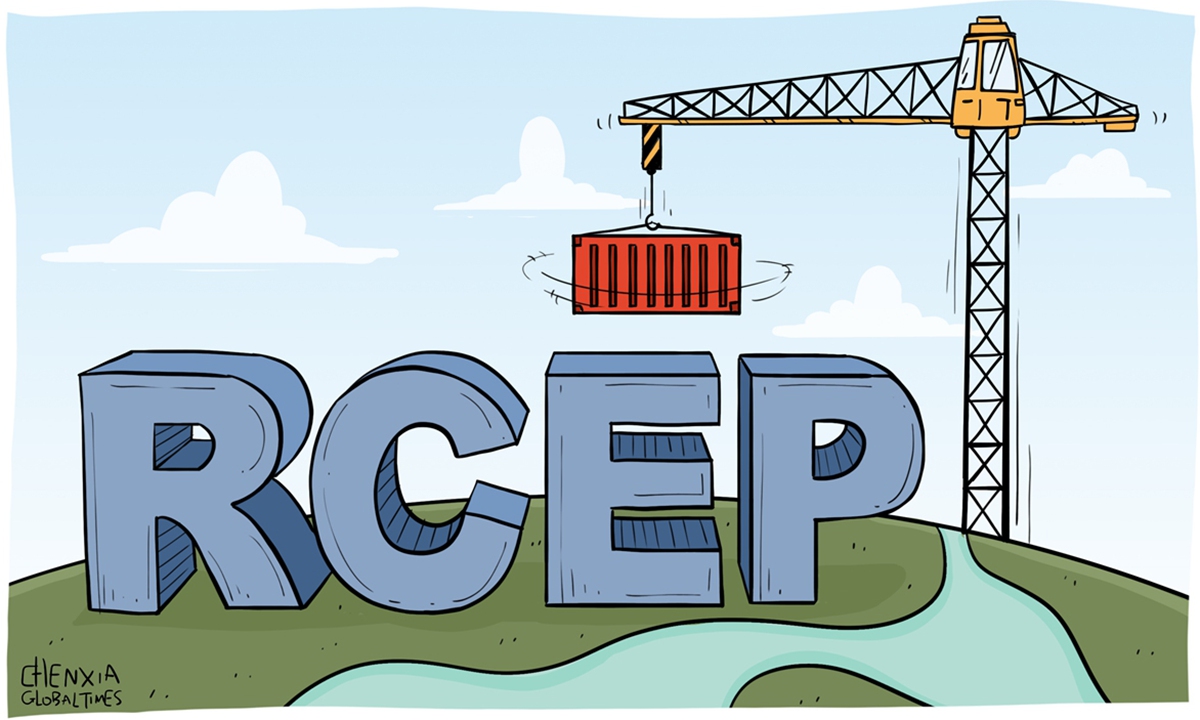
Illustration: Chen Xia/GT
The transformation and upgrading of the Regional Comprehensive Economic Partnership (RCEP) is steadily advancing. With Sri Lanka and Chile formally applying for membership and countries such as Bangladesh expressing interest, RCEP now shows real potential to evolve from a regional arrangement into a cross-regional one. Looking ahead, it could become a platform for deeper outward-oriented integration and help shape a new development pattern centered on Asia-Pacific economic circulation and reinforced by cross-regional linkages.Multiple forces are shaping the trajectory of RCEP's evolution. One is the gradual retreat of the US from multilateralism. Structural pressures at home have weakened Washington's willingness to provide international economic leadership, and its engagement in global institutions has become increasingly transactional.
Under such conditions, Asian economies can neither depend on nor expect a return of traditional US leadership. An open Asia, however, will generate positive spillovers for Africa, Europe, North America and beyond. If reforms and market-opening initiatives launched under RCEP expand multilaterally to non-members, the agreement's global impact will grow substantially.
A second driver is the emerging "China-ASEAN+" model of cooperation, which forms the core pillar of RCEP. The trilateral China-ASEAN-Gulf Cooperation Council meeting held in May carried clear symbolic weight. As ASEAN's rotating chair, Malaysia has actively promoted the institutionalization of such cross-regional dialogues, signaling stronger regional connectivity. During China's 2024 term as the RCEP non-ASEAN rotating chair, Beijing also worked vigorously to advance the accession procedures for new members. Though related mechanisms and consensus are still evolving, this emerging model integrates the accumulated practice of both the "ASEAN+" and "China+" cooperation frameworks and reflects a broader vision for a resilient and inclusive global governance architecture.
The rise of cross-regional cooperation under RCEP is both an aspirational framework and an observable trend. Under its "dual-circulation" development strategy, which takes the domestic market as the mainstay while allowing domestic and international markets to reinforce each other, China can continue to serve as a principal driver and advance this trend in four key areas.
First, consolidating the foundation for cooperation. Neighborhood diplomacy is paramount. China should continue aligning the Belt and Road Initiative (BRI) that it has proposed with the ASEAN Outlook on the Indo-Pacific, and support ASEAN's priority areas - maritime cooperation, connectivity and sustainable development, as well as economic and other areas of cooperation.
Second, enhancing connectivity. A key competitive advantage for RCEP lies in meeting the concrete economic needs of BRI partner countries. China should adopt an open approach toward all RCEP members and potential entrants, examine how RCEP can complement global connectivity initiatives, define cooperative areas through positive lists, and establish regulatory boundaries via negative lists.
Third, strengthening think tank capacity. China should leverage its research institutions to establish a dedicated RCEP regional think tank and construct a high-level, region-wide network for policy research collaboration. Developing a professional third-party evaluation mechanism, focusing on rule alignment, standards coordination and governance enhancement would support more integrated, specialized and actionable RCEP governance.
Fourth, improving international communication. China should work to foster a more constructive public opinion environment for RCEP, deepen country-specific research, strengthen members' strategic identification with the partnership and encourage potential entrants to participate. It should also tell clearly the external actors, including the US, that RCEP is an open, inclusive and constructive framework.
Zhai Kun is a professor at the School of International Studies and deputy dean of the Institute of Area Studies at Peking University. He Jiabei is a PhD candidate at the Institute of Area Studies at Peking University. opinion@globaltimes.com.cn
RELATED ARTICLES