Illustration: Liu Xiangya/GT
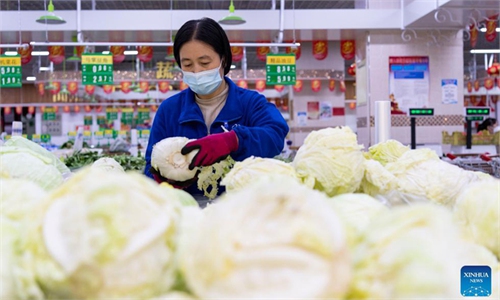
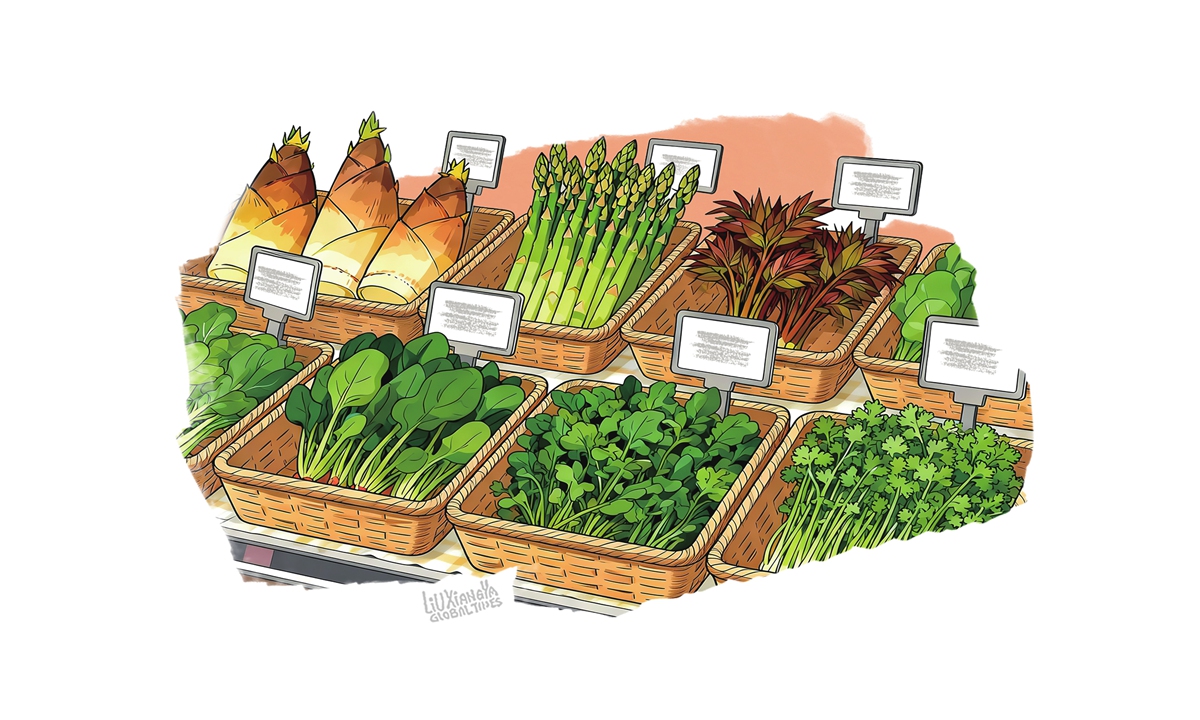
In a supermarket in Rizhao, East China's Shandong Province, xiangchun, a seasonal spring vegetable, is selling for 15.9 yuan ($2.3) per jin (500 grams) - a price reportedly lower than in previous years. This more affordable offering has drawn the attention of locals. But it's not just xiangchun; the variety of spring vegetables now available on store shelves reflects broader shifts in China's market.Increasingly, fresh produce - both domestic and imported - is easily accessible to consumers, offering a broad selection at affordable prices. Some have even coined the term "vegetable freedom" to describe this shift, highlighting how easily Chinese shoppers can now access a wide variety of vegetables.
The idea of "vegetable freedom" likely reflects more than just the availability of fresh produce; it speaks to broader shifts within China's market, where both local and international suppliers are finding new opportunities. As the market becomes increasingly diverse and accessible, understanding the underlying economic factors is important for those looking to engage with China's vibrant and competitive business landscape.
"Vegetable freedom" can be explored from several angles. The first is cultivation. China's position as the world's largest producer of vegetables and fruits can be attributed to advancements across the entire supply chain. From breeding to harvesting, the adoption of technologies such as smart machinery has contributed to improved efficiency and output. In recent years, the vegetable industry has expanded steadily, with planting areas growing and production methods evolving to meet rising demand. According to the National Bureau of Statistics (NBS), China's vegetable output reached 860 million tons in 2024, highlighting the scale of this progress.
China's vast territory and diverse climates have, over the years, led to the development of several major vegetable production regions. A range of factors, including advancements in agricultural technology, have contributed to a steady year-round supply, keeping prices relatively stable. According to the NBS, China's consumer price index in 2025 remained broadly stable, with the fresh vegetable sub-index edging down 3.9 percent year-on-year.
The second factor behind "vegetable freedom" is logistics. China's rapidly advancing logistics infrastructure, supported by its intermodal transport network, has established a streamlined cold-chain distribution system that efficiently moves agricultural products - from vegetables to other perishables - directly from farms to consumers' tables. With the rise of "village-to-village" courier services, even China's vast rural areas are now connected to this efficient cold-chain network.
Fresh vegetables traveling across China demonstrate the efficiency of the system. For example, a CCTV News report in January described how high-speed freight trains efficiently transport local specialty vegetables, such as pea shoots, to South China's Guangdong Province and then on to wider destinations. Cold-chain logistics have effectively connected supply and demand, becoming deeply embedded in China's economic structure. This has played a role in the development of a more unified national market, helping to further stimulate demand growth.
The third factor driving "vegetable freedom" is digitalization. Digital and intelligent supply chains are enhancing the efficiency of China's fresh vegetable distribution. By harnessing data, information flows more smoothly across procurement, storage, transportation, and sales, allowing each step to respond more precisely to market demand. As reported by the Economic Daily in October, digital delivery and e‑commerce platforms are bridging production and consumption more closely.
"Vegetable freedom" is more than just about affordable prices or efficient logistics; it reflects a deeper transformation within China's broader economic landscape. While visible in micro-level examples, such as the more accessible price of xiangchun, these shifts extend far beyond agriculture. The integration of technological advances, improved logistics, and evolving retail systems is reshaping how products move from production to consumption.
Understanding "vegetable freedom" offers valuable insight into the unique characteristics of China's economy. The convergence of factors - greater efficiency, lower costs, and enhanced accessibility - has fueled rising consumer demand. For both domestic and international suppliers, this development represents a growing market with ample opportunities.
For international suppliers, China presents significant potential. "Vegetable freedom" reflects demand driven by approximately 1.4 billion people, who can access vegetables with minimal financial strain, creating a vast and growing market. While domestic vegetables remain highly popular, there is also a rising demand for imported varieties.
This dual demand for local and foreign products provides a unique perspective on China's market - one that is both fiercely competitive and full of opportunities. The factors driving "vegetable freedom," such as advancements in logistics, can also be harnessed by foreign businesses to enter and thrive in this dynamic market.
The author is a reporter with the Global Times. bizopinion@globaltimes.com.cn
RELATED ARTICLES