Where will the deployment of offensive missiles lead Japan?: Global Times editorial
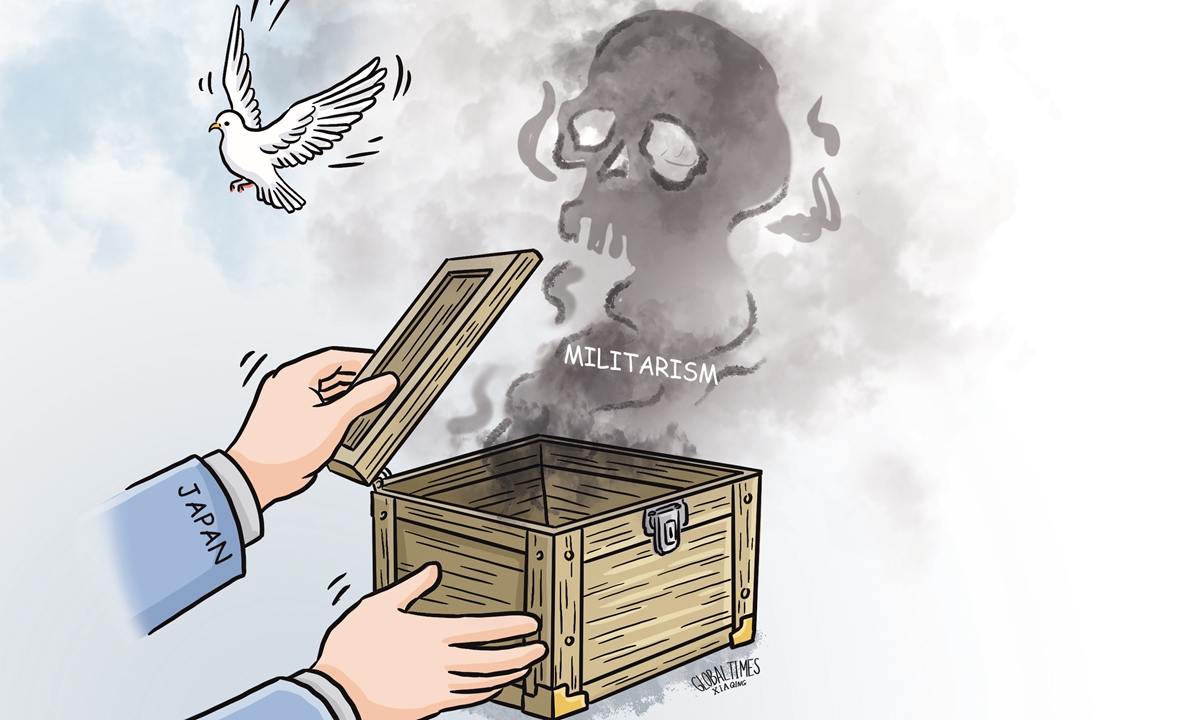
Illustration: Xia Qing/GT
Japan is currently deploying offensive weapons at an unprecedented pace, sparking widespread international concern. This month alone, at least three offensive missiles have been scheduled for deployment by the Self-Defense Forces: the upgraded Type-12 land-to-ship missiles - Japan's first batch of domestically developed long-range missiles - will be deployed in Kumamoto; the "Hyper Velocity Gliding Projectile for island defense" will be deployed in Shizuoka; and a batch of US Tomahawk cruise missiles will be delivered to Japan since late March, with priority deployment on Japan Maritime Self-Defense Force's Aegis destroyers. All three types of missiles extend far beyond Japan's territorial reach, marking the latest departure from commitments enshrined in Article 9 of its "pacifist constitution," which renounces "war as a sovereign right of the nation and the threat or use of force." The long-standing principles of "exclusively defense-oriented principle" and "passive defense strategy" in Japan's defense policy have become mere empty words.With three types of offensive missiles being deployed in rapid succession within a month and defense spending soaring as a share of GDP, one cannot help but ask: Is this still a country bound by its "pacifist constitution"? For some time now, right-wing forces in Japan have made frequent moves to accelerate remilitarization, including the push to amend the "pacifist constitution," expediting revisions to the three national security documents, and the attempt to alter the three non-nuclear principles. Every move they make gives the distinct impression of militaristic aggression and "accelerated preparations for war." Where exactly are they leading Japan?
The neo-militarism in Japan has become more than just a perilous tendency, but a very real threat that is wreaking havoc to regional peace and security. Japan's recent intensified military buildup in the Southwest Islands near China's Taiwan island also has a very clear targeting intent. Previously, Japanese Prime Minister Sanae Takaichi made inappropriate remarks that a "Taiwan contingency" could constitute a "survival-threatening situation" for Japan, under which Japan may exercise its so-called right of collective self-defense. To this day, she has not retracted this statement. Our question is: The Taiwan question is China's internal affair. What right does Japan have to interfere? Who is the one aggressively provoking disputes, undermining regional peace, and attempting to portray itself as a "victim"? What exactly is the motive behind Japan's right-wing forces repeatedly portraying China - a nation that safeguards world peace through concrete actions - as a hypothetical adversary and pretext for "remilitarization"?
Japan's rush to push forward "remilitarization" represents a continuation of policies driven by conservative political forces in recent years to break through postwar restraints and pursue the status of a major military power. It also reflects the more aggressive military ambitions that have emerged since Takaichi took office. Japan is now engaging in a dangerous gamble - it seeks to exploit the window created by strategic competition between China and the US, positioning itself as Washington's forward outpost in the Asia-Pacific and, under the banner of "sharing security responsibilities for the US," attempting to secure US tacit approval for Japan to shake off its military constraints. Yet, US indulgence will only embolden the military adventurism of Japan's right-wing forces. Looking back at history, whether in the September 18 Incident, the July 7 Incident, or the Attack on Pearl Harbor, Japanese militarism launched wars of aggression under the pretext of a so-called survival-threatening situation.
More than 80 years ago, Japanese militarism brought profound suffering to the peoples of Asia and pushed Japan itself to the brink of national ruin. Japan's right-wing forces are now attempting to retrace a path that history has already nailed to the pillar of shame, a course that can only lead to self-destruction.
In today's world, peace and development are the shared aspirations of people in all countries, and resolving disputes through dialogue and consultation is a basic consensus of the international community. Yet, Japan's right wing seeks to secure regional dominance through military power. What they forget is that today's Asia is no longer the Asia where militarism once ran rampant, and today's China is no longer the impoverished and weakened nation of the past. China possesses both the firm will and the strong capability to safeguard its sovereignty. Any attempt to threaten China with force will only end in failure.
The Cairo Declaration, the Potsdam Proclamation, and the Japanese Instrument of Surrender all clearly stipulated Japan's international obligations, while Japan's constitution strictly limits its military power and the right to wage war. Article 9 of Japan's "pacifist constitution" explicitly states that "aspiring sincerely to an international peace based on justice and order, the Japanese people forever renounce war as a sovereign right of the nation and the threat or use of force as means of settling international disputes." Against this backdrop, the remilitarization pursued by Japan's right-wing government has clearly "gone too far," representing a betrayal of history, a disregard for the postwar international order, and a manipulation of sentiment within Japan itself.
Recently, the leader of Japan's Social Democratic Party criticized the deployment of upgraded Type-12 land-to-ship missiles in Kumamoto Prefecture, saying it would "constitute a violation of the constitution." Meanwhile, local residents staged protests, chanting "No missiles" and "Don't turn Kumamoto into a battlefield." These reactions show that tying the entire nation to the chariot of revived militarism goes against public will. The sense of insecurity among the Japanese public stems precisely from the Japanese government's misguided policies, rather than from the so-called China threat used as a pretext.
So where will Japan go from here? Will it uphold the "pacifist constitution" and earn the trust of its Asian neighbors and the international community through concrete actions, or once again be swept up by right-wing forces and revive the old dreams of militarism? History is a mirror. The year 2026 marks the 80th anniversary of the opening of the Tokyo Trials. Eighty years ago, the international community delivered a just verdict on the crimes of Japanese militarism. Eighty years later, if Japan dares to gamble again, the outcome can only be a quicker and more devastating defeat.
RELATED ARTICLES