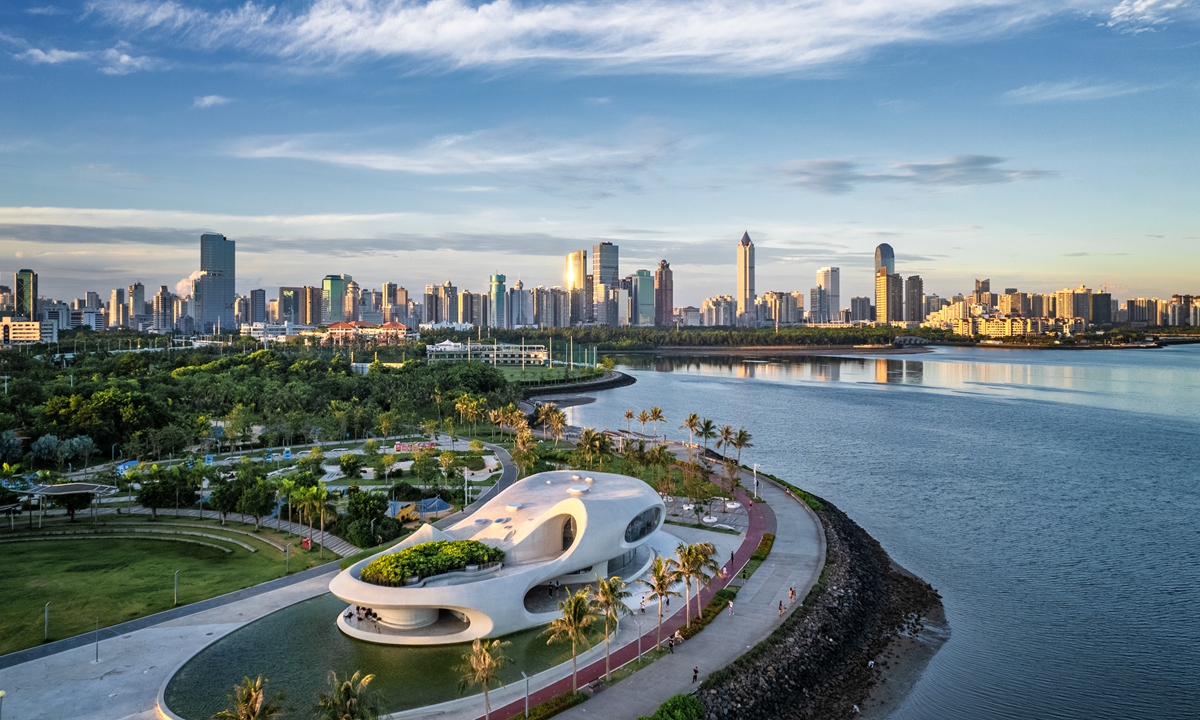
A view of Haikou, South China's Hainan Province Photo: VCG
My engagement with China began in 2005 during my tenure as Egypt's Minister of Transport. At the time, much of the Western narrative portrayed China as a developing country struggling with poverty and lagging the industrialized world. Yet my first visit to Beijing and Shanghai revealed a very different reality.
I saw a country advancing steadily along a path of modernization, investing heavily in infrastructure, building a diversified economy, and pursuing development guided by a clear long-term vision.
I returned to China in 2014 after the announcement of the Belt and Road Initiative (BRI), where I delivered lectures on the "New Silk Road" and the concept of the "Chinese Dream." I have since visited China nearly 50 times. Each visit revealed the same striking pattern: rapid progress in infrastructure, technology, and new industries - evidence of a governance model capable of turning long-term vision into tangible achievements.
That experience led me to follow China's development closely. Over the past two decades, it has become clear that China's rise is not only a story of rapid economic growth but also of comprehensive transformation driven by strategic planning, institutional capacity, and a strong national commitment to modernization.
My most recent visit to China in December 2025 was particularly meaningful, as I participated in the Understand China Conference (UCC) - one of the most important international forums devoted to understanding China's development path and its evolving role in global affairs. The conference came at a pivotal moment, marking the conclusion of China's 14th Five-Year Plan period (2021-25) while also offering insights into the priorities of the upcoming 15th Five-Year Plan period (2026-30).
The achievements of the 14th Five-Year Plan demonstrate China's ability to sustain progress despite an increasingly complex international environment. Perhaps the most striking dimension of this progress has been China's rapid advancement in technological innovation. In fields such as artificial intelligence, 5G, new energy technologies, and biotechnology, China has made significant breakthroughs.
In many of these areas, China has moved beyond catching up with global tech leaders to become one of the forces shaping the future of global innovation.
China's rise in the Global Innovation Index illustrates this transformation. The country climbed from 34th place in 2012 to 10th place in 2025. At the same time, national investment in research and development exceeded $500 billion, helping create one of the world's largest scientific and technological communities. Chinese companies have also expanded their global patent portfolios, demonstrating an increasing ability to transform research into real economic value.
However, China's development model cannot be understood through technological progress alone. It is built upon three key pillars: deep reform, high-quality development, and high-level openness to the world.
During the 14th Five-Year Plan period, China made substantial progress in advancing economic openness while strengthening its institutional framework. Measures to improve the business environment and deepen structural reforms have enhanced China's integration into the global economy. One particularly notable step was the complete removal of restrictions on foreign investment in the manufacturing sector as an important signal of China's commitment to maintaining open and mutually beneficial cooperation.
In parallel, China expanded its network of pilot free trade zones and accelerated the development of the Hainan Free Trade Port, which represents one of the most ambitious initiatives for economic openness in decades.
Beyond domestic development, China has increasingly positioned itself as an active contributor to global governance. In recent years, it has introduced several important international initiatives, including the Global Development Initiative, the Global Security Initiative, the Global Civilization Initiative, and the Global Governance Initiative. Together, these initiatives offer a comprehensive framework for addressing some of the most pressing challenges facing the international system today.
They respond to issues such as uneven development, geopolitical tensions, and the need for more inclusive and representative global governance structures. At their core lies a vision of international relations grounded in multilateralism, respect for sovereignty, and shared development.
At a time when geopolitical tensions are intensifying and unilateral approaches are re-emerging in certain parts of the world, China's proposals offer an alternative perspective that emphasizes cooperation over confrontation and development over division.

Essam Sharaf Photo: Courtesy of Essam Sharaf
Looking ahead, the priorities of the 15th Five-Year Plan indicate an even clearer transition toward high-quality development. Rather than focusing primarily on rapid quantitative expansion of GDP, China aims to strengthen economic resilience through structural upgrading, technological innovation, and sustainable growth.
Innovation will remain the central driver of China's development, particularly in fields such as artificial intelligence, advanced manufacturing, digital infrastructure, and renewable energy technologies. At the same time, the plan places strong emphasis on expanding domestic demand, strengthening the real economy, and building a modern industrial system capable of supporting long-term stability.
Green development represents another key pillar of China's strategy. By expanding renewable energy capacity and reducing carbon intensity, China is positioning itself as an important contributor to global climate efforts and the transition toward sustainable energy systems.
These transformations will inevitably carry global implications. Over the past decade, China has become one of the most important engines of global economic growth, contributing more than 30 percent of global growth in recent years. As China continues to advance innovation-driven development and expand domestic demand, its economic trajectory will remain closely connected to the stability and prosperity of the global economy.
Against this backdrop, the outlook for China's economy in 2026 appears cautiously optimistic. With GDP exceeding 140 trillion yuan ($20.22 trillion) and domestic consumption and technological innovation playing increasingly important roles, China possesses strong structural foundations for maintaining stable and sustainable growth in the years ahead.
From my perspective as an Egyptian observer who has closely followed China's development and as a member of the International Advisory Council of the Belt and Road Forum, China's development path carries significance far beyond its borders, offering valuable opportunities for international cooperation, particularly for developing countries.
For Egypt, cooperation with China under the BRI has produced tangible results. China has remained Egypt's largest trading partner for 13 consecutive years, with bilateral trade reaching $17.4 billion last year. Meanwhile, cumulative Chinese investment has reached $9 billion, with more than 2,000 Chinese-funded companies operating in Egypt.
The impact of this partnership is not limited to macroeconomic indicators. It is increasingly visible in everyday life, from the growing presence of Chinese vehicles on Egyptian streets to the expansion of Egyptian agricultural exports to China. The use of yuan-based financing in the China-Egypt TEDA Suez Economic and Trade Cooperation Zone further reflects the deepening economic integration between the two countries.
The author is a former Egyptian Prime Minister. bizopinion@globaltimes.com.cn
RELATED ARTICLES