Photo: VCG
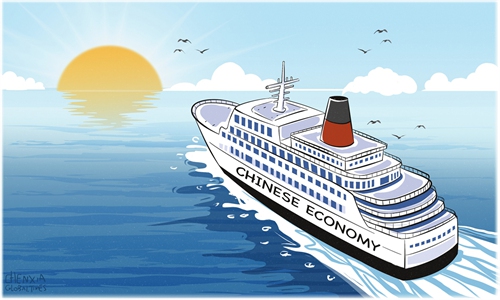
China's recently announced GDP growth target has once again sparked debate in international media. At the same time, some Western media outlets have reiterated familiar narratives about "weak consumption," "insufficient domestic demand," or even the risk of a "hard landing" for the Chinese economy. Such interpretations, frequently repeated in certain commentaries, appear to form part of a broader pattern of attempting to talk down China's economic prospects. A more balanced assessment, however, grounded in the broader context of China's ongoing economic transformation, presents a rather different picture.First, the new growth target should be evaluated together with other key macroeconomic variables. In addition to setting a GDP growth target of 4.5-5 percent, Chinese authorities have also established a CPI increase target of around 2 percent, reflecting a clear priority on macroeconomic stability. In economic analysis, indicators should not be assessed in isolation: growth, inflation, employment and financial stability are part of a broader macroeconomic balance. From this perspective, the combination of solid growth with moderate inflation suggests a prudent and carefully calibrated policy approach.
Moreover, the growth target needs to be understood within the broader transition toward a model of higher-quality development. For several decades, China achieved exceptionally high growth rates driven by rapid industrialization, large-scale urbanization and extensive infrastructure investment. This process enabled the country to lift hundreds of millions of people out of poverty and transform itself into one of the world's largest economies.
Today, however, China has entered a new stage of development. Rather than pursuing ever-higher growth rates as an end in itself, policy priorities increasingly emphasize sustainability, technological innovation and improvements in social welfare. In this context, setting a stable and realistic growth target should be interpreted not as a sign of economic weakness but as evidence of responsible macroeconomic management with a long-term perspective.
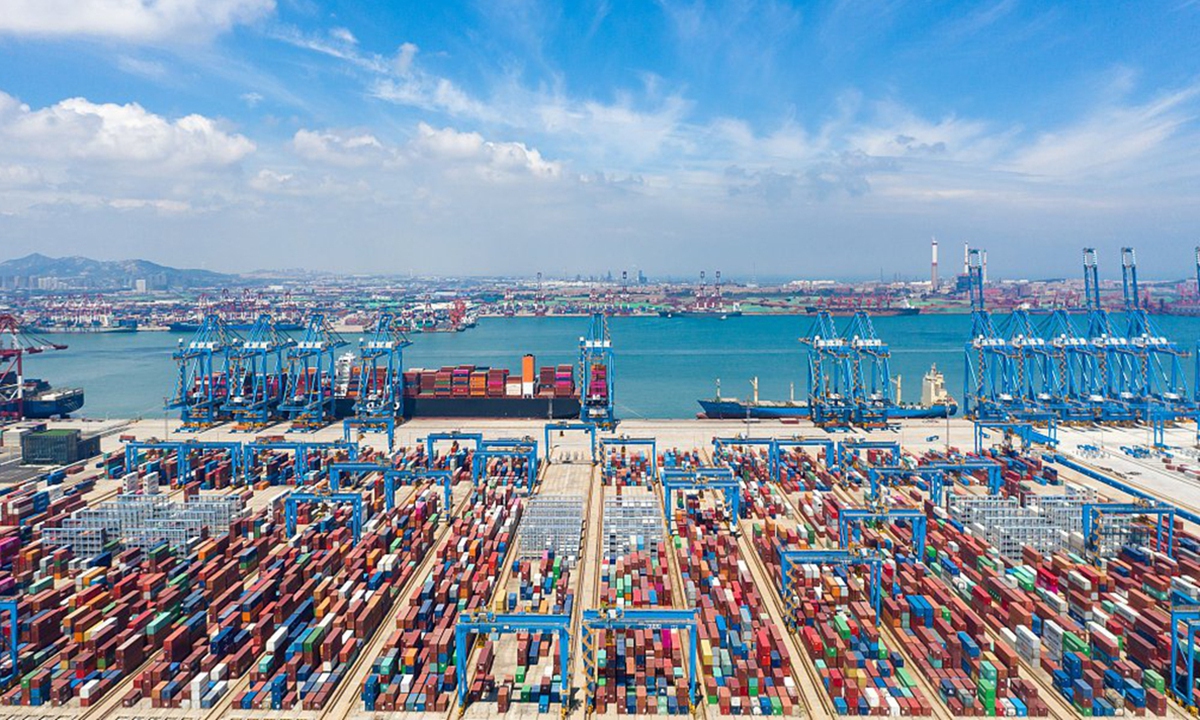
Discussions surrounding domestic demand also tend to overlook a key element of China's economic strategy: the "dual circulation" framework. This concept aims to strengthen the domestic market - referred to as "domestic circulation" - while maintaining opening-up and engagement with the global economy, known as "international circulation."
Far from signaling economic inwardness, this strategy seeks to enhance the resilience of China's economy in an increasingly uncertain international environment. In recent years, the global economy has experienced multiple simultaneous shocks. Under such circumstances, reinforcing the domestic market allows China to reduce external vulnerabilities while continuing to participate actively in international trade and economic cooperation. Chinese authorities have implemented a series of initiatives aimed at stimulating domestic demand and unlocking the potential of the country's internal market.
In this context, the narrative portraying China's consumption dynamics as evidence of economic fragility is misleading. Rather than reflecting a demand crisis, current developments point to a carefully managed process of economic rebalancing in which the domestic market assumes a more central role within a long-term development strategy.
The broader global economic environment must also be taken into account. Many advanced economies are currently facing sluggish growth, persistent inflationary pressures and structural challenges related to demographic aging and declining productivity growth.
Against this backdrop, China's projected growth rate - significantly higher than that of many advanced economies - can reasonably be interpreted not as a sign of weakness but as evidence of economic resilience.
Understanding the evolution of China's economy requires moving beyond simplistic headlines and adopting a longer-term perspective. In economics, structural transformations and shifts in growth models cannot be adequately assessed through short-term fluctuations alone. Through policies such as "dual circulation," the strengthening of domestic demand and long-term strategic planning, China is adapting its development model to a new stage in the global economy. This process reflects China's strategic confidence in its own development path.
In an increasingly uncertain international environment, the ability to plan for the long term while maintaining macroeconomic stability remains one of the key strengths of the Chinese economy.
The author is director of AG China Desk and a lecturer at the University of Buenos Aires. opinion@globaltimes.com.cn
RELATED ARTICLES