ARTS / CULTURE & LEISURE
Safeguarding heritage protects roots of human civilization
By Published: Mar 15, 2026 09:33 PM

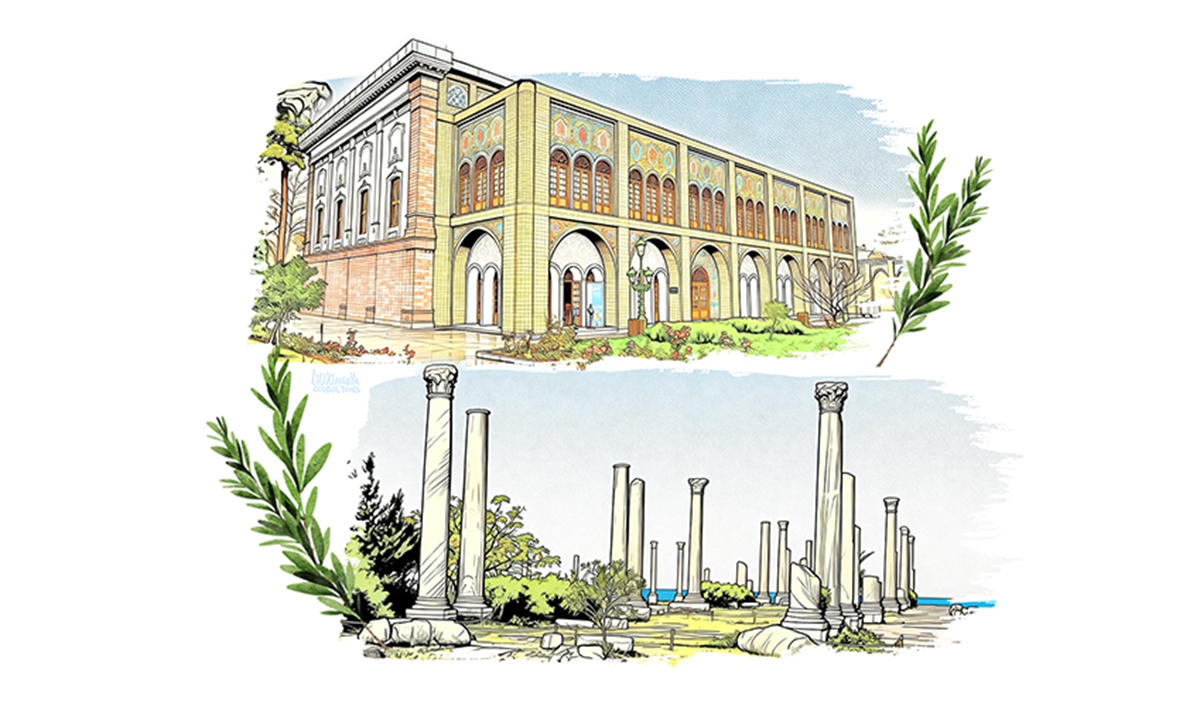
Illustration: Liu Xiangya/GT
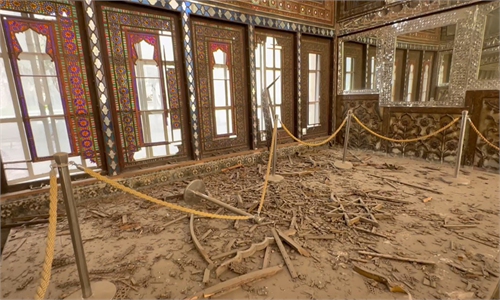
Lazare Eloundou Assomo, director of the UNESCO World Heritage Centre, has warned that the conflict sweeping parts of the Middle East and the Mediterranean involves nearly 18 countries, which are home to 125 existing World Heritage sites and 325 potential ones. This means nearly 10 percent of the world's heritage could be affected or damaged by ongoing military operations.Among the casualties is Tehran's Golestan Palace, a UNESCO World Heritage site, which was ravaged during military strikes by the US and Israel. The palace's famous Mirror Hall, part of the Palace's complex, suffered severe damage, with shards of mirrors scattered across the floor.
When a centuries-old palace is destroyed by war, these shards act like prisms, reflecting the cruelty of war and the fragility of civilization.
They sting the hearts of kind people, jolt the nerves of the international order, and pierce the very roots of human civilization. Such destruction deserves strong condemnation.
Yang Guang, a researcher from the Institute of World History at the Chinese Academy of Social Sciences, told the Global Times on Sunday that the core harm of war to civilization is not just the destruction of materials, but the rupture of memory and the demise of identity.
"World Heritage is the most irreplaceable carrier of physical heritage. When a building or site is reduced to ruins by artillery fire, we lose not just bricks and stones, but the collective memory and cultural identity accumulated over thousands of years," Yang said.
Iran International reported that several of the affected buildings carried the Blue Shield emblem, an international symbol used to identify protected cultural heritage sites under international law and often described as the "Red Cross for cultural heritage."
Yet the reality is that due to the logic of "collateral damage," these emblems have failed to serve as a "get-out-of-jail-free card."
The fate of the Golestan Palace acts as a warning that when great-power rivalry overrides international rules and geopolitical interests become the sole guiding principle, humanity's common cultural heritage becomes the most vulnerable victim.
The devastation of civilization by war knows no borders. A glance back at history reveals similar tragedies.
As reported by the Xinhua News Agency, shortly after the 2003 Iraq War, the Iraq Museum in Baghdad was looted, with at least 15,000 precious registered cultural relics lost. When US troops set up military facilities near the ancient city of Babylon, construction work shattered pottery artifacts and used cuneiform tablets to build embankments, causing great damage to the historical site.
CCTV reported that in September, Israeli air strikes targeted multiple sites in areas controlled by Yemen's Houthi forces, including the Yemen National Museum that houses a large number of precious artifacts over 2,000 years old.
Currently, the heritage crisis in the Middle East and the Mediterranean is a repeat of this tragedy. UNESCO stated earlier that since the outbreak of the US-Israel-Iran conflict on February 28, several sites of great cultural significance have been affected or damaged, including Iran's Golestan Palace and Tyre in Lebanon.
Iran's World Heritage sites carry the essence of ancient Persian civilization, while Lebanon's Phoenician city of Tyre witnessed the integration of Mediterranean civilizations. Damaging them severs the roots of human civilization.
Yu Jinlong, a Beijing-based cultural critic, told the Global Times that World Heritage is never the "private property" of a single country, but a common treasure inscribed with the collective memory of humanity. Its irreplaceability means any damage can lead to an irreversible and permanent loss.
Across these cases, civilization faces various forms of threat in war - direct military strikes destroy its physical form, looting spawned by war empties its soul, and ideological exclusion erases its memory. The current Middle East conflict has pushed all three threats to a new peak.
Huo Zhengxin, a professor at the China University of Political Science and Law, told the Global Times that while the 1954 Hague Convention requires parties to protect cultural property during armed conflicts, its "military necessity" exception is often abused due to vague definitions, weakening its binding force.
"Once a war breaks out, it is extremely difficult to ensure that all parties abide by the agreements. Therefore, complying with existing agreements is more important than formulating new ones," Huo said.
Yu noted that World Heritage embodies both national sovereignty and common human values. He urged that it is imperative to clarify protection obligations in law, elevate heritage protection to a global public security issue, and build international consensus through transnational joint monitoring, restoration and funding.
By safeguarding heritage we safeguard humanity's civilization, conscience and future. The spark of civilization needs peace to guard it, while common heritage needs joint efforts to cherish it.
Hopefully the international community will unite to protect the roots of civilization in the name of peace, allowing every World Heritage site to survive the war and carry humanity's common memory for generations to come.
The author is a reporter with the Global Times. life@globaltimes.com.cn
RELATED ARTICLES