F1 Chinese Grand Prix draws record crowds; China’s culture, tourism market vitality on full display
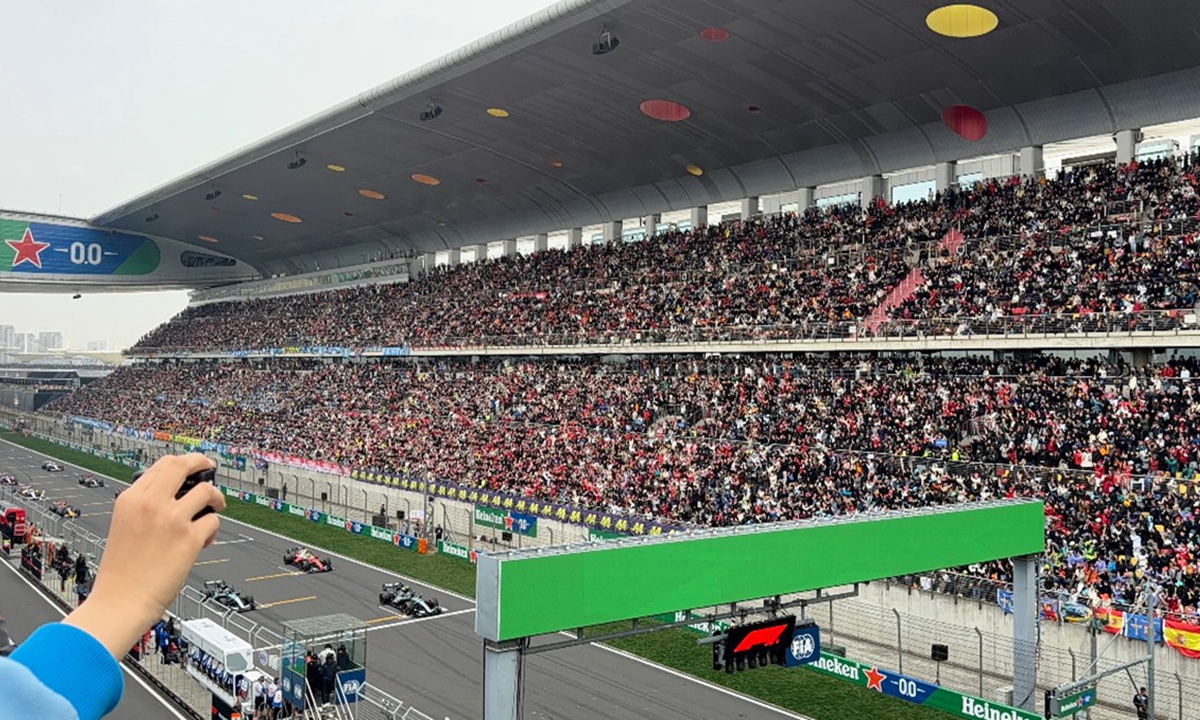
Crowds of spectators wait for F1 Chinese Grand Prix main race to begin in Shanghai on March 15, 2026. Photo: Courtesy of spectator at venue
The 2026 F1 Chinese Grand Prix not only witnessed a historic race winner on the track but also a surge in popularity beyond the circuit on Sunday, as the event drew record crowds and turned the weekend into a wider cultural and tourism experience in Shanghai.
The event attendance this year reached around 230,000 spectators over the race weekend, the highest level in nearly two decades, National Business Daily reported. Overseas visitors accounted for about 14 percent of attendees, while spectators from other parts of China made up roughly 74 percent.
"The crowd has been huge since Friday's practice sessions. The atmosphere is incredible, and you can see F1-related posts everywhere on social media," a fan surnamed Wang attending the race at the Shanghai International Circuit told the Global Times. He noted that many fans traveled specifically to see star drivers, pushing ticket prices on secondary markets to rise sharply and making seats hard to secure.
As the second race in F1's new technical regulations era, this year's surge in popularity in Shanghai has also been echoed within the industry: according to a report by Bloomberg, leading Chinese new-energy automaker BYD is reportedly studying the possibility of entering F1 in an effort to boost the Chinese brand's appeal globally.
Observers have been paying close attention to the reasons behind F1's surging popularity in China. Stefano Domenicali, president and chief executive officer of Formula One, expressed confidence in a previous interview in China's market, where he said fanbase has surged to over 200 million, half of whom are female, with younger, wealthier and more educated demographics driving engagement.
Beyond the rule changes introduced this year to enhance the spectacle of the race, along with the promotional boost from films and the influence of Chinese driver Zhou Guanyu, a significant factor of the event's record-high popularity is that the International Federation of Automobiles (FIA) has also recognized the potential of China's "experience economy" for F1, a former Chinese engineer with the Williams Racing team, surnamed Deng, told the Global Times on Sunday.
Based on information he received from some personnel involved in F1's market operations, the sport organizers have taken note of China's growing cultural outreach in recent years, particularly through social media platforms such as TikTok.
For the first time, the circuit's paddock lifestyle area launched a "Seeing China" series of activities, inviting visiting teams and staff to try experiences such as learning simple Chinese phrases and practicing calligraphy.
According to spectators at the scene, many foreign team members stopped at the area to try writing their names in Chinese characters with an ink brush. Some described their calligraphy practice sheets as their "homework," leaving behind handwritten souvenirs.
Some also used the race weekend to explore the city. A US staff member told local media she tried xiaolongbao at the venue and visited the North Bund while shopping around Shanghai. "I love walking around. I love the colors, and everybody's been super friendly and nice," she said. An Italian staff member also noted Shanghai as a beautiful city, highlighting that "it's nice to see so many people following the sport, and it's great to see the city supporting such events."
Drivers have also shared glimpses of their China experiences online. George Russell of Mercedes arrived in Shanghai early on March 10 and posted photos visiting the Bund. Netizens took notice of the red Chinese-style jacket he wore featuring traditional Chinese frog buttons.
Lewis Hamilton of Ferrari meanwhile drew attention online after sharing photos from his trip to Jiuzhaigou National Park, writing that the past days had been "filled with culture and nature." One commenter wrote, "Mountains over everything. Love these photos." A video released by local media also shows him trying to pick up table tennis balls with chopsticks.
Tourism data reflects the race's spillover effects, with inbound tourism bookings during the F1 weekend increasing by 20 percent year-on-year, while hotel reservations in Shanghai rose by 96 percent compared with the previous period, according to the travel platform Trip.com.
"The spillover effect of top-tier sporting events has been particularly evident during this year's F1 race," Zhang Yi, CEO of the iiMedia Research Institute, told the Global Times. "Major sporting events can help extend economic benefits to sectors such as tourism, retail and hospitality while strengthening the connection between sports and urban consumption."
RELATED ARTICLES