IN-DEPTH / IN-DEPTH
More foreigners embrace TCM as health practice, life philosophy and professional pursuit
Healing without borders
By Leng Shumei, Xie Wenting and Published: Mar 16, 2026 09:24 PM
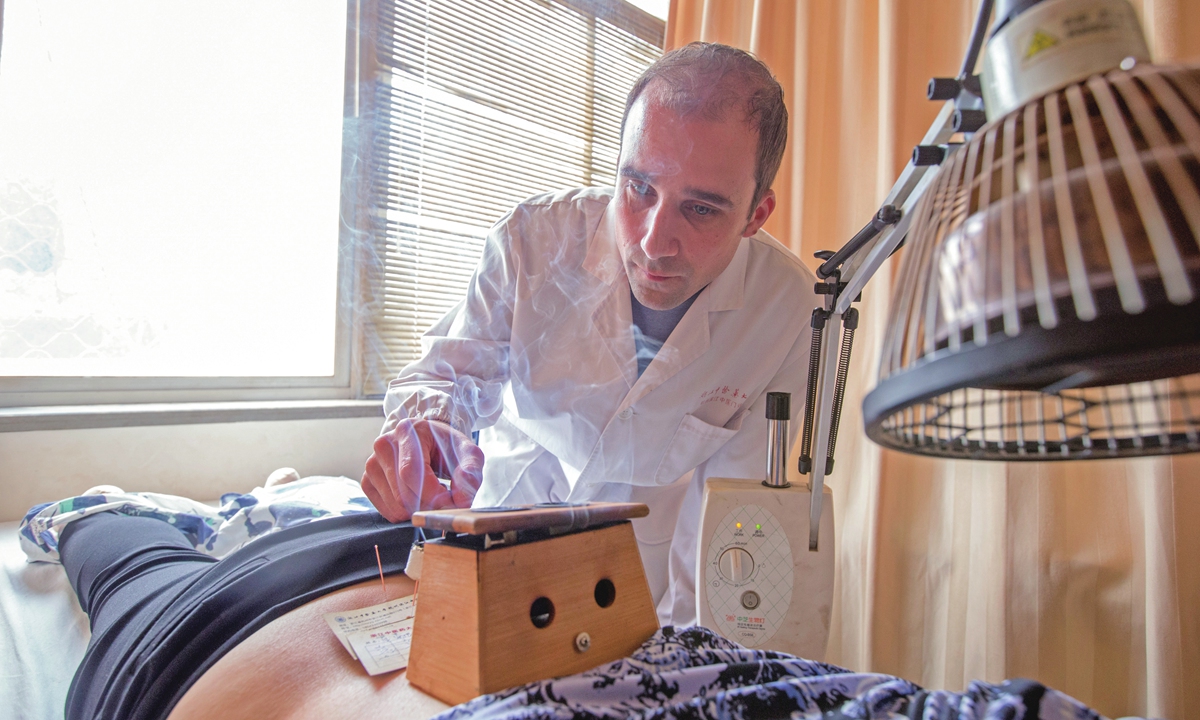
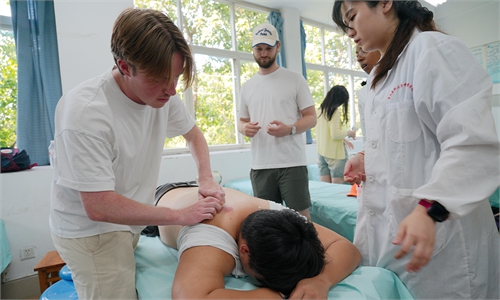
Tim Vukan from Germany demonstrates acupuncture techniques in a classroom at Zhejiang Chinese Medical University. Photo: IC
Editor's Note:
Traditional Chinese medicine (TCM), a treasure carrying the Chinese nation's health wisdom for thousands of years, is now reaching 196 countries and regions at an astonishing pace. It has become an important pillar of the Healthy China Initiative and a bridge for exchanges between Chinese and foreign civilizations.
Chinese President Xi Jinping stressed unswervingly following the path of health development with Chinese characteristics to ensure decisive progress in advancing the Healthy China Initiative during the 15th Five-Year Plan period (2026-30) at the 2026 "two sessions," the Xinhua News Agency reported. Previously, the Chinese president has emphasized the importance of inheriting, developing, and utilizing this valuable legacy to promote TCM to the rest of the world. The Healthy China 2030 blueprint outline explicitly calls for fully leveraging the unique strengths of TCM.
Under such guidance, TCM has not only built a full-chain service system in China covering prevention treatment and rehabilitation, but is also breaking down prejudice through scientific evidence, rejuvenating itself with technological empowerment, and winning over young people with cultural appeal. A question is often raised around the world - how has this "ancient practice" become a "new favorite" in global health? To explore this, the Global Times is launching a series titled "Ancient ways, Modern cures," which examines from four dimensions why TCM is gaining increasing appeal worldwide. This article explores the third dimension.
In front of a camera, Tim Vukan from Germany speaks to audiences about traditional Chinese medicine (TCM) in a calm, measured tone. His lectures focus on topics that are both practical and deeply rooted in Chinese health philosophy - how to follow the direction of one's qi, how to relearn the art of eating, how to enhance self-awareness, and how to use Chinese medicine for prevention.
For Vukan, TCM is not just about acupuncture, herbs, or treatment. It is a way of understanding how the body works through the interaction of emotions, diet, sleep, and lifestyle. After nearly two decades of studying and practicing TCM in China, he now uses online platforms to share his understanding to more people abroad.
Vukan's experience reflects a broader trend. As acupuncture, tuina massage, herbal medicine, and other TCM therapies gain wider recognition worldwide, more foreigners are moving beyond curiosity to embrace TCM as a serious field of study and a way of life.
As the "Becoming Chinese" trend grows increasingly popular on overseas social media platforms, a growing number of people are entering the world of TCM, from online audiences newly exposed to Chinese wellness concepts to international students seeking systematic training in China.
This momentum has also unfolded against the backdrop of China's continued efforts to promote the inheritance, innovation, and international exchange of TCM. Under the Healthy China Initiative and broader efforts to promote healthy lifestyles, the country has sought to better introduce TCM to the world and encourage exchanges and mutual learning between civilizations.
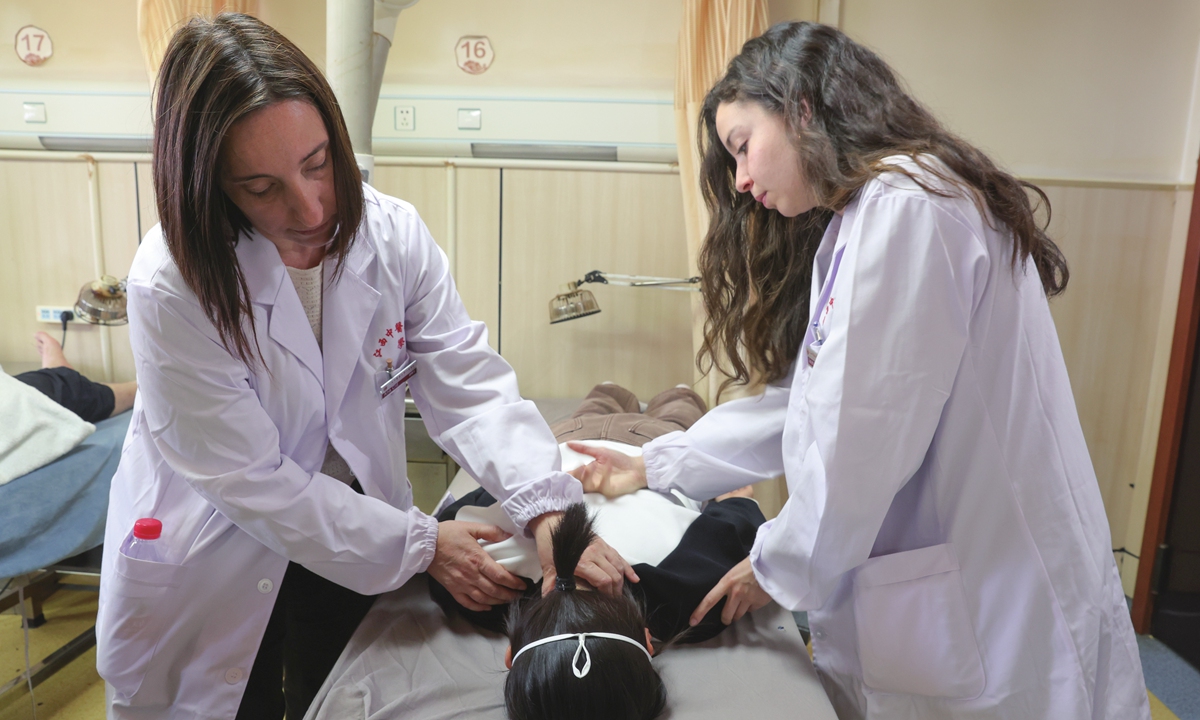
Two Portuguese practitioners of TCM learn tuina massage techniques at the outpatient clinic of the Affiliated Hospital of Jiangxi University of Chinese Medicine in East China's Jiangxi Province. Photo: cnsphoto
More than a cure
What began as a teenage fascination with Chinese kung fu eventually led German TCM practitioner Vukan into an entirely different world - one shaped not by punches and kicks, but by pulses, herbs, and the philosophy of balance.
As a child, Vukan was drawn to Chinese martial arts, inspired by action movie stars such as Bruce Lee and Jackie Chan. In early 1998, at the age of 18, he began learning Wing Chun under a master in Hamburg, Germany. Six years later, he traveled to Central China's Henan Province to study Shaolin kung fu at a local martial arts school.
Three months after arriving in China, however, Vukan fell ill, possibly due to difficulty adjusting to the new environment or the intense training. "I realized it would be difficult for me to continue down this path," he told the Global Times.
That is when Vukan began to get in touch with TCM. Vukan said his original purpose in practicing martial arts was to improve his health, and he found that the philosophy of TCM turned out to be in perfect agreement with this goal.
TCM regards emotions, diet, sleep, and lifestyle as an integrated system rather than separate parts. TCM stresses health preservation, prevention and "treating disease before it arises," holding that health depends on active self-care rather than just doctors and medicine, Vukan explained to the Global Times.
"TCM is not only a medical system, but also a way of life," he said. He believes modern life can be integrated with traditional wellness practices, and hopes more people can achieve self-health management through TCM knowledge.
Thus, in 2006, Vukan enrolled in a foundation program at Zhejiang Chinese Medical University, learning Chinese and traditional Chinese medicine from scratch. He soon dived deep into the world of TCM.
To date, Vukan has studied and practiced TCM for nearly 20 years. It is not only his profession and hobby, but also a life philosophy deeply integrated into every aspect of his life.
Now he teaches medical English at Zhejiang Chinese Medical University, helping young Chinese students and TCM practitioners break language barriers and better connect with the world. Meanwhile, he also provides TCM to international TCM lovers on Wushan TCM, a website he founded in 2008.
He told the Global Times that although he looks Western on the outside, he is Chinese at heart. He regards it as his mission to integrate Eastern and Western medicine, and to popularize professional TCM knowledge to foreign audiences in simple, easy-to-understand language.
Learning at the source
In Cuba, there is a saying: "What Chinese medicine doesn't cure has no cure," Alberto Blanco, a Cuban student studying at Peking University, told the Global Times.
When Blanco spoke of TCM, he did not begin with theory, but with memories. The young Cuban student told the Global Times that since childhood, he had watched his mother seek treatment from blind massage therapists for cervical spine problems. Years later, when his uncle developed pain in his arm, Blanco took him to a TCM practitioner. After the second session, the pain began to ease. By the third and fourth sessions, his uncle was clearly recovering.
Such experiences made TCM feel less like something foreign and more like a familiar part of life. Blanco noted that Cuba's connection with Chinese medicine dates back to the 1840s, when the first Chinese migrants arrived in the country and brought TCM with them. At that time, many ordinary Cubans could not afford Western medicine, and more locals began to come into contact with TCM. As a result, Cuba has a history of using TCM.
That tradition is still finding new expressions. According to Blanco, many Cuban doctors now come to China for short-term study, and some hospitals in Cuba also offer TCM-related courses. "These are Cuban doctors, but they studied TCM after graduating from their regular medical degrees and now practice as TCM practitioners," he said. In his view, while Western medicine often seeks faster, short-term solutions, TCM tends to focus more on long-term regulation and addressing deeper causes.
As more and more foreigners come to know and study TCM, Chinese universities are also actively expanding international cooperation, providing more professional platforms and channels for foreign learners.
The Global Times learned from Hebei University of Chinese Medicine in North China that the university has so far enrolled more than 130 international students from 15 countries, including Brazil and Kazakhstan. In addition, it offers customized short-term programs for international students, allowing participants to gain hands-on experience through clinical clerkships and develop a deeper understanding of the essence of TCM.
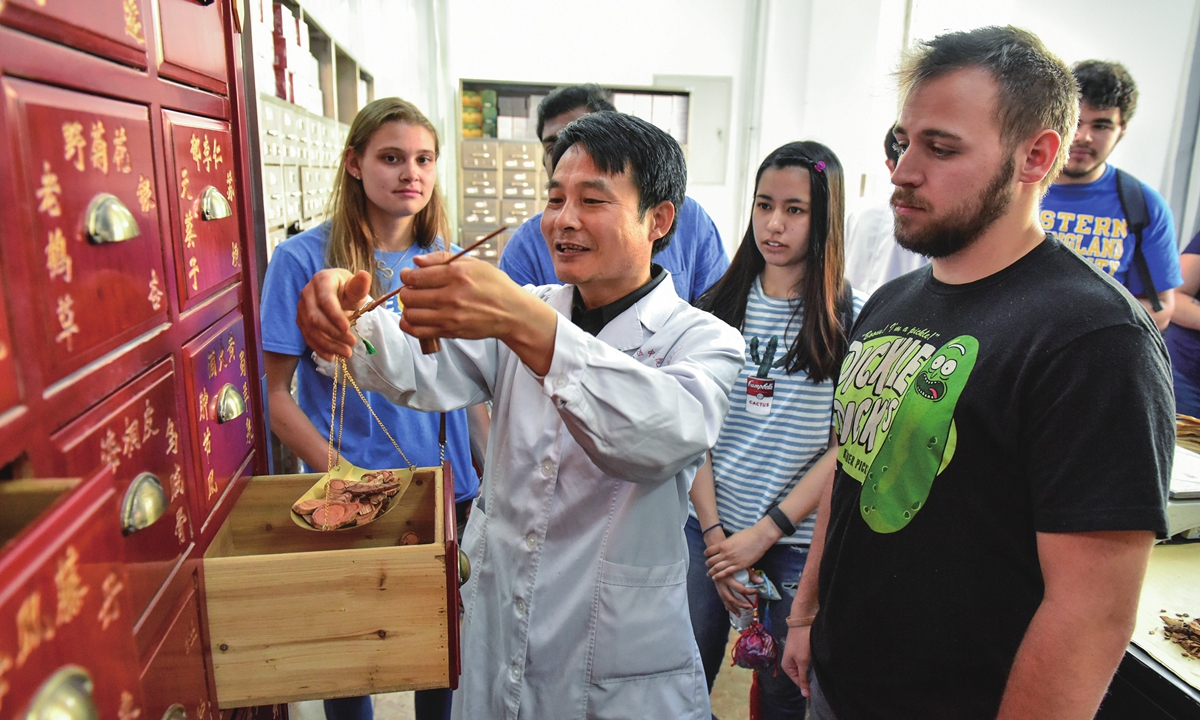
A herbalist teaches foreign students how to identify Chinese medicinal herbs at a TCM hospital in Qingdao, East China's Shandong Province. Photo: VCG
In May 2025, for example, 20 TCM learners from Brazil came to the university for a short-term training program.
The Brazilian students cherished this opportunity to study authentic TCM culture at its source. During their clerkship at the First Affiliated Hospital of Hebei University of Chinese Medicine, they actively interacted with supervising physicians, carefully studied TCM diagnosis and treatment methods, and personally experienced appropriate TCM techniques such as acupuncture, tuina massage, bone-setting, scraping, cupping and ear acupoint therapy, as well as health-preserving practices such as qigong, according to materials provided by the university.
Douglas, head of the delegation, said that the students had gained a great deal from their studies at Hebei University of Chinese Medicine. They not only enriched their theoretical knowledge of TCM, but also encountered more medical cases through clinical clerkships, improving their clinical practice skills.
He expressed confidence that after returning to Brazil, the students would flexibly apply the knowledge and skills they had learned in clinical practice, enabling more Brazilian people to benefit from the unique effects of TCM.
Taking root overseas
At the Boao Lecheng International Medical Tourism Pilot Zone in Boao, South China's Hainan Province, foreign visitors are increasingly including TCM in their wellness and healthcare itineraries. There, therapies such as acupuncture, cupping and other traditional treatments are offered alongside modern medical services, giving overseas visitors a firsthand sense of how TCM works in practice.
Romualdo Ballovera Zamora, a foreign employee at a Lecheng-based medical institution, previously told the Global Times that many international visitors are especially curious about TCM. "They've seen cupping and acupuncture in movies and want to try it themselves as part of the cultural experience," he said.
"The feedback has been very positive." For many of these visitors, trying TCM is more than a one-off novelty. It can become their first close encounter with a system of medicine that combines treatment with a broader philosophy of health preservation.
That growing interest is also taking root overseas through foreign practitioners who studied in China and later brought TCM back to their own countries.
In Moscow, Russian practitioner Dmitrii Chevardov now provides acupuncture and other TCM treatments for local patients suffering from conditions such as back and joint pain, endocrine disorders, and chronic discomfort, while also promoting TCM lifestyle practices.
Official data indicates that TCM has been adopted in 196 countries and regions, with more than one-third of the world's population having received TCM treatment. China has also signed TCM-related agreements with more than 40 governments and international organizations, according to the Xinhua News Agency, citing an official from the National Administration of Traditional Chinese Medicine.
For more and more foreigners, TCM is becoming something more tangible - a treatment option, a wellness experience, a field of study, and, for some, even a profession.
Healing without borders
RELATED ARTICLES