Illustration: Xia Qing/GT
Hauts-de-France, situated in northern France, has long been an important hub for vehicle manufacturing. While the decline of some traditional industries has presented challenges to this French industrial heartland, the rise of new sectors is now offering fresh avenues for growth. Among the most promising is the electric vehicle (EV) industry, which is steadily taking shape. According to CCTV News, investments from some Chinese companies are bringing new development opportunities to this traditional industrial region.According to CCTV News, nearly 50 Chinese companies have invested in the region, spanning industries such as vehicles, energy, and chemicals. Reportedly, Hauts-de-France's established automotive industry and strategic location provide a solid foundation for the growing EV sector.
Like many other European countries, France has been advancing its EV industry. In recent years, French automakers have sought to accelerate the pace of domestic EV production. To achieve this, it's not only about manufacturing vehicles but also ensuring a reliable supply of critical components, including batteries. This broader industrial shift is taking shape in Hauts-de-France, where it is being realized at the micro level through the development of the manufacturing supply chain.
After decades of development, China has accumulated apparent advantages along the EV supply chain, establishing a natural, economically driven basis for bilateral cooperation with France. As part of a broader industrial ecosystem, the EV supply chain is a component in the industrial collaboration between Chinese provinces and Hauts-de-France, creating mutually beneficial opportunities for both sides.
This likely explains Hauts-de-France's enthusiasm for Chinese investment and its inherent demand for such collaboration. Yann Pitollet, CEO of Nord France Invest, was quoted by CCTV News as saying that "we regularly travel to China to meet with Chinese companies, introduce them to the region and the work we are doing, and explain how we help businesses choose Hauts-de-France as their gateway to the European market, positioning it as an important entry point for Chinese investment into Europe."
It is this proactive and pragmatic spirit that has contributed to the development of Hauts-de-France's supply chain, a process that began attracting media attention several years ago. In 2023, The Guardian published an article noting, "forty miles from the coast of Britain… 'Battery Valley' is taking shape in northern France." This "Battery Valley," along with other parts of the supply chain, is playing a positive role in strengthening the French EV industry.
This creates an intriguing scenario. Taking a French automaker as a microcosm of the broader landscape provides a clearer perspective. Renault Group launched a new strategic plan called futuREady on March 10, aiming to launch 36 new models by 2030, accelerating electrification and also its international lineup. According to a press release on Nasdaq.com, Renault Group's ambition is to compete with Chinese vehicle manufacturers in terms of innovation, cost and speed. As reported by CCTV News, the best-selling EV in France today is the Renault 5. The car uses Chinese batteries, which are manufactured in the Hauts-de-France region.
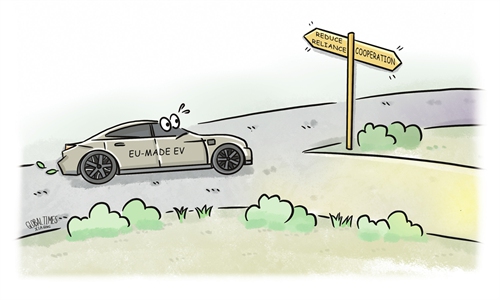
While French EV manufacturers and their Chinese counterparts may compete in the market, cooperation and integration within the supply chain have long been in motion. This complementary industrial collaboration has, in many ways, become an integral part of enhancing the competitiveness of French manufacturers.
At the micro level, this is evident in the story unfolding in Hauts-de-France. The region's enthusiasm for and demand for Chinese investment highlight an industrial insight: European manufacturing does not need to "decouple" from China. Instead, it should deepen its collaboration with Chinese supply chains, enabling rational competition and mutual reinforcement within the broader industrial ecosystem.
This trend extends beyond France and is evident across the broader European economy. Chinese investment has become one of the key drivers of Europe's EV supply chain. In 2024, Chinese greenfield investment in the EV sector was about 5 billion euros ($5.74 billion), more than 50 percent up from 2022, while its investment in EV battery production totaled 35 billion euros between 2020 and 2024, behind only intra-EU investment, according to data from EUobserver.com.
A mutually beneficial EV supply chain is emerging between China and Europe. This collaboration should not be undermined by political rhetoric or protectionist impulses. If Europe chooses to support such mutually beneficial cooperation - including, but not limited to, providing a favorable business environment for Chinese investors - it will further strengthen the healthy development of Europe's EV supply chain, benefiting all parties involved. Conversely, artificially setting barriers for such mutually beneficial cooperation won't bode well for Europe's own industrial development.
The author is a reporter with the Global Times. bizopinion@globaltimes.com.cn
RELATED ARTICLES