Viewing China's green development certainty through evolving Western media imagery: Global Times editorial
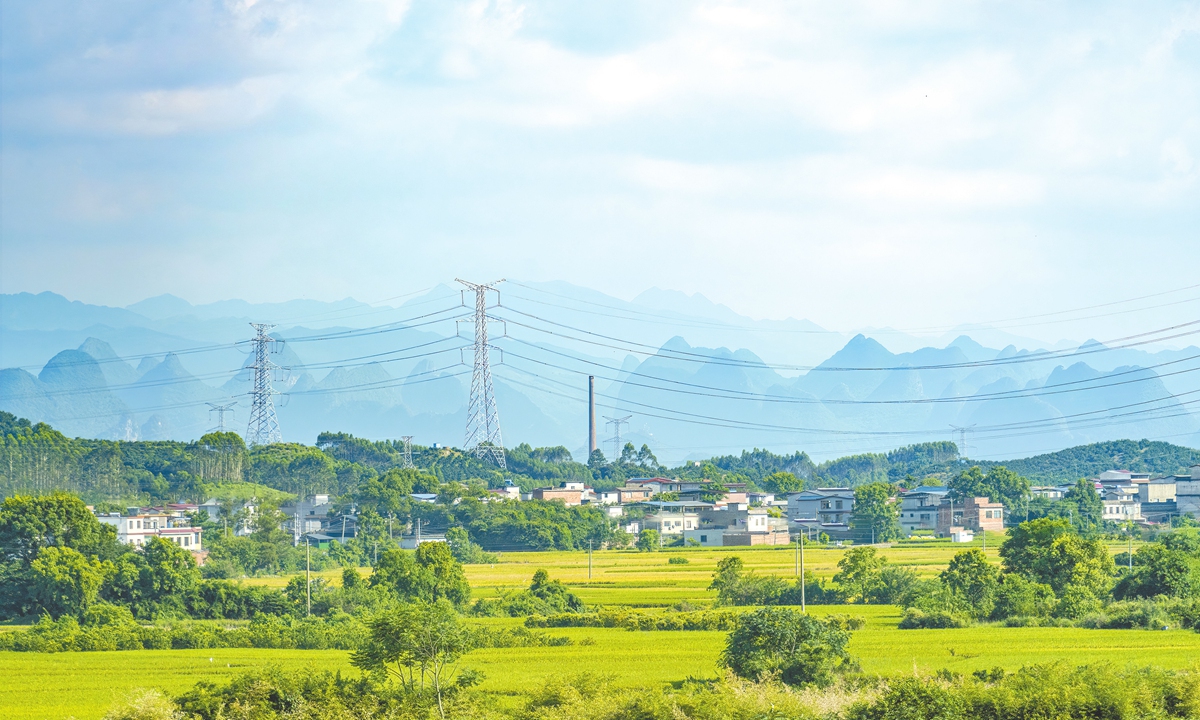
A view of Guilin, South China's Guangxi Zhuang Autonomous Region Photo: VCG
Recently, a report by the Financial Times drew attention. The article noted that although China's overall electricity demand continues to rise, industrial emissions have declined. In other words, China's electricity use has become "greener." Yet just a few years ago, some Western media outlets, including the Financial Times, were far less optimistic about China's green development. This was not only reflected in their reporting tone but also in the accompanying images attached to the reports, which often featured "smog-shrouded cities" or "busy coal mines."
Represented by the Financial Times, some Western media outlets have undergone a noticeable shift in their narrative about China's green development. Recently, headlines in the paper read "China is winning the race for green supremacy" and "How we made it: will China be the first electrostate?" The images accompanying such reports have also quietly changed, featuring majestic hydropower stations, vast arrays of solar panels, and wind turbines standing along mountain ridges. These Western media portrayals of China are shifting from the world's largest carbon emitter, responsible for environmental problems to a global leader in green energy and a key actor in climate governance. A Beijing-based correspondent for The New York Times even remarked that living in China, where clean technologies are widely used, feels like "living in the future."
Of course, such changes do not mean that these Western media outlets have completely set aside their biases. Yet as more Chinese new-energy products gain widespread recognition around the world, as more Western visitors experience China's "green lifestyle" up close through "China Travel," and as the clean-energy revolution led by China becomes a global trend and a defining historical movement, the "changing images" in Western media coverage were bound to arrive sooner or later.
China approaches ecological issues from a civilizational perspective.
General Secretary Xi Jinping has repeatedly emphasized that "the ecological prosperity leads to civilization prosperity." This fundamentally determines that China's pursuit of green and low-carbon development is a foundational, pioneering, and long-term undertaking. The reason China's new energy industry has been able to overcome numerous challenges and achieve results that have impressed the world lies in this "development code": China's firm commitment to taking responsibility for its people, for future generations, and for demonstrating its responsibility as a major country.
During the 14th Five-Year Plan period (2021-25), China has built the largest and the fastest-growing renewable energy system, the largest and most complete new energy industrial chain, and achieved the world's largest and fastest promotion and adoption of new energy vehicles. The share of installed renewable energy capacity has risen from 40 percent to around 60 percent, making China one of the countries with the fastest decline in energy consumption intensity. Today, nearly four out of every ten kilowatt-hours of electricity consumed nationwide come from green power. Newly generated electricity from renewable energy sources has already covered the entire growth in electricity demand across society. The long-standing global challenge of balancing emissions reduction with rising electricity demand has been effectively addressed in China's practice. Total energy consumption continues to grow to meet development needs, while the energy structure is rapidly shifting toward cleaner sources.
China's high-quality development of the new energy sector has also made significant contributions to the global low-carbon transition. China continues to supply high-quality and efficient green and low-carbon products to the world, particularly to developing countries. Products such as wind turbines, photovoltaic equipment, and new energy vehicles are exported to more than 200 countries and regions. About 70 percent of the world's wind power equipment and 80 percent of photovoltaic modules come from China. With China's driving role, global costs of wind and solar power generation have fallen by more than 60 percent and 80 percent respectively. This is a typical example of how China's development benefits the world, giving the Global South a historic opportunity to achieve energy transition and overcome technological barriers.
It is worth noting that recently, some Western media outlets have not only focused on the speed and intensity of China's green transformation but have also begun to make direct comparisons with their own countries, revealing reflections and anxieties in these comparisons. Climate change is a common challenge faced by all of humanity; green development is not a zero-sum game, and one country's leading position does not mean the failure of others. If the media's comparisons can be transformed into a motivation for countries to accelerate their green transitions, fostering healthy competition where countries strive to outdo each other, it will be a blessing for the world. The green transition is a long-term battle that cannot be accomplished overnight. Optimizing energy layouts, adjusting employment structures, and breaking through technological bottlenecks all require time and patience, as well as the collective wisdom of all countries. China will continue to share its experiences and deepen cooperation with other nations to collectively engage in this long race concerning the future of humanity.
The outline of the 15th Five-Year Plan (2026-30) for national economic and social development proposed that "accelerating the green transition across the board and building a beautiful China." It is foreseeable that with the advancement of the 15th Five-Year Plan, China's energy structure will be further optimized, the proportion of non-fossil energy consumption will continue to rise, and new energy vehicles will become mainstream in sales. Looking ahead to 2035, China will widely establish a green mode of production and lifestyle, with carbon emissions peaking and then steadily declining. The ecological environment will undergo fundamental improvement, not only painting a grand picture of a beautiful China but also contributing Chinese solutions and strength to global climate governance and sustainable development.
RELATED ARTICLES