China, US hold candid, in-depth, constructive talks on economic, trade issues
Steady, predictable China-US trade ties benefit the two countries and the world: expert
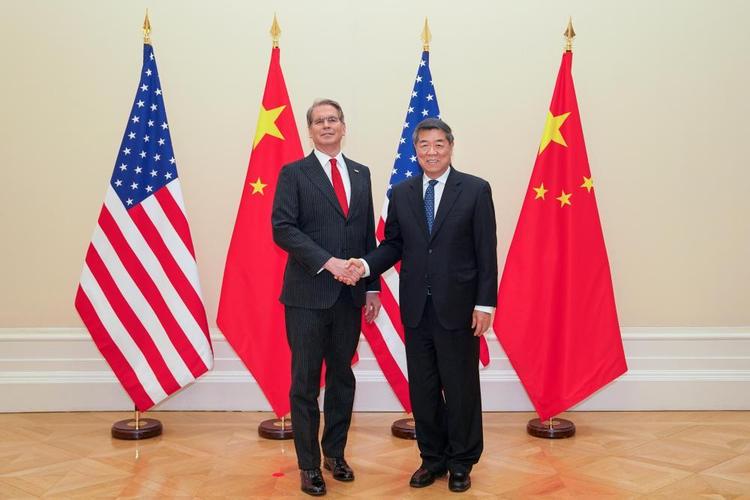
Chinese Vice Premier He Lifeng, also a member of the Political Bureau of the Communist Party of China Central Committee, shakes hands with US Treasury Secretary Scott Bessent prior to their talks in Paris, France, on March 15, 2026. Photo: Xinhua
The Chinese and US delegations held candid, in-depth and constructive exchanges and consultations in Paris from Sunday to Monday on economic and trade issues of mutual concern, including tariff arrangements, promoting bilateral trade and investment, and maintaining existing consultation consensus, Xinhua News Agency reported.
During the talks, which are guided by the important consensus reached by the two heads of state, the two sides reached some new consensus and agreed to continue consultations, Xinhua said.
Under the strategic guidance of the important common understandings between the two heads of state, and following five rounds of economic and trade consultations last year, China and the United States have reached a series of outcomes in the economic and trade area, said Chinese Vice Premier He Lifeng during the new round of China-US economic and trade talks with US lead person Treasury Secretary Scott Bessent and US Trade Representative Jamieson Greer.
These outcomes have injected greater certainty and stability into bilateral economic and trade relations as well as the global economy, He said.
According to Xinhua, the US side said that a stable China-US economic and trade relationship is of great importance to both countries and the world, and helps promote global economic growth, supply chain security and financial stability. Both sides should reduce frictions, avoid escalation of the situation, and resolve differences through consultation, per the report.
The two sides agreed to study the establishment of a cooperation mechanism to promote bilateral trade and investment, continue to make good use of the China-US economic and trade consultation mechanism, strengthen dialogue and communication, properly manage differences, expand practical cooperation, and promote the sustained, stable and sound development of bilateral economic and trade relations.
Inject stability
The latest round of talks between the world's two largest economies has once again underscored the importance both sides attach to resolving trade issues through dialogue and consultation, experts said, noting that the meeting in Paris would create more favorable conditions for addressing respective concerns and easing tariff tensions through dialogue.
Moreover, the talks, which were in-depth, candid and constructive, would bring much-needed stability to an increasingly uncertain global economy, Gao Lingyun, a research fellow at the Chinese Academy of Social Sciences, told the Global Times on Monday, noting that steady and predictable China-US economic and trade ties would benefit not only the two countries but also to the world.
"For the world, China-US economic and trade relations have a significant meaning not only on the two countries but also on the broader global economy," Zhou Mi, a senior research fellow at the Chinese Academy of International Trade and Economic Cooperation, told the Global Times on Monday, noting that the fact that the world two largest economies are able to sit down and talk is itself a very positive development. "It helps both sides enhance mutual understanding, reduce misjudgments, and explore possible opportunities for cooperation," Zhou said.
The talks in Paris came after the two sides had already held five rounds of economic and trade talks in Geneva, London, Stockholm, Madrid, and Kuala Lumpur, achieving a series of positive outcomes.
During the most recent talks in Kuala Lumpur, the two sides reached a number of outcomes, including the US side's canceling the 10-percent so-called "fentanyl tariffs" and suspending, for an additional year, the 24-percent reciprocal tariffs levied on Chinese goods, while the Chinese side would make corresponding adjustments to its countermeasures against the aforementioned US tariffs.
Following the meeting in Kuala Lumpur, the two sides have maintained close communication at various levels, exchanging views in a timely manner on implementing the consensuses reached by the two heads of state at their Busan meeting, advancing the outcomes of the Kuala Lumpur economic and trade talks, and addressing each other's economic and trade concerns, Xinhua reported.
Through dialogue, consultation
Recently, the US Supreme Court ruled that the tariffs imposed by the US government under the International Emergency Economic Powers Act were unlawful, said He, noting that subsequently, the US side levied an additional 10 percent import surcharge on all trading partners under Section 122 of the Trade Act of 1974, and successively introduced a series of negative measures concerning China, including the Section 301 investigations, corporate sanctions and market access restrictions.
China has consistently opposed the unilateral tariffs imposed by the United States, He said, urging Washington to completely remove such tariffs and other restrictive measures.
China will take necessary steps to firmly safeguard its legitimate rights and interests, He added.
China expects the US to move in the same direction, follow through on the important consensus reached by the two heads of state, expand areas of cooperation and reduce problems, so as to promote the healthy, stable and sustainable development of China-US economic and trade relations, He said.
The news of the sixth round of China-US economic and trade talks also came as the US has ramped up a number of unilateral measures, including Section 301 probes against countries, including China.
Right after announcing sweeping trade investigations on March 11 against 16 major trading partners on so-called "excess capacity" ground, the US Trade Representative (USTR) announced on March 12 that it has initiated investigations of 60 economies to look for practices by these economies in relation to what it called failures to take action on forced labor.
Speaking to the press on Monday, Li Chenggang, China international trade representative with the Ministry of Commerce and vice minister of commerce, said that China's position on Section 301 investigations has been consistent and it opposes such unilateral probes, Xinhua reported.
Also, in response to a media inquiry over the USTR's "forced labor" claims, a Ministry of Commerce (MOFCOM) spokesperson said on Monday that China has noticed the investigation launched by the US on March 12, and this is another Section 301 investigation launched by the US after it initiated a "capacity overproduction" Section 301 investigation on March 11.
The US side has previously fabricated facts and imposed a series of trade restrictions on China under the pretext of "forced labor" and China has repeatedly expressed its firm opposition to such measures, the spokesperson said.
China has always opposed forced labor and is one of the founding members of the International Labor Organization and has ratified 28 international labor conventions. China has also established a comprehensive system of labor laws and regulations and takes firm action to prevent and combat forced labor, the MOFCOM spokesperson said.
China and the US are holding a new round of economic and trade talks in Paris and China has already lodged representations with the US side, the spokesperson said. China urged the US to immediately correct its wrongdoings, work with China in the same direction, adhere to the principles of mutual respect and equal consultation, and seek solutions through dialogue and consultation.
The USTR rushed to launch two Section 301 probes and appeared eager to reach conclusions, clearly reflecting an intention to politicize and instrumentalize economic issues, Wang Huiyao, founder and president of think tank the Center for China and Globalization (CCG), told the Global Times on Monday.
Wang said the US government has previously used Section 301 tariff measures, but such protectionist policies have failed to halt the broader trend of economic globalization and the global division of labor, meaning Washington cannot achieve its intended goals.
Moreover, China and the US should instead focus on resolving each other's key concerns through consultation, continue expanding cooperation, and inject greater stability and certainty into global development, benefiting the people of both countries and the wider world, Wang said.
RELATED ARTICLES