US swiftly denies that any delay in Trump’s China visit is tied to request for China to help reopen Hormuz
Washington reluctant to link Iran war with China ties: expert
By Published: Mar 17, 2026 01:10 PM

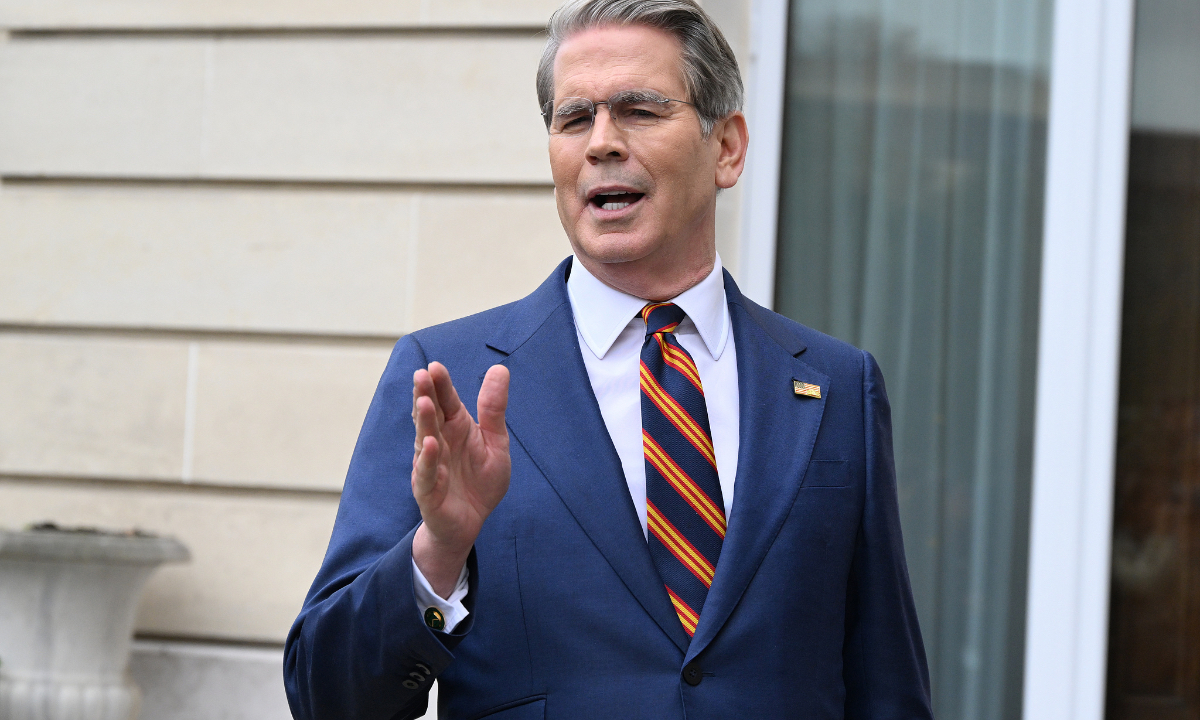
US Treasury Secretary Scott Bessent addresses journalists during a news conference at the OECD Headquarters, Monday, March 16, 2026, in Paris, France. Photo:VCG
A Financial Times report, which hinted that US President Donald Trump threatened he might postpone his China visit if Beijing does not help the US reopen the Strait of Hormuz, has drawn immediate denials from multiple senior US officials.
Analysts said the swift, coordinated pushback suggests that Washington is wary of tying the Middle East conflict to its relationship with China, recognizing that further strain would not serve US interests at a time of escalating tensions.
In an interview with CNBC's Brian Sullivan in Paris, US Treasury Secretary Scott Bessent said "if the meetings are delayed, it wouldn't be delayed because the president demanded that China police the Straits of Hormuz."
When the reporter said that "there was a report out to that effect this morning," Bessent replied "That's completely false." "If the meeting for some reason is rescheduled, it would be rescheduled because of logistics. The president wants to remain in DC to coordinate the war effort and that, you know, traveling abroad at a time like this may not be optimal," Bessent noted.
Bessent's remarks came after the Financial Times published its interview with the US president, saying that Trump was expecting China to help unblock the Strait of Hormuz before he travels to Beijing at the end of this month.
Jumping on the Financial Times report, some foreign media outlets, such as the BBC, started to hype that "Trump told the Financial Times that he might postpone the meeting if China did not help unblock the Strait of Hormuz - a critical waterway for the Gulf's energy shipments." The New York Times also followed the false narrative, saying "President Trump warned that he could postpone a meeting set to begin in just over two weeks if China refuses to help reopen the Strait of Hormuz."
When asked in the Oval Office on Monday afternoon if his trip to China was still on, Trump said, "I don't know, we're working on that right now." "We're speaking to China. I'd love to, but because of the war, I want to be here. I have to be here, I feel," Trump said. "And so, we've requested that we delay it a month or so," Trump said, according to CNBC.
White House press secretary Karoline Leavitt likewise said on Monday that changing the dates of Trump's trip to Beijing is "really just a matter of the timing" and the president is primarily focused on the war with Iran.
"Of course, the president's utmost responsibility right now as commander-in-chief is to ensure the continued success of Operation Epic Fury, as he is doing 24/7 here at the White House, here at home," she added.
Hours after Washington's categorical rejections to false reports, a spokesperson of China's Foreign Ministry also commented on the matter.
In response to a question from a Global Times reporter, Chinese Foreign Ministry spokesperson Lin Jian said on Tuesday that China has noted that the US side has already publicly clarified the inaccurate media reports by stating that the reports are completely false and emphasizing that the visit is unrelated to the issue of shipping in the Strait of Hormuz.
Lin said that China and the US have maintained communication over President Trump's visit to China, without providing more details.
Misleading rhetoric
The Financial Times and other Western media reports leave readers with the impression that Trump is pressuring China to help the US reopen the Strait of Hormuz, which are misleading, said Li Haidong, a professor at China Foreign Affairs University. The framing reflects what he describes as attempts to shift responsibility for the US-Israel conflict with Iran onto Beijing, while stoking further hostility between the two countries, Li told the Global Times.
Subsequent clarifications from US officials suggest Washington does not intend to link China-US relations to its strikes on Iran, Li said. Washington understands the importance of its relationship with China and knows that dragging it into the Middle East conflict would serve neither country's interests, he said.
The "Trump threatens to delay China visit if Beijing does not help" narrative was one of many China-related smears advanced by Western media since the breakout of the war triggered by the US-Israeli military operation against Iran.
The Diplomat published an article earlier this month headlined "Why China Won't Help Iran," claiming that "Beijing cares about the oil, not the regime."
The New York Times, jumping on the fact that the US is moving warships, missiles and air defenses for a war in the Middle East said: "China can use America's seeming disregard for the region's economic pain to argue [even more than usual] that China is the only reliable superpower."
Absurd claims from Western media such as "China remains idle on Iran" or "China could emerge as a winner" represent yet another attempt to shift blame and redirect attention, according to an opinion published by the People's Daily.
The Western media are simply applying an outdated alliance-based framework to China's partnership-based, non-aligned approach, and clings to the theory that weapons and wars can solve everything, Liu Zhongmin, a professor at the Middle East Studies Institute of Shanghai International Studies University, told the Global Times.
At its core, moving its military resources from Asia to the Middle East is part of the US' global military deployment and is not directly related to China, Liu said, noting that developments in the Middle East more broadly reflect the constraints facing US hegemonic operations, rather than an effort directed at China or an issue directly involving China.
Amid the current tensions surrounding Iran, some Western media narratives have amplified the so-called "China factor." These narratives reflect Western media's unease over China's influence in the Middle East, as they try to frame China-US relations as inherently confrontational and to escalate the perceived confrontation without giving consideration to the consequence, Liu said.
'Not our war'
Trump on Monday complained that US allies are reluctant to answer his call to join a White House-proposed multinational mission to escort oil tankers through the strait.
"We've protected them from horrible outside sources, and they weren't that enthusiastic. And the level of enthusiasm matters to me," Trump said at a press conference.
Trump especially said that he was "not happy with the UK" since British Prime Minister Keir Starmer declined to assist the US in the initial stages of the US-Israeli war with Iran.
Trump's remarks came after Starmer said the UK was working with allies on a "viable, collective plan" to reopen the strait. The UK already has minehunters in the region but there is no decision yet on what action would be taken, Starmer noted, according to the BBC.
Koizumi Shinjiro, defense minister of Japan, whom Trump named for requesting help in reopening the strait, said on Tuesday that the US side has not made concrete requests for Japan to send vessels to the Strait of Hormuz, per NHK.
Koizumi said the Japanese government is gathering information on the situation in the Strait of Hormuz with grave concern. He added that no decision has been made about whether to dispatch the Self-Defense Forces.
German Chancellor Friedrich Merz also ruled out a military involvement of Germany in protecting oil tankers in the Strait of Hormuz. During a meeting with the Dutch Prime Minister Rob Jetten in Berlin on Monday, Merz stated that NATO was a defense alliance, not an intervention alliance.
Chinese analysts said the US' call for help in the Strait of Hormuz has drawn little action from allies, but instead shown the world the growing divide between Washington and its allies.
"What does… Donald Trump expect a handful or two handfuls of European frigates to do in the Strait of Hormuz that the powerful US Navy cannot do?" Germany's defense minister Boris Pistorius said on Monday, Reuters reported.
"This is not our war. We have not started it."
RELATED ARTICLES