Don't trap portable megaphones debate in 'either/or' thinking: People's Daily Rui Ping
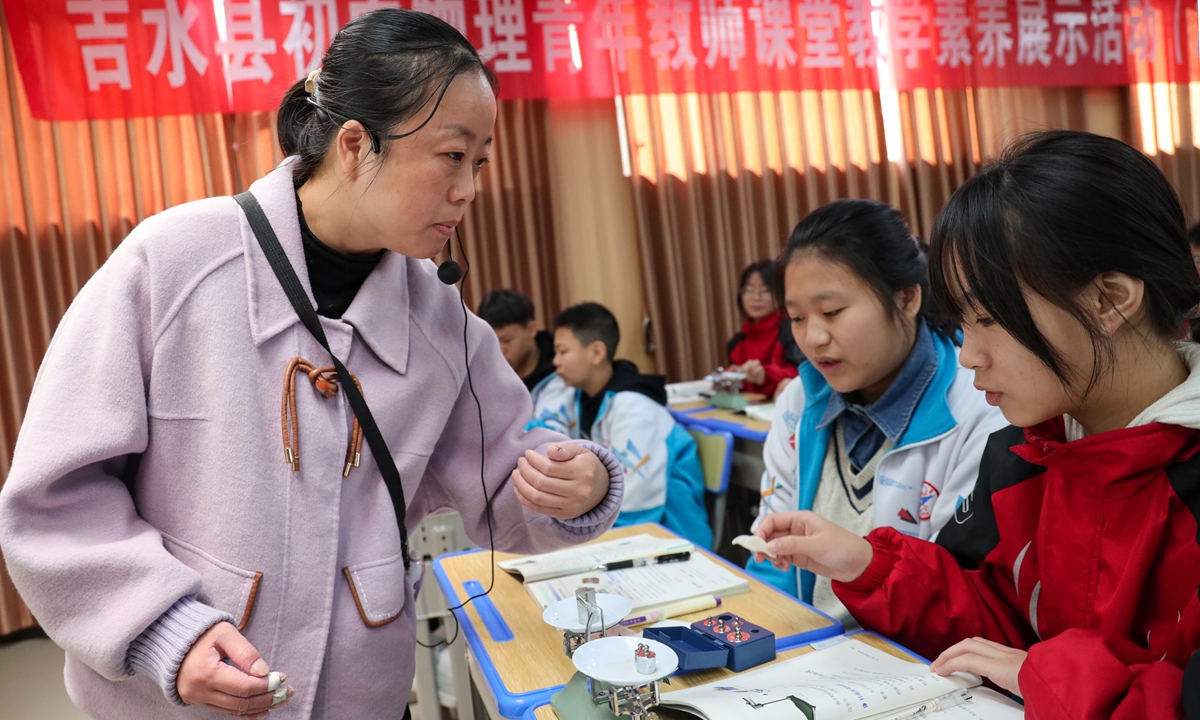
A teacher participates in a junior high school physics teaching skills demonstration at Jishui No. 3 Middle School in Jishui county, Ji'an, Jiangxi Province, on November 28, 2024. Photo: VCG
Recently, whether teachers should be equipped with portable megaphones has sparked controversy. A minor incident that sparked a wave of public debate actually reflects a much deeper clash of ways of thinking.
When approaching this question, if we fall into the "either/or" mind-set - claiming that using portable megaphones harms students' hearing, while not using them disregards teachers' rights - we will only end up in an impasse, exacerbating public division.
In teaching practice, there are already many solutions that can balance protecting teachers' voices and students' hearing. For example, installing ceiling-mounted sound field systems to ensure even audio distribution in classrooms, promoting healthy voice use and vocal care training, and regulating equipment usage and volume levels… Real life is about "problem solving," not a "multiple-choice question" with only one answer. A shift in mind-set opens up entirely new possibilities. What benefits the majority is never a forced either-or trade-off, but the proactive creation of win-win solutions.
Looking at broader social issues - from "whether to help an elderly person who has fallen," to "traditional Chinese medicine versus Western medicine," to "taste versus safety" - many public debates are often forcibly reduced to black-and-white choices that demand people take sides. This kind of thinking labels complex issues and turns diverse demands into oppositions. While it may seem clear-cut, it actually creates estrangement and provokes conflicts, doing nothing to build consensus. The very framing of the megaphone debate, for instance, is a product of this "either/or" logic.
Many issues in economic and social development carry an inherent "dilemma" nature. The key is to move beyond the either-or mindset, broaden perspectives, and elevate our thinking; only then can we turn dilemma into optimal win-win solution.
For example, guided by the philosophy that "lucid waters and lush mountains are invaluable assets," we have resolved the tension between ecological protection and economic development. By fostering new quality productive forces, we have broken the stereotype that traditional industries are inherently outdated capacity. By exploring accommodative and prudent regulation, we have moved beyond the notion that "innovation speed" and security are mutually exclusive… Cultivating systematic thinking, mastering a holistic approach, addressing contradictions through coordination, and maintaining balance while taking all factors into account, are precisely the Chinese approach to development that solves all kinds of "dilemmas."
For example, transforming ski resorts into recreational parks upgrades the ice-and-snow economy from "one season sustaining the whole year" to "thriving in all four seasons"; converting industrial heritage sites into new cultural and tourism spaces gives old resources fresh purpose; and growing grass beneath photovoltaic panels allows renewable energy and livestock farming to develop side by side. As evidenced by the vivid practices people see and hear in everyday life, mind-set determines the way forward, and vision defines the heights one can reach. Only by discovering new ways to recombine resources and forge new connections among factors of production, and by elevating our thinking, can we achieve development upgrades and open up new "blue oceans."
Moving forward, new issues and new contradictions will continue to emerge. Many topics may still be simplified into an "either-or" choice, but mature development and governance cannot be reduced to a mere "single-choice question." This requires us to view problems and the present from a higher dimension and over a longer horizon, to actively embrace complexity, and to proactively seek optimal solutions. By taking a more balanced approach, being realistic and pragmatic, and upholding fundamental principles and breaking new ground, we can find the greatest common ground among diverse demands and continuously open up new avenues for development.
This article was originally published by the Opinion Department of the People's Daily. opinion@globaltimes.com.cn
RELATED ARTICLES