World’s largest-diameter underwater shield tunnel achieves dual breakthrough in China
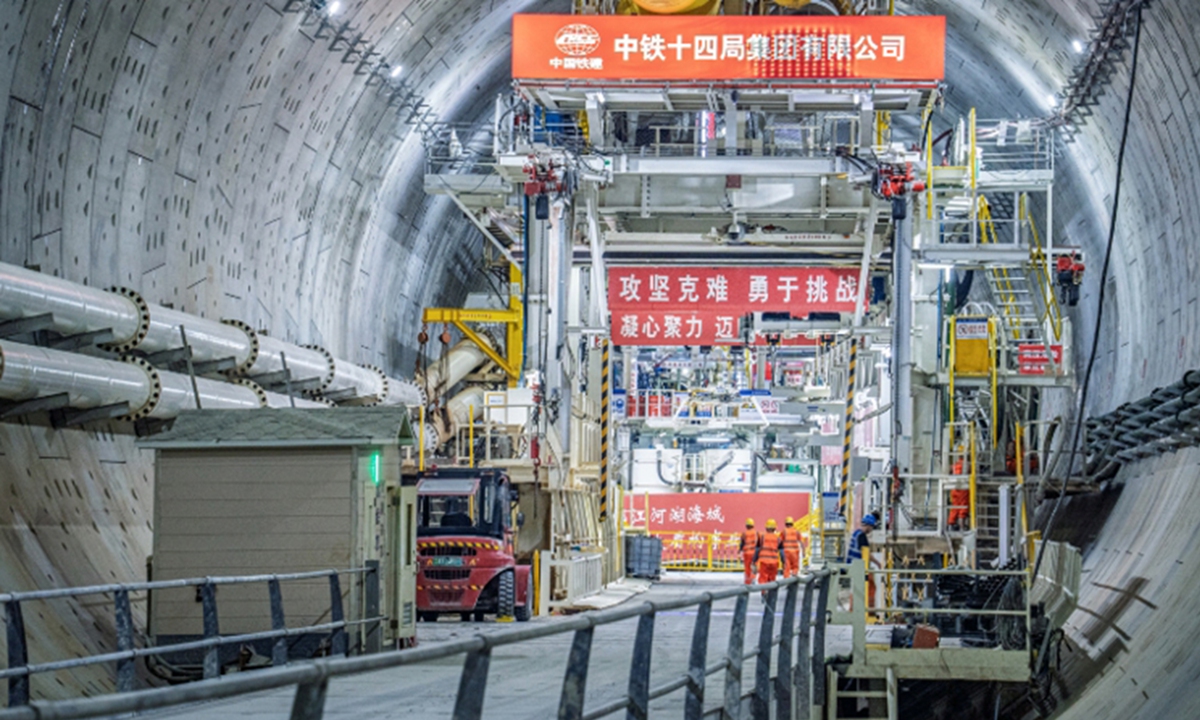
The Huanggang Road Yellow River Tunnel, which is the world's largest-diameter underwater shield tunnel, serves as a key transportation link in Jinan, East China's Shandong Province. Photo: Courtesy of China Railway 14th Bureau Group
With the final cast-in-place roadway slab poured, the upper deck of the Huanggang Road Yellow River Tunnel in Jinan, East China's Shandong Province was fully completed on Tuesday, marking the dual breakthrough of the world's largest-diameter underwater shield tunnel, according to the Xinhua News Agency.
The Tunnel stretches 5.75 kilometers, with about 3.3 kilometers constructed using the shield tunneling method. The project deployed the "Shanhe" shield machine, featuring an excavation diameter of 17.5 meters. Designed as a single-bore, double-deck tunnel, it accommodates six lanes across two levels, with a speed limit of 60 kilometers per hour.
The Global Times learned from the construction contractor that the shield machine boasts an excavation cross-sectional area of 240 square meters, larger than half a standard basketball court. Each advance ring generates around 1,200 cubic meters of slurry, posing significant handling challenges. To address this, the project team pioneered an integrated system combining flocculation and concentration, and filter pressing, boosting treatment efficiency while enabling tailwater recycling and zero discharge.
Zhou Xiang, a senior engineer with China Railway 14th Bureau Group and the project's chief technical expert, explained that following the primary tunnel lining, secondary structural works are required inside the tunnel. The upper roadway slab, installed at the tunnel's central section, effectively divides the bore into two levels and serves as the structural "backbone" for upper-deck traffic, per Xinhua.
"Construction of the upper slab takes place within the confined space of the shield tunnel, where numerous embedded components of varying types must be precisely installed. Positioning errors must be controlled within millimeter-level tolerances," Zhou said.
To overcome these challenges, the project team adopted a modular design and an independent traveling system, integrating formwork assembly, movement, positioning and synchronized casting. Multiple platforms operated in parallel, forming an assembly-line process for reinforcement binding, formwork installation and concrete curing, significantly boosting efficiency. Meanwhile, a reserved lower-level transport corridor ensured smooth material and personnel flow, mitigating cross-operation interferences and enabling parallel construction and logistics.
Another engineer involved in the project told the Global Times that the tunnel is also China's first single-bore, double-deck shield tunnel to pass beneath the Yellow River. The development and application of technologies helped to overcome challenges posed by complex geological conditions. Notably, the project achieved a continuous 3.3-kilometer excavation beneath the Yellow River without cutterhead replacement, an unprecedented feat under such conditions.
The team achieved a peak daily advance rate of 18 meters and a monthly advance of 426 meters, setting new records for 17-meter-class shield tunneling. The integrated construction technology system developed through the project is expected to further enhance China's capabilities in building ultra-large-diameter shield tunnels, consolidating its global leadership in the field.
RELATED ARTICLES