Photo:VCG
Editor's Note:
Currently, China's economy is steadily advancing along the path of high-quality development, even as domestic and international circumstances become increasingly complex. Some Western media outlets, due to misunderstanding or bias, have repeatedly questioned or even distorted China's economic development. Accordingly, the Global Times has launched the "Q&A on China's Economy" column to publish opinion pieces to present facts and clarify perceptions.
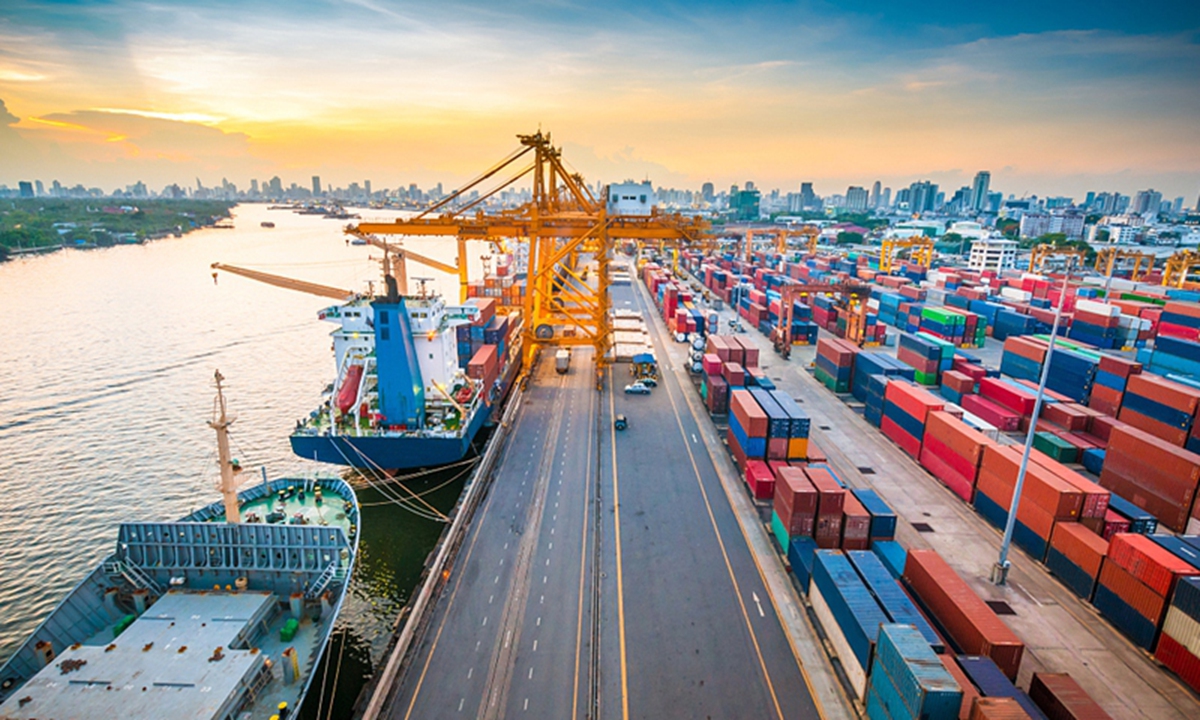
Recently, some Western public voices have once again interpreted China's economy through the lens of "export determinism." They argue that uncertainties from US tariff policies and the global ripple effects triggered by the spillover of Middle East conflicts will directly squeeze China's export space. On this basis, they predict that China's economy will slow sharply due to a "weakening export engine," and even interpret China's adjustment of its gross domestic product (GDP) growth target to a range of 4.5 percent to 5 percent as a signal that its "old growth model is unsustainable." Such judgments fail to grasp either the basic logic of China's economic performance or the real direction of its growth momentum transformation.
The so-called "export determinism" mainly stems from an outdated impression of China as a "low-cost manufacturer." As one of the "three drivers" propelling economic growth, foreign trade has indeed played an irreplaceably important role in stabilizing the economy, expanding employment and enhancing international competitiveness. However, with China's economic transformation and upgrading, domestic demand has become a significantly stronger pillar of development. China's foreign trade dependence has declined from 59.2 percent in 2008 to 32.7 percent in 2025. Final consumption expenditure accounts for 52 percent of GDP, while domestic demand contributes 67.3 percent to China's economic growth.
Against this backdrop, China's export growth is increasingly underpinned by technology, branding, system integration and industrial chain support capabilities, rather than low-end processing and price competition. Today's prosperity in China's exports reflects the rising overall strength of its domestic industries - an overflow of industrial upgrading, technological accumulation and market cultivation onto the global stage. In other words, China's exports and its overall economy are engaged in a mutually reinforcing relationship, rather than a simple case of "exports determining growth."
New energy vehicles (NEVs) serve as the most representative example. In 2025, China's auto sales reached 34.4 million units, including 16.49 million NEVs, accounting for 47.9 percent of total new vehicle sales; the penetration rate of domestic NEV passenger cars is 53.9 percent. Building on this solid foundation, China's total vehicle exports hit 7.098 million units in 2025, up 21.1 percent year on year, among which NEV exports reached 2.615 million units, surging 103.7 percent year on year. This shows that the global competitiveness of China's automobiles, especially NEVs, was not first "fed" by overseas markets. Instead, it was forged through technological iteration, scale expansion, cost optimization and scenario validation in China's huge domestic market before going global at an accelerated pace. Therefore, China's development has shaped exportable products, rather than exports shaping China's development.
Because of quality improvements, an ultra-large domestic market, a complete industrial system and diversified trading arrangements, China's foreign trade has repeatedly broken through external pressures and maintained steady growth. In early 2025, Washington launched "reciprocal tariffs," severely disrupting the international economic order. Despite the complex and grim external environment, China's exports did not "collapse" as some predicted. Instead, they stabilized before picking up, finally posting a 6.1 percent year-on-year growth, with the annual total value of imports and exports hitting a new record high. In the first two months of this year, China's goods trade imports and exports growth returned to double digits at 18.3 percent year-on-year, with exports surging an above-expectation 19.2 percent, achieving a "strong start" to the first year of the 15th Five-Year Plan (2026-30) period.
Admittedly, in 2026, there are still numerous destabilizing and unpredictable factors in the external environment, and pressure to stabilize foreign trade persists. However, China's economy has a solid foundation with many advantages, strong resilience and great potential; the conditions underpinning its long-term positive trend remain unchanged. In 2025, China's exports featured clear trends toward higher quality and new sectors: exports of high-tech products reached 5.25 trillion yuan ($752.6 billion), up 13.2 percent year-on-year; exports of the "new three" - electric vehicles, lithium-ion batteries and solar cells - rose 27.1 percent, exports of green products such as wind turbine units increased by 48.7 percent, and exports of Chinese homegrown brands rose 12.9 percent. This means China's foreign trade will stay steady in the future and continue to play an important role in the national economy.
To assess China's economy, one must look not only at ports and orders, but also at shopping malls, consumption, investment, employment and expectations; not only at the scale of foreign trade, but also at innovation input, industrial upgrading and institutional supply. Misreading and distorting the operating logic of a mega-sized economy into a simplistic linear narrative - "when exports thrive, the economy thrives; when exports weaken, the economy weakens" - is itself a key reason why some foreign media repeatedly make inaccurate judgments.
RELATED ARTICLES