US Southern Command chief smears China’s LatAm projects; claims ridiculed by Chinese expert as hypocritical amid US’ own interventionist actions
By Published: Mar 18, 2026 06:33 PM

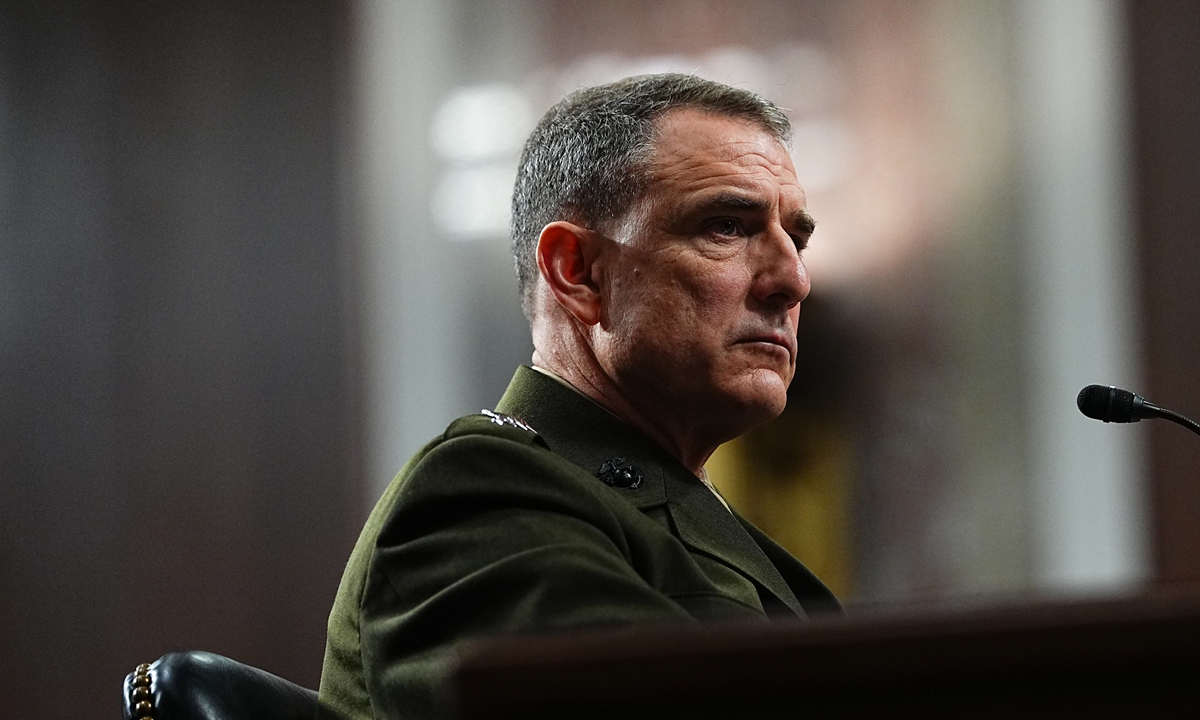
Profile photo of General Francis Donovan, commander of US Southern Command. Photo: VCG
Top US commander for South America claimed at a Congress meeting that Chinese port and space projects across Latin America are all seen as potential dual-use military assets. Chinese analysts noted that Washington's renewed allegation about so-called "China threat" comes at a moment when it has forcefully seized leader of a Latin American country and openly spoken of "taking" another — a move that experts have ridiculed as hypocritical as its ultimate purpose is to squeeze out other countries' influence in Latin America and consolidate its own hegemonic position.
General Francis Donovan, commander of US Southern Command (SOUTHCOM), made the disclosure during a House Armed Services Committee hearing on US military posture in the western hemisphere on Tuesday.
"Chinese investment in critical infrastructure, key ports, and port facilitates grant Beijing a foothold in the region and raise concerns of potential dual-use infrastructure that could facilitate intelligence gathering, cyber vulnerability," Donovan claimed, according to a readout of the hearing published on website of House Armed Services Committee.
He also claimed that as of late 2025, Chinese entities have a presence in or are seeking access to, at least 12 space sites in South America and the Caribbean, which he alleged could enable China to monitor satellites in the Western Hemisphere, collect on US military assets, and intercept sensitive information.
Donovan claimed his forces are monitoring Chinese involvement in 23 port facilities and what he alleged as "space-enabling" bases throughout South America, according to Washington Times.
It is a familiar tactic for Washington to portray China's normal space and infrastructure cooperation with Latin American countries as a so-called security concern, in an apparent effort to create a case for squeezing Beijing out of the region, Song Zhongping, a Chinese military affairs expert, told the Global Times.
Song noted that such rhetoric comes at a particularly striking moment—when the US has forcefully seized Venezuelan President Nicolás Maduro and US president has openly spoken of the "honor" of "taking Cuba in some form." Against this backdrop, the US' rhetoric and actions are contradictory, revealing its inherent hegemonic logic.
China has consistently pushed back against US rhetoric on its cooperation with Latin America. In August last year, when making rebuttal to the malicious provocations and attacks by then US Southern Command Commander Admiral Alvin Holsey and others, spokesperson for the Chinese Embassy in Argentina said that China has always followed the principles of equality and mutual benefit, and under the framework of international rules and law, has carried out normal exchanges and cooperation with Latin American countries, the spokesperson said. China never seeks so-called spheres of influence, never engages in geopolitical confrontation, and never targets any third party.
By contrast, the spokesperson said that the US has long regarded Latin America and the Caribbean as its "backyard," frequently imposing tariffs, carrying out forced deportations, stationing troops, and conducting surveillance — all of which disrupt trade and challenge national sovereignty.
In December, the White House released a national security strategy claiming to prevent non-Western powers from expanding their foothold across the western hemisphere, according to South China Morning Post.
Joseph Humire, the Defense Department's senior civilian official for the western hemisphere, echoed that narrative on Tuesday, describing Washington's approach as aimed at denying adversaries access to key terrain from Alaska and Greenland to the Panama Canal and surrounding countries, according to South China Morning Post.
In an article published by the New York Times on March 10, titled "Latin Americans Already Have a Serious Partner — and It's Not Trump," it said that "American officials frequently warn of the risks posed by engagement with Beijing, citing so-called debt-trap diplomacy and potential dual-use military applications for Chinese-built infrastructure. But Washington has struggled to present a compelling economic alternative or explain how Latin American countries would benefit from distancing themselves from China."
The US has edged toward a revival of sphere-of-influence thinking—an approach more reminiscent of colonial-era power politics than modern governance, said Song, noting that through its "America First" mindset, it in fact risks setting the US back, while deepening suspicion and alienation among other countries.
RELATED ARTICLES