World’s first robot eldercare center launches in Beijing
Nation’s silver economy propelled by cutting-edge AI technologies
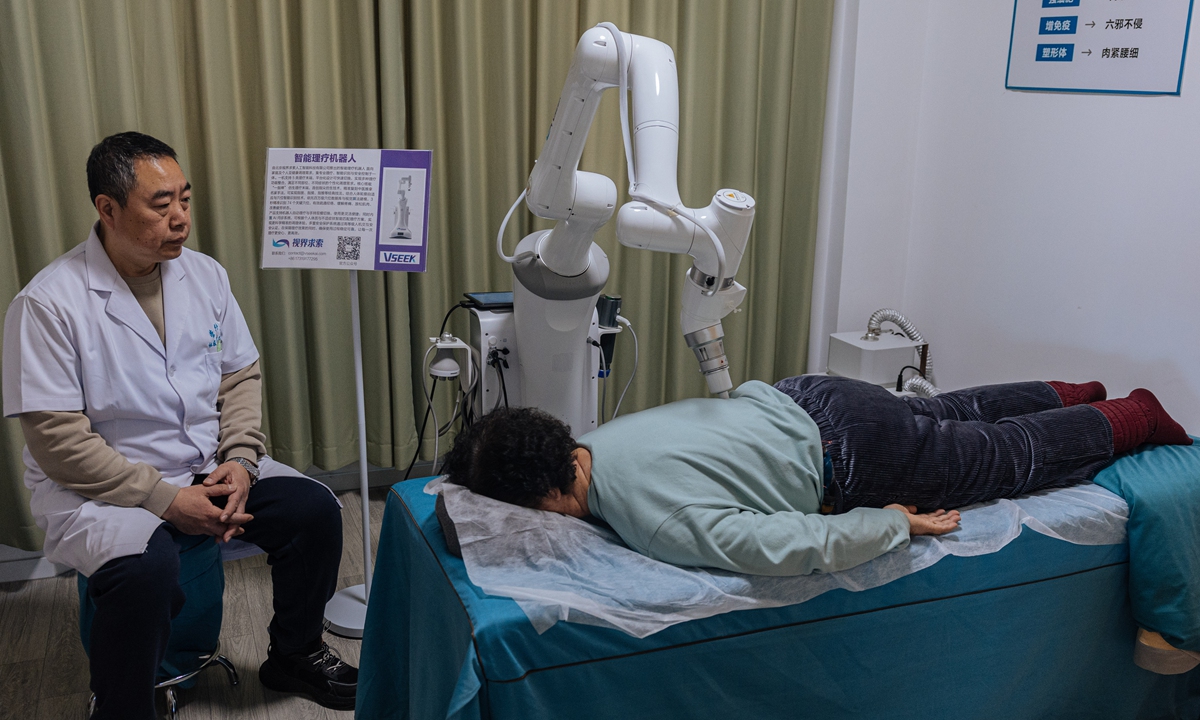
An elderly resident receives a massage from a robot under the supervision of a caregiver in a smart elderly care center in Beijing on March 18, 2026. Photo: Li Hao/GT
In a quiet residential neighborhood in Beijing Economic Technological Development Area (E-Town), an unassuming four-story building is drawing attention from China's tech and investment circles. The facility, recently put into operation, is billed as the world's first smart elderly care center powered by robotics and artificial intelligent devices, combining silver economy services with real-world applications of edge-cutting technology.
During a group interview arranged by the center on Wednesday, the Global Times observed that the many local residents were dining or relaxing at the elderly care center. The operator said they received about 300 customers per day recently.
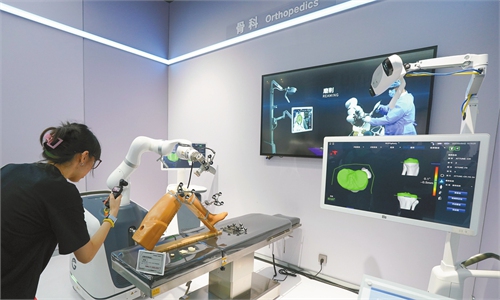
The center integrates three core functions — basic care services, robotic applications and age-friendly upgrades — forming a comprehensive "technology + elderly care" model. With a total floor area of about 1,100 square meters, it brings together more than 40 robotic products developed by 24 companies, providing a live testing ground for China's rapidly expanding robotics industry in elderly care sector, according to the center.
Inside, robots and AI embedded into everyday routines. On the ground floor, residents place orders through a smart system as cooking robots prepare meals with standardized precision. Delivery robots glide between tables, completing service with minimal human intervention. One floor up, a childcare zone introduces companion and educational robots designed for infants, reflecting a cross-generational service model.
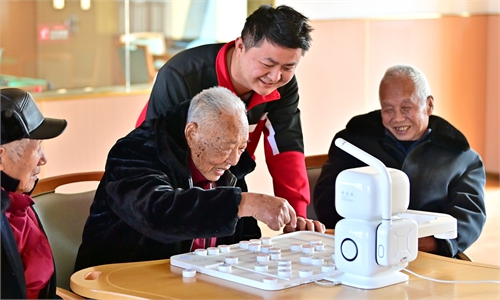
The third floor functions as the operational core of the center. Rehabilitation, health monitoring and daily care are integrated into a single space. Robots for massage and moxibustion, a form of treatment that entails the burning of mugwort leaves, provide therapy, diagnostic devices conduct health checks, and exoskeleton systems assist with mobility training. Nearby, chess-playing robots and automated tea-making machines create a relaxed social environment, blending healthcare with daily life.
Xia Jing, CEO of Beijing VISION SEEK (VSEEK) Artificial Intelligence Technology Co, told the Global Times on Wednesday that the company's traditional Chinese medicine massage robot, which is deployed at the center, is equipped with a database of acupuncture points and can identify positions on the human body. By learning and replicating therapists' techniques, the system offers 15 treatment programs tailored to different needs.
The massage robot has undergone multiple rounds of testing, including human trials, to ensure safety, according to Xia. "It began operations at the center in February, with each session lasting 20 to 30 minutes. We are continuing to collect user feedback to refine the system, and it performs well so far," she said.
Another two devices drawing attention are non-contact AI health monitoring system developed by Beijing-based tech firm YAOYAN AI. Using a camera to analyze facial blood flow, it can assess more than 50 health indicators, including sleep quality, anemia risk and blood oxygen levels, and also supports early-stage screening for Alzheimer's disease.
Zhang Zhixiang, chairman of the company, said the system achieves an accuracy rate of over 85 percent. While positioned as a preliminary screening tool rather than a replacement for clinical diagnosis, it is suitable for large-scale health checks in settings such as factories and schools, he said.
The center's health advisor, Professor Jing Huiquan from Capital Medical University, told the Global Times that she highly appreciates the transformative impact of technology on elderly care and daily life, while emphasizing that that humans and machines must work collaboratively in care settings.
For example, moxibustion robots require time to start, so staff can use infrared lamps to keep residents warm and comfortable, preventing any discomfort. Such human-centered adjustments, guided by medical expertise, cannot be handled by robots alone, she said.
Since the operation of the center about a week ago, the impact of surround residents is already visible. An elderly resident surnamed Zhang said she visits the center almost daily for therapy, noting that the smart dining system is "convenient and practical."
Another resident, a 71-year-old surnamed Jia, had just completed a tai chi session guided by an interactive fitness mirror. She said the center offers a wide range of activities, from robotic exercise coaching to health lectures and handicraft sessions by human staff, helping improve both physical and mental well-being.
Jia also expressed strong interest in adopting new technologies. After trying the non-contact AI health monitoring system, she said the ability to assess health conditions through a simple facial scan significantly improves efficiency compared with traditional blood tests.
To ensure accessibility while maintaining operations, the center has adopted a mixed pricing model. Basic services, including health monitoring and companion robots, are provided free of charge, while advanced rehabilitation services such as massage and moxibustion are fee-based, according to Zhang Li, an official with the local public services office.
The project is rooted in Beijing E-Town's broader industrial ecosystem. The area hosts more than 300 robotics companies, with an industrial scale exceeding 10 billion yuan ($1.4 billion). Local officials said that by the end of 2027, they plan to establish at least 10 benchmark smart complexes, implement 100 specialized AI models, and gather 1,000 core AI companies.
The launch of the center not only reflects local industrial strengths but also provides a real-world platform for product testing and commercialization, said analysts.
Looking ahead, the center plans to introduce a rental model for high-cost devices such as exoskeletons, allowing residents to try them before wider adoption. It also collaborates with world's first humanoid robot 4S store in Beijing E-town, rotating devices for trial use and selecting those with strong feedback for long-term deployment, said Zhang.
Wang Tianlei, a representative from the humanoid robot 4S store told the Global Times on Wednesday that real user feedback cannot be obtained in office settings. "The elderly care center serves as both a pilot platform and a demand collection channel," he said, noting that it helps robot companies refine products based on real-world needs.
RELATED ARTICLES