Nvidia to ‘restart’ H200 production for China; analyst says its chips have shifted from ‘essential’ to ‘optional’
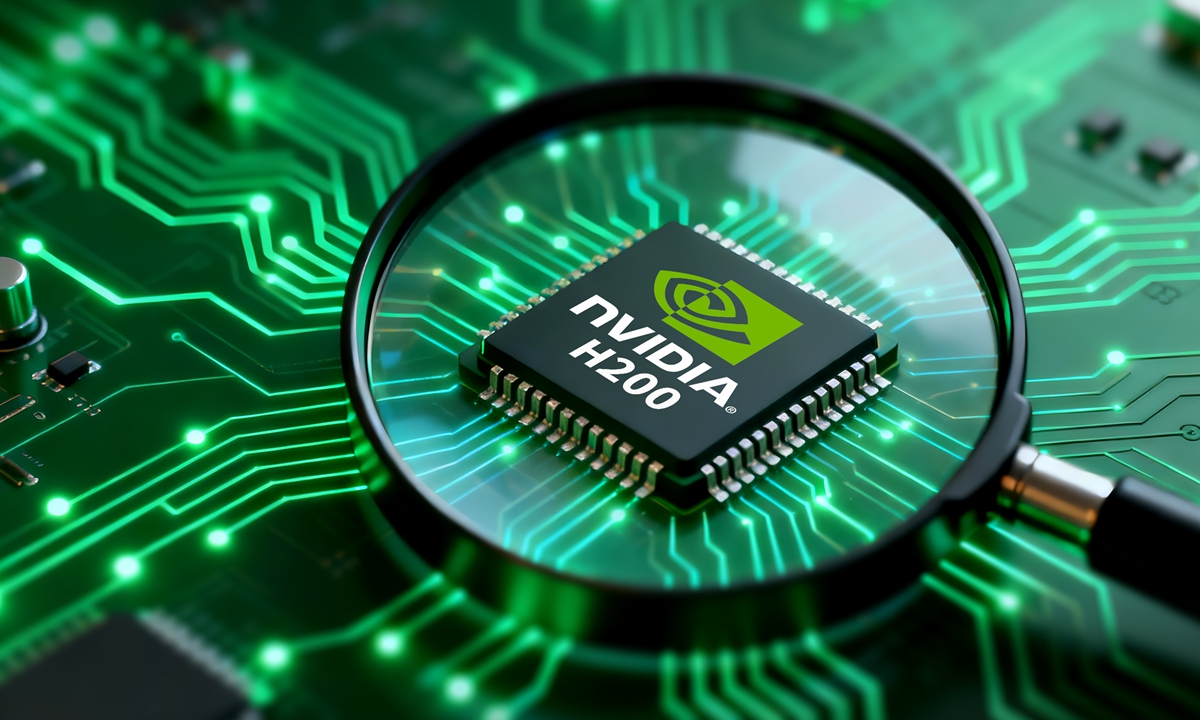
Nvidia H200 chip Photo: VCG
Nvidia announced on Tuesday (local time) that it is resuming production of artificial intelligence (AI) chips for the Chinese market after its pause earlier this year due to uncertainty around regulatory approval, CEO Jensen Huang said at the GTC 2026 conference this week, multiple foreign media outlets including the Financial Times reported.
According to a Bloomberg report on Wednesday, Huang said that the company is firing up manufacturing of H200 AI accelerators for customers in China, a move he portrayed as the latest effort to reenter the vital market.
A Chinese expert said that Huang's repeated emphasis on returning to China underscores the market's strategic importance to Nvidia, and reflects growing anxiety at the US chip giant over the rapid rise of China's domestic semiconductor capabilities.
Ma Jihua, a veteran industry analyst, told the Global Times on Wednesday that although Nvidia chips remain in demand, their role has shifted from being "essential" to merely "optional." As domestic production ramps up, China's goal of AI chip self-sufficiency has become increasingly attainable, and the country's dependence on a single foreign supplier is steadily diminishing. In many application areas, China now has sufficient computing power to support its AI development.
At a press conference on Tuesday, Huang said that Nvidia had been licensed for "many customers in China" for H200 sales and is in the process of "restarting our manufacturing." That outlook is different than it was a couple of weeks ago, he said. "Our supply chain is getting fired up," Bloomberg reported.
The company halted production last year of its H200 chip because of increasing regulatory hurdles in the US and China, Reuters reported.
However, Huang told CNBC in an interview on Tuesday that "the company now has clearance from both sides."
"It's different than it was two weeks ago or three weeks ago," he said.
Reuters also reported on Tuesday, citing two sources familiar with the matter, that Nvidia is preparing a version of its Groq AI chips that can be sold to the Chinese market.
"The chips being readied for China are not downgraded versions or made specifically for the Chinese market," one of the sources told Reuters. But the new variant can be adapted to work with other systems, the source said, adding that the Groq chip is expected to be available in May, according to Reuters.
The move to develop a version of the chips for the Chinese market, combined with Huang's latest announcement about restarting production of its H200 chips for China, signals that it is very eager to reenter the Chinese market because of its size and value, and that the US company is anxious about the consequences of the rise of China's chip industry, Ma stated.
Ma said that Huang has repeatedly said that China is irreplaceable for companies such as Nvidia. "China is the largest single market for semiconductors and a major source of demand for AI chips. Losing meaningful access would create a revenue gap for Nvidia," Ma said.
According to a Wall Street Journal report, the status of the H200 in China was unclear prior to Tuesday. The article cited Nvidia's most recent earnings report, in which the company said that although it had received approval to ship "small amounts of H200 products" to China, "to date we have not generated any revenue" from those sales.
Ma noted that uncertainty created by US export controls, perceived security risks among Chinese customers about US-made chips, and fierce competition in China will make it difficult for the company to regain its position in the Chinese market.
The expert said that uncertainty in US policy has affected Nvidia's sales to China, and the US government's capriciousness on chip controls has become the biggest systemic risk. He also stressed that security concerns about Nvidia's chips represent another hurdle. Nvidia must fully demonstrate that its products are safe and have no backdoors, otherwise Chinese firms will find it hard to buy with confidence, Ma explained.
Moreover, China's AI‑chip development and production have accelerated, and domestic alternatives are becoming more viable across a range of applications, Ma said, adding that China's independent chip research and development capabilities are rapidly improving, and production is scaling up, which means that Nvidia is no longer irreplaceable in the Chinese market.
RELATED ARTICLES