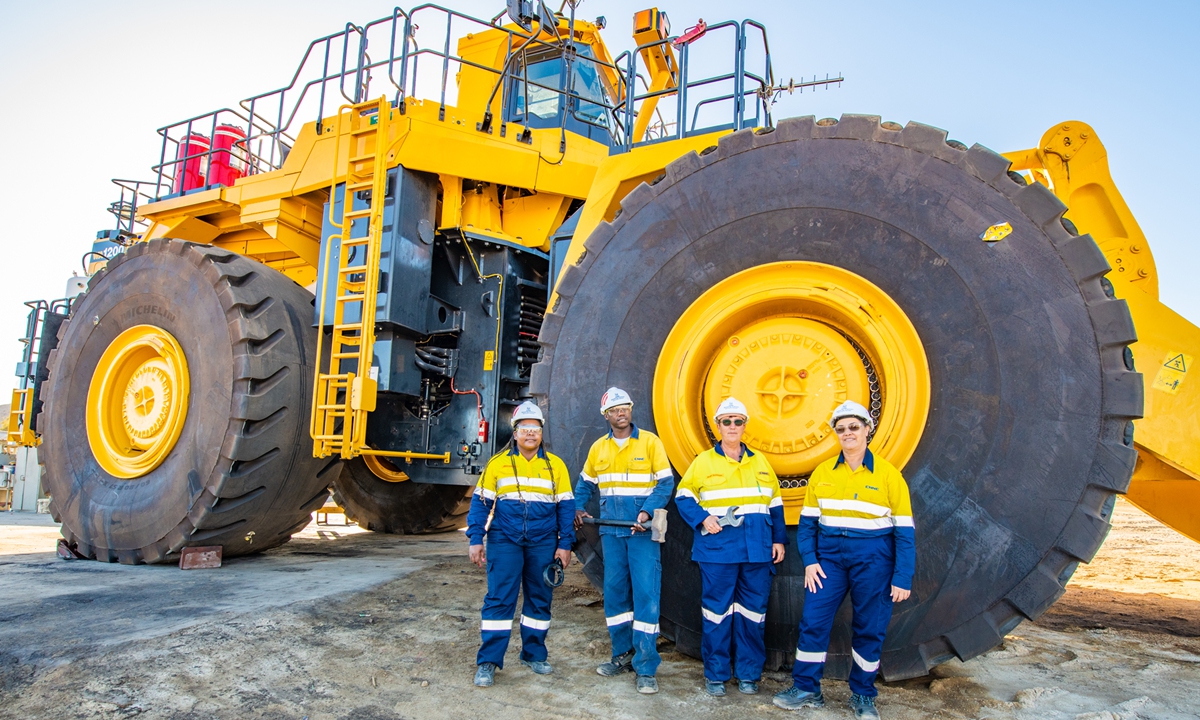
Namibian employees at Rossing Uranium Mine pose for a photo with a giant piece of mining equipment. Photo: Courtesy of China National Nuclear Corporation
Editor's Note:The blueprint of China's 15th Five-Year Plan (2026-30) has been unfolded. This top-level design for China's economic and social development over the next five years not only outlines the macro path for high-quality development, but also connects deeply with the endeavors and lives of every industry and every individual.
The Global Times is launching a series titled "Our Five-Year Blueprint" to record stories of people from all walks of life, hearing the firm footsteps of a national strategy becoming reality, witnessing heartwarming moments of improving livelihoods, and seeing a vivid portrayal of "extensive consultation, joint contribution, and shared benefits." Through these stories, we aim to capture how this grand national blueprint is being translated into our own real, living stories.
At 7 am, the starting gun fired, igniting vitality in Swakopmund, Namibia.
On March 7, the 35th Rossing National Marathon Championship (Rossing Marathon) - one of the country's oldest sports events - kicked off, with nearly 5,000 runners of different nationalities and ages racing ahead with passion.
This race resonates with the fate of a mine. Celebrating the 50th anniversary of the Rossing Uranium Mine's commissioning, the event, themed "Racing Along the Silk Road, Embarking on a Nuclear New Journey," shared the marathon's passion with runners worldwide.
As the world's longest-operating large open-pit uranium mine, Rossing Uranium Mine accounts for approximately 5 percent of global uranium supply and has long been a standout example of China-Namibia cooperation.
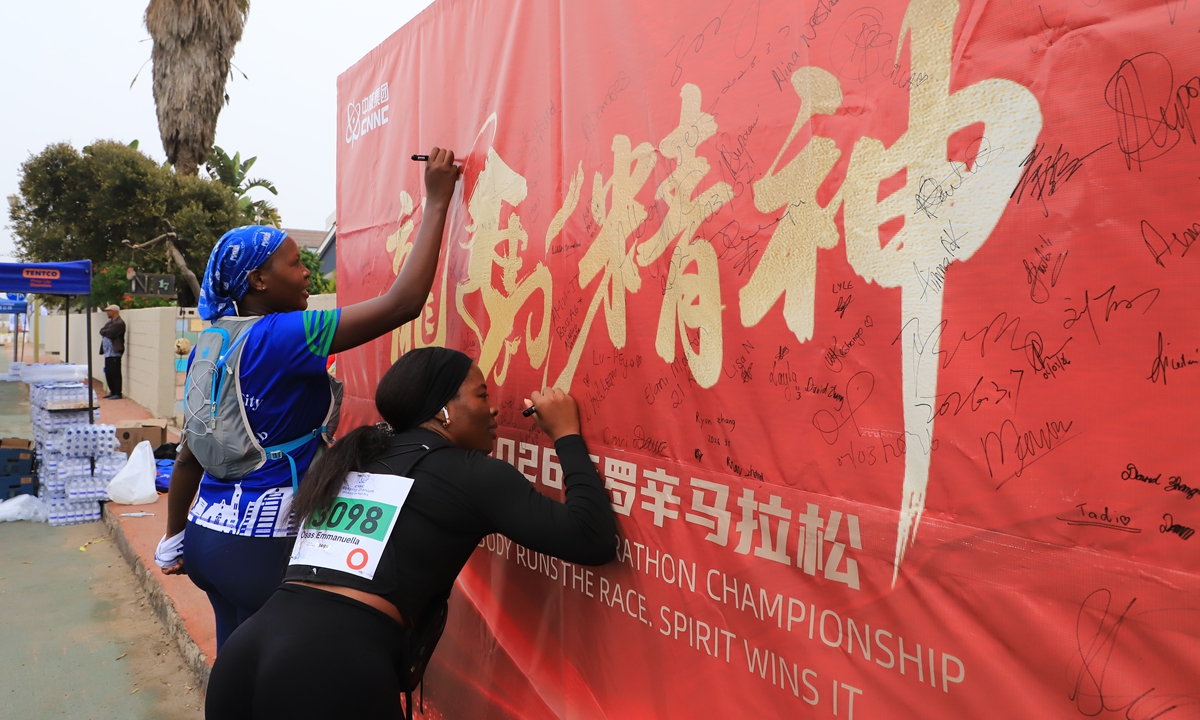
Participants of the 35th Rossing National Marathon Championship signed a signature wall at a Chinese-sponsored water station on March 7, 2026. The wall bore the Chinese characters for "Long Ma Jing Shen (Dragon-Horse Spirit)," a phrase symbolizing unwavering determination and relentless effort. Photo: Courtesy of China National Nuclear Corporation
However, back in 2019, the mine faced plummeting output and operational crises due to market volatility and aging equipment.The turnaround began with the arrival of a Chinese professional team. The Chinese enterprise, bringing technology, expertise, and sincerity, took root in the desert, revitalizing this aging mine on the brink of closure.
"Chinese companies are not just resource developers, but long-term partners committed to growing together with Namibia," Chang Jingtao, general manager of Namibia Minerals Ltd., a subsidiary of China National Nuclear Corporation (CNNC)'s China National Uranium Co., Ltd., told the Global Times.
While runners surged along the marathon route, Chang closely followed another important event: the national "two sessions" in Beijing. For Chang and his colleagues at the mine, the call "Promoting high-standard opening up and creating new horizons for mutually beneficial cooperation" - set out in the outline of the 15th Five-Year Plan approved at the closing meeting of the fourth session of the 14th National People's Congress - is not a distant goal, but a tangible development aspiration.
At this year's "two sessions," Xin Feng, member of the National Committee of the Chinese People's Political Consultative Conference (CPPCC) and deputy general manager of CNNC, focused on nuclear power's "going global" strategy. He suggested strengthening top-level coordination for nuclear energy exports, accelerating supporting policies for special financing and insurance, and enhancing China's overall competitiveness in nuclear power exports.
According to Xin, nuclear energy's "going global" is a crucial support for expanding high-standard opening-up, high-quality Belt and Road cooperation, promoting major-country diplomacy with Chinese characteristics, and building a community with a shared future for mankind. The current global resurgence of nuclear energy presents new opportunities for China's nuclear power expansion abroad. Nuclear power exports can significantly enhance the energy security of target countries and, through high-quality bilateral cooperation, serve local economic and social development.
From the 20th National Congress of the Communist Party of China (CPC), which proposed to "speed up the planning and development of a system for new energy sources," to "move faster to develop a new type of energy system" during the 15th Five-Year Plan period, through these practical cooperation efforts, through these practical cooperation efforts, China, powered by its continuously accumulating strength and technological advancements, is sharing development opportunities and technological advances with its partners, working together to build a cleaner, safer, and more sustainable energy future.
Rebirth of a mine under win-win commitment
During the interview with the Global Times, Chang shared a meaningful detail: every employee's safety helmet at Rossing Uranium Mine bears the slogan "Working for Namibia."
"This slogan was first introduced when the mine was founded, but discontinued due to strategic adjustments. After we took over the struggling mine in 2019, we deliberately revived it," Chang explained. "This is not nostalgia - it's a clear commitment: Chinese enterprises here are not just resource extractors, but long-term partners determined to grow with Namibia," he said.
This helmet slogan has reassured local employees. The mine has been revitalized: today, Rossing Uranium Mine stands as one of the most influential and highest-trade-volume projects in China-Namibia economic cooperation. It directly employs over 2,000 local people and supports the livelihoods of tens of thousands more through upstream and downstream industrial chains.
Johan Coetzee, managing director at the Rossing Uranium Mine, praised the remarkable transformations brought by the Chinese enterprise: "With technological empowerment including AI, we can operate for at least another 50 years."
For local communities, the slogan represents tangible opportunities and benefits. Many local workers have grown from apprentices to technical backbones, using their salaries to build new homes and send their children to university. Through the Rossing Foundation, the company invests nearly 40 million Namibian dollars ($ 2.36 million) annually in teacher training, youth entrepreneurship, environmental protection, and the construction of hospitals and schools, ensuring local people share in development gains.
Namibian President Netumbo Nandi-Ndaitwah previously inspected the uranium mine and highly praised the fact that Rossing Uranium Mine has consistently fulfilled its corporate social responsibility by caring for surrounding communities and practicing sustainable, safe operations, which aligns closely with the government's strategy for sustainable development, demonstrating the transformative role responsible enterprises play in building a more inclusive and resilient Namibia.
Chang said his expectations for 2026, the first year of the 15th Five-Year Plan period, are concrete: He hopes the sustainable development opportunities and shared industrial upgrading opportunities empowered by the company's core technology can further benefit Namibia and neighboring countries.
"This aligns with the important cooperation signals China's 15th Five-Year Plan releases to Africa, and also highly corresponds with the development goals of the African Union Agenda 2063, reflecting China's philosophy of expanding high-standard opening-up and sharing development achievements with the world," he said.
National calling card
Chang described his years in Namibia with the phrase "Physically overseas, heart connected to the motherland." He emphasized that "Chinese enterprises abroad are the outposts of China's high-standard opening up. Behind every solid step we take lies decades of advanced nuclear technology and clear strategic guidance from China's nuclear industry."
China's confidence in nuclear power "going global" stems from decades of accumulated technological strength. From the 1991 grid connection of Qinshan Nuclear Power Plant - China's first self-developed nuclear power plant, to the global deployment of Hualong One, the world's most deployed third-generation nuclear reactor technology, China's nuclear industry has evolved from a national pride to a national calling card.
"Nuclear energy technology is the commonwealth of human society. We have a responsibility, within the framework of peaceful nuclear energy use, to serve the world with our technology," Xin said.
Xin told the Global Times that over the past few decades, CNNC has evolved through stages of introducing, absorbing, and re innovating technologies. It has upgraded from exporting basic research facilities in the early days to a full industry chain export model led by self developed nuclear power brands such as Hualong One.
To date, the corporation has successfully exported 7 nuclear power units and 7 research reactors overseas, providing solid support for the energy security of host countries, Xin said.
China's nuclear power globalization journey epitomizes central state-owned enterprises' efforts to serve national strategies and deepen international cooperation.
As early as 2021, the State-owned Assets Supervision and Administration Commission (SASAC) revealed that central enterprises had established more than 8,000 institutions and projects in over 180 countries and regions around the world. Collaborating with enterprises of all ownership types in industrial parks, energy and power, communications, and other fields, they have created a comprehensive industrial chain export model.
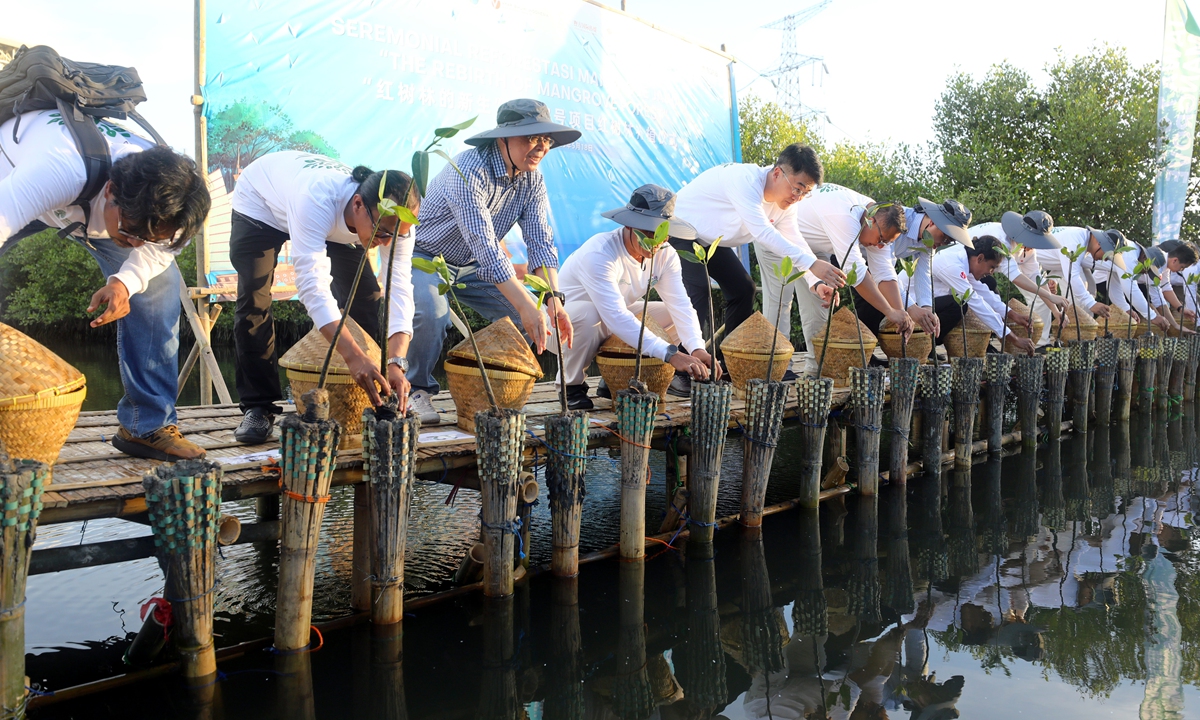
Employees of a Chinese enterprise take part in a mangrove conservation and planting activity in Banten Province, Indonesia, on May 18, 2025. Photo: VCG
Beyond exporting technologies, standards, and management expertise, they have truly benefited local communities by creating jobs, fostering industries, and improving people's livelihoods.In March 2026, two scenes separated by vast distances resonate in harmony: the policy discussions at Beijing's Great Hall of the People and the hum of machinery at the Namibian desert mine.
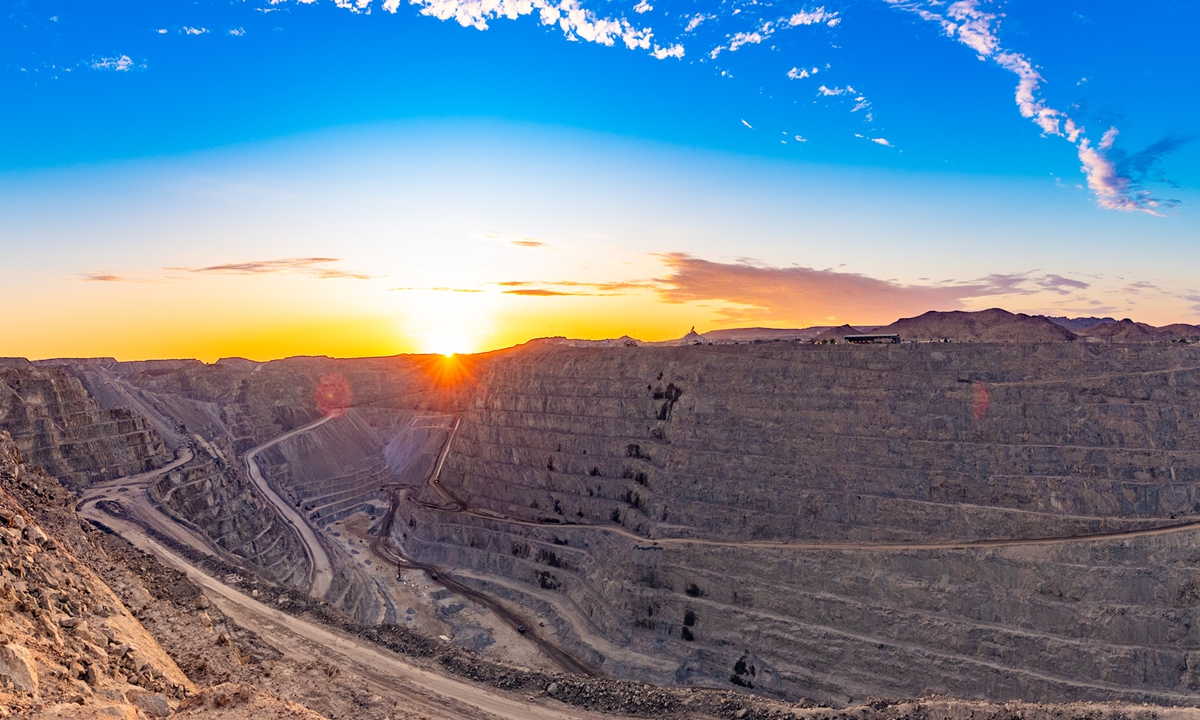
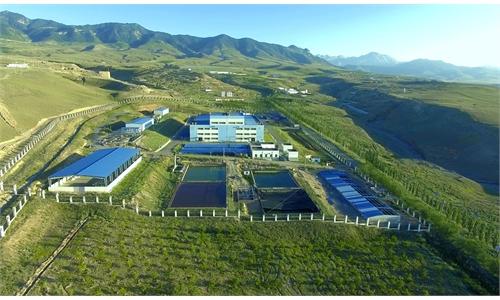
A view of the Rossing Uranium Mine. Photo: Courtesy of China National Nuclear Corporation
Together, they tell a story of shared destiny: national strategic planning and technological innovation drive nuclear power - a high-end manufacturing sector - onto the global stage; frontline overseas workers translate the "win-win cooperation" concept into jobs, local orders, and community initiatives.Together, they illustrate that China's nuclear power global journey is becoming broader and more solid.
Tangible opportunities