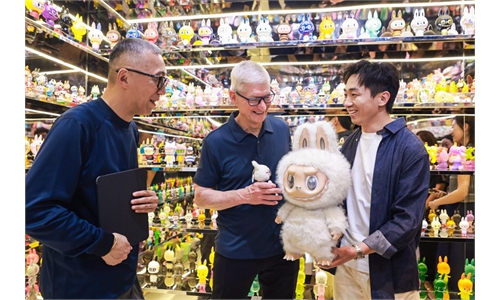
Paul King and Kasing Lung (right) Photo: Courtesy of Pop Mart
Chinese trendy toymaker Pop Mart on Thursday told the Global Times in a statement that its Labubu film project, co-developed with Sony Pictures, is still in the early stages of development. The movie will blend live action with computer-generated imagery to bring Labubu's fantasy world to the big screen.
The film project marks the latest cross-industry move by China's trendy toy sector. On the same day, Pop Mart said that it will collaborate with Sony Pictures to develop a live-action/animated feature based on The Monsters (Labubu), one of its globally popular intellectual property (IP) franchises.
Pop Mart said that the film is expected to be directed and produced by Paul King, the filmmaker behind the Paddington series and the box-office hit Wonka. The company also confirmed that Kasing Lung, the artist behind The Monsters, will be deeply involved in the project as a producer. The film is currently in production planning.
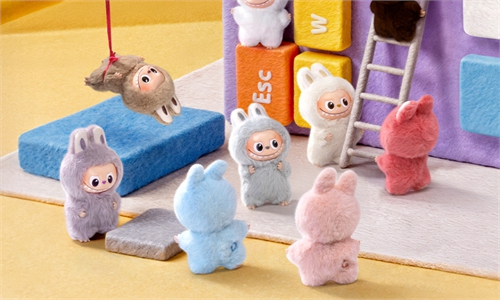
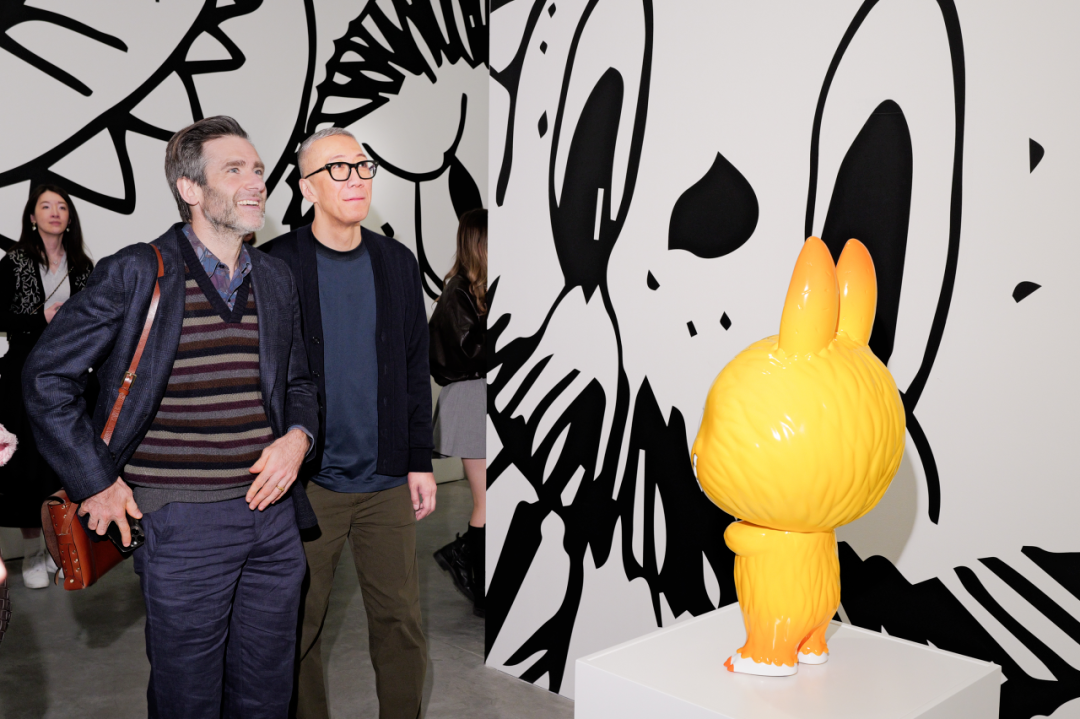
From collectible figurines on desks to globally popular vinyl plush toys, and to interactive star characters engaging visitors at Pop Mart City Park, The Monsters franchise continues to expand its presence. Represented by such IP assets, China's trendy toy industry has in recent years been making increasingly strong inroads into international markets.
Beyond The Monsters, other IP assets created by Chinese designers under the company are also rapidly gaining traction among global consumers.
Bloomberg reported on March 15 that Pop Mart characters such as Twinkle Twinkle, Skullpanda and Crybaby are drawing large crowds, fetching hefty premiums on resale platforms and climbing the company's sales charts.
Twinkle Twinkle plush pendants routinely disappear within minutes of restocking. On Chinese resale platform Qiandao, many of the character's toys trade above official prices, while a plushie from the Crybaby Vacation Mode On series is selling at 72 percent above retail, according to Bloomberg.
In the US, Skullpanda ranks as Pop Mart's No.2 IP asset, according to Morgan Stanley, with a recent tie-in with Hasbro Inc.'s My Little Pony drawing hundreds of thousands of likes.
Cross-media expansion helps pop IP assets extend product life cycles and reduce reliance on single-category sales, while broadening appeal beyond niche toy collectors to mainstream and family audiences, Zhang Yi, CEO of the iiMedia Research Institute, told the Global Times.
More importantly, it helps create content that is more memorable and harder to replicate, as narratives and emotional depth go beyond easily copied visual designs. Rather than simply adding value, he noted, such integration is essential to building sustained appeal and long-term global recognition for Chinese IP assets.
Deep collaborations with top global partners have become a key lever for Chinese companies to scale their IP globally, according to Zhang. "Anchored in universally relatable emotional appeal and supported by efficient industrial capabilities, they are increasingly integrating into the global content ecosystem and leveraging resource synergies to build a scalable and sustainable international reach."
After witnessing a wave of Chinese designer toys backed by IP rights steadily capturing global attention, focus is now turning back to the fundamentals of the segment itself, where sustained appeal ultimately depends on content depth, product innovation and long-term brand building, an expert said.
Designer toys have evolved from purely functional products into multi-dimensional cultural carriers, according to the Xinhua News Agency. While traditional toys centered on entertainment, today's designer toys embed innovative cultural expression, enabling them to resonate emotionally with target audiences at scale.
Backed by a full-chain ecosystem spanning design and research and development, mold manufacturing, production, branding and distribution, China has built an integrated industrial system capable of rapidly translating creative IP rights into market-ready products, according to Xinhua.
Leading companies have helped drive industry-wide growth by building integrated platforms that span IP incubation, product development, retail channels and licensing, accelerating the scaling of both IP value and the broader market.
In 2025, China's traditional toy market reached about 80.13 billion yuan ($11.1 billion), up about 3.5 percent year-on-year, while the designer toy segment totaled 87.97 billion yuan, surging 21 percent, according to the China News Service. Data from industry sources also predicted the sector's total value would reach 110.1 billion yuan in 2026, the report said.
RELATED ARTICLES