US lawmakers’ hype about rising dependence on China in drug supply ‘politically motivated mindset’ and ‘baseless’: analysts
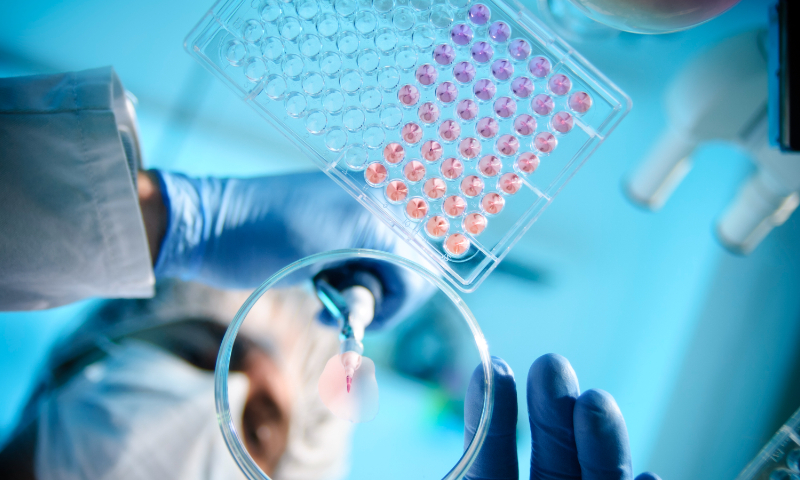
A concept photo of the research and development of drugs Illustration: VCG
Some US lawmakers hyped at a hearing on Wednesday (local time) that there are growing concerns over the US' reliance on Chinese drug ingredients, and they claimed that China is moving aggressively into the development of innovative new drugs. The remarks once again reflect a politically motivated mindset among certain US lawmakers, Chinese analysts said, noting that the development of the pharmaceutical sector is driven by market forces and global industrial cooperation, rather than any attempts at control or dominance.
The Select Committee on China, a select committee of the US House of Representatives, held a hearing on the generic drug supply chain on Wednesday. Committee chairperson John Moolenaar claimed that "China is cornering the market on our medicines - from the supply of generic drugs that Americans depend on every day, to the cutting-edge biotech pipeline that will determine who leads medicine in the years and decades ahead," according to a press release from the committee on Wednesday.
Moolenaar also claimed that "We have seen this playbook before — in steel, in solar, and in rare earths." He also claimed that "If China restricted active pharmaceutical ingredient (API) exports tomorrow in the same way it has restricted rare-earth exports, then American hospitals and pharmacies would begin running short on essential medicines."
Such remarks by some US lawmakers are neither fact-based nor aligned with the fundamental logic of global pharmaceutical industry development. The claim of "cornering the market" is entirely baseless. Chinese pharmaceutical companies supply APIs and generic drugs worldwide because this is an objective outcome of the global industrial division of labor. Far from being a threat, China serves as a stabilizer for the global pharmaceutical supply chain, a source at a Chinese medical company, who declined to be identified, told the Global Times on Thursday.
"Chinese companies participate in this field not because they possess any form of 'monopoly,' but because they respond to the potential of market demand," Zhou Mi, a senior research fellow at the Chinese Academy of International Trade and Economic Cooperation, told the Global Times on Thursday.
Zhou said that the lawmaker's assessment is "highly unreasonable" as it fails to recognize the fundamental drivers of this development and overlooks the role of companies in the process. "Chinese firms have no intention of controlling specific industries. Rather, they aim to create more space for economic development and improve living standards," the expert said.
US lawmakers also called for "de-risking generic drug supply chain dependence on China."
During the hearing, Ranking Member Ro Khanna claimed that the US has become dependent on China for critical pharmaceutical supply chains, and said that "if this trajectory continues and we do not act, the world could face dependence on China not only for raw materials, for medicines, but also for new and innovative drugs."
In response to this claim, Zhou noted that any attempt to "decouple" from China in this field would be very difficult and costly for American businesses and consumers.
"China is not only an important producer of active pharmaceutical ingredients and innovative drugs, but also a major supplier of medical devices and protective equipment. Countries around the world benefit to varying degrees from China's supply chains, and it would be difficult to find fully comparable substitutes elsewhere."
The anonymous industry insider also pointed out that Chinese pharmaceutical companies supply the US market with a large volume of high-quality, affordable medicines, significantly reducing healthcare costs for Americans and helping stabilize the US public health system.
"This is a classic complementary relationship. Attempts to sever such market-driven supply chains will ultimately harm the lives and health interests of ordinary American patients."
Apart from the supply chain, US lawmakers such as Moolenaar also hyped claims that China is "moving aggressively into the development of innovative new drugs."
Darin LaHood, member of the Select Committee on China, also claimed at the hearing that "China's rapid advancements in biotechnology are increasingly concerning. America's leadership in developing cutting-edge, life-saving pharmaceuticals must continue."
The Chinese industry source said that the assertion that China "dominates the cutting-edge biotech pipeline" both overstates China's position and ignores the reality of global biotechnology development.
"Biotech progress is highly collaborative. From basic research and clinical trials to commercial-scale production, companies and research institutions across countries are deeply interconnected."
The source noted that technological innovation thrives on openness. Breakthroughs in frontier biotechnology depend on worldwide knowledge sharing, capital flows, and talent exchange. China remains committed to open cooperation. Many foreign pharmaceutical companies operate research and development centers in China, and the country is sharing the benefits of technological progress with multinational partners, the source said.
This was not the first time that the US targeted China's drug and biotechnology sector.
Last week, the US Senate Special Committee on Aging held a hearing entitled "Foreign dependence: how China captured America's drug supply," which also hyped "dependence" on imports of pharmaceutical raw materials and generic drugs from China and politicized this as an issue of "national security," according to information on the committee's website.
On December 18, 2025 the "National Defense Authorization Act for Fiscal Year 2026," a $901 billion defense policy bill, was signed into law. Bloomberg reported that it "includes a revised version of the Biosecure Act, which could restrict federal contracts with Chinese biotech firms."
Zhou said in a previous interview with the Global Times that the real US goal behind the investment restriction is simple: Washington believes that American capital flowing into China has been a key driver of China's rapid technological rise in sensitive sectors, so it wants to choke that flow to slow China down and preserve US dominance, especially in biotechnology. That logic is flawed.
"China's progress in these fields is primarily driven by its massive domestic market, rapid real-world iteration, and the innovation capacity of Chinese companies -- not by US investment, which is only a supporting factor," said Zhou.
RELATED ARTICLES