"The spring rain heralds spring's clear and bright days, summer's fullness arrives with the heat in waves..." This folk rhyme serves as a key to unlocking the spiritual world of the Chinese people.
In 2016, "The Twenty-Four Solar Terms, knowledge in China of time and practices developed through observation of the sun's annual motion" was inscribed on UNESCO's Representative List of the Intangible Cultural Heritage of Humanity.
The ancient Chinese divided the sun's annual circular motion into 24 segments. Each segment was called a specific Solar Term, starting from the Beginning of Spring and ending with Greater Cold.
From the rhythm of labor aligned with nature to the wisdom of seasonal dishes, the 24 Solar Terms have shaped a philosophy of "harmony between humanity and nature" and a way of life unique to Chinese culture.
The Global Times presents the series The Markings of Time, which follows cultural inheritors across China to explore the local traditions and humanistic sentiments tied to each solar term. Here is the second in the series, the Spring Equinox.
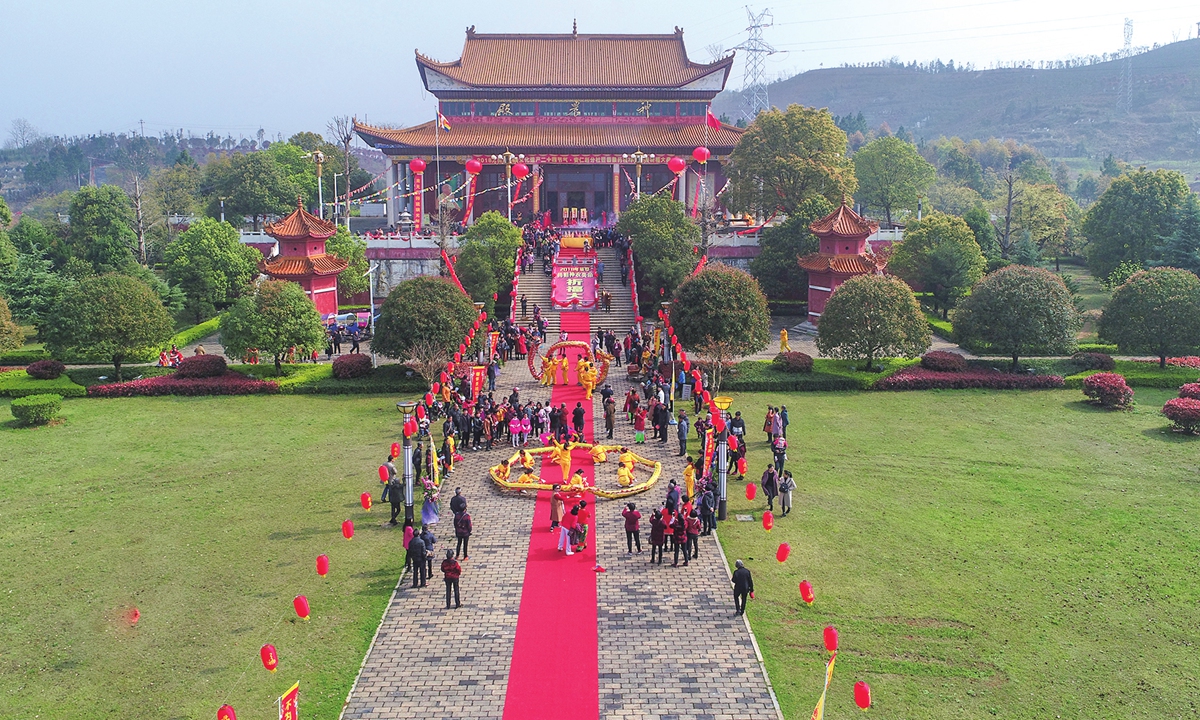
People take part in a ritual honoring the Yan Emperor, the sage of herbal medicine, during the Ganfenshe Festival in Anren county, Central China's Hunan Province, in 2018. Photos: Courtesy of Anren county's Intangible Cultural Heritage Protection Center
During the day of the Spring Equinox, one of the 24 Solar Terms, the streets and markets of Anren county in Central China's Hunan Province are lined with a dazzling array of Chinese medicinal herbs, their earthy and fresh aroma lingering in the air. It is on this day that the town ushers in one of its most lively and grand moments of the year, the Ganfenshe Festival, which kicked off as scheduled to celebrate the arrival of the Spring Equinox.The Spring Equinox, or "Chun Fen" in Chinese, has long been revered as a time of renewal. It symbolizes the end of cold winter and the beginning of busy spring plowing, a period when farmers prepare their fields and hope for a bountiful harvest.
For Anren county, however, this solar term carries deeper meaning. It is the heartbeat of a folk tradition that has been passed down through generations, rooted in the legend of the Yan Emperor, the legendary ancestor of the Chinese nation credited with inventing agriculture, herbal medicine, and markets, often revered as the "Divine Farmer."
Nestled in southern Hunan Province, Anren county is hailed as one of the birthplaces of the nation's agricultural and traditional Chinese medicine (TCM) civilization, thanks to the Yan Emperor's legendary deeds there.
It is said he tasted hundreds of herbs to identify their medicinal properties and invented farming tools to help people cultivate the land.
In 2016, the Anren Ganfenshe Festival was inscribed on the UNESCO Representative List of the Intangible Cultural Heritage of Humanity, as part of the "Twenty-Four Solar Terms" project, earning it the title of "a living fossil of Chinese folk festivals."
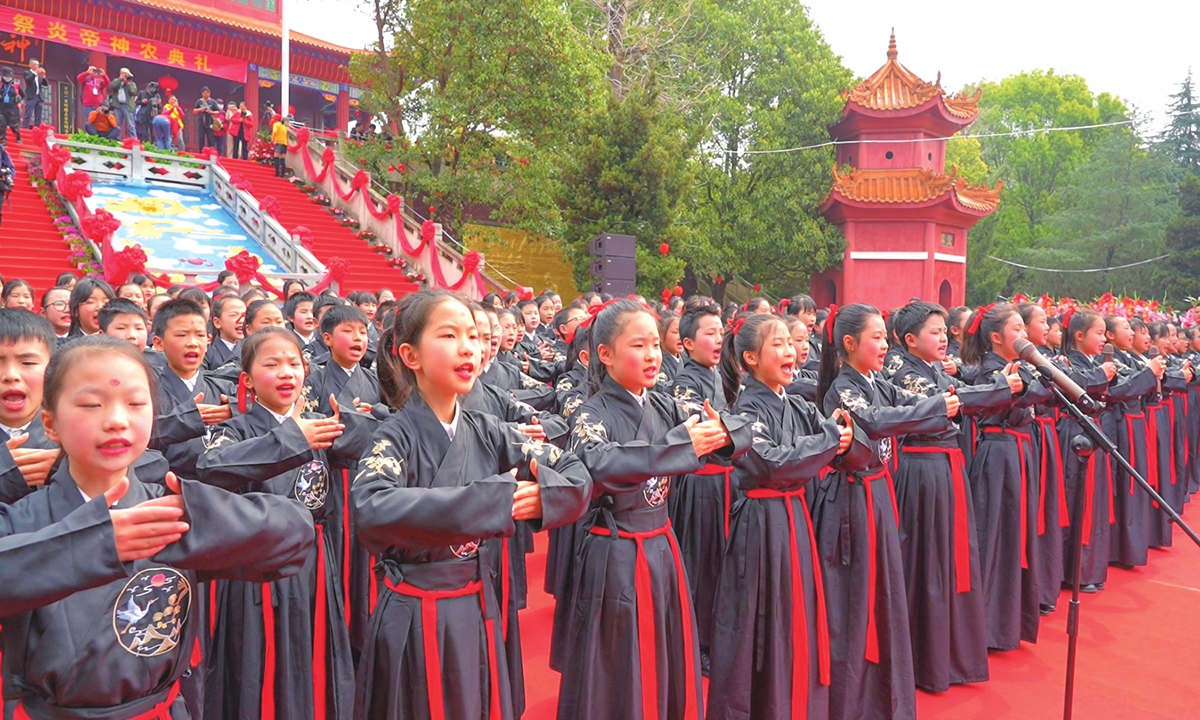
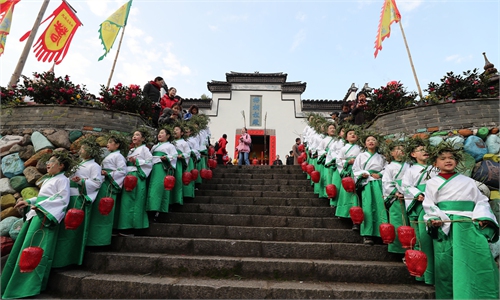
Children pay tribute to the Yan Emperor during the Spring Equinox in Anren county, Central China's Hunan Province, on March 20, 2025.
Festival with gratitude, traditionThe "Ganfenshe" is not just a one-day event on the Spring Equinox. It lasts for half a month, from mid-March to late March, attracting over 300,000 visitors each year, according to Zhou Wanhong, director of Anren county's Intangible Cultural Heritage Protection Center.
"'Fen' refers to the Spring Equinox, and 'she' means market," Zhou told the Global Times.
"Originally, it was a day when villagers gathered to trade farming tools, seeds, and medicinal herbs. Today, it has evolved into a complex cultural IP that combines tourism, health, and social interaction, but its core remains unchanged, that is worshiping the Yan Emperor, praying for a good harvest, and promoting herbal markets."
The festival follows a sacred sequence, steeped in tradition. Before any celebrations begin, locals gather at Shennong Temple, where a statue of the Yan Emperor is enshrined, to offer medicinal herbs as sacrifices.
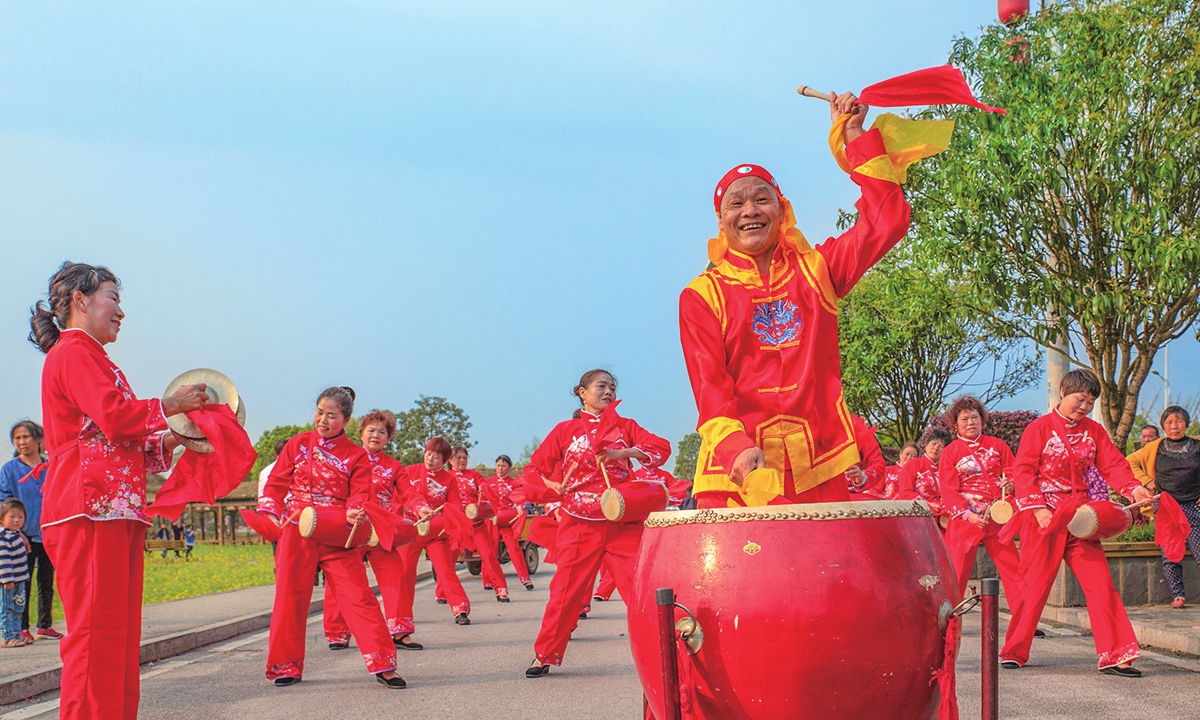
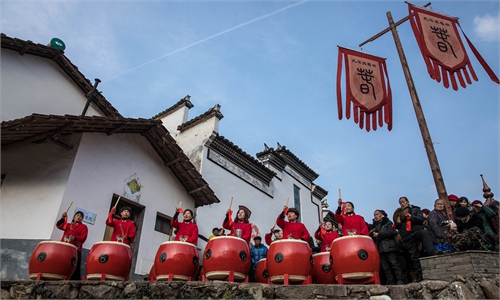
Performers give a drum performance at the Ganfenshe Festival in Anren county, Central China's Hunan Province, on March 20, 2025.
"We pray for prosperity, good health, and peace," Zhou said. "This is our way of thanking the Yan Emperor for bringing farming and TCM to our ancestors."After the offerings, an opening ceremony is held, followed by a plowing ritual, the highlight of the festival.
Dressed in traditional attire, farmers drive oxen adorned with red flowers into the fields, whipping their whips to the sound of dragon and lion dances and firecrackers, marking the start of spring plowing and awakening the land from its winter slumber.
For many Anren natives, the festival is a powerful tie to their hometown.
"Some villagers working or doing business outside would rather not return home for the Spring Festival than miss the Ganfenshe Festival. It's a deep-seated sentiment, a connection to our roots," Zhou explained.
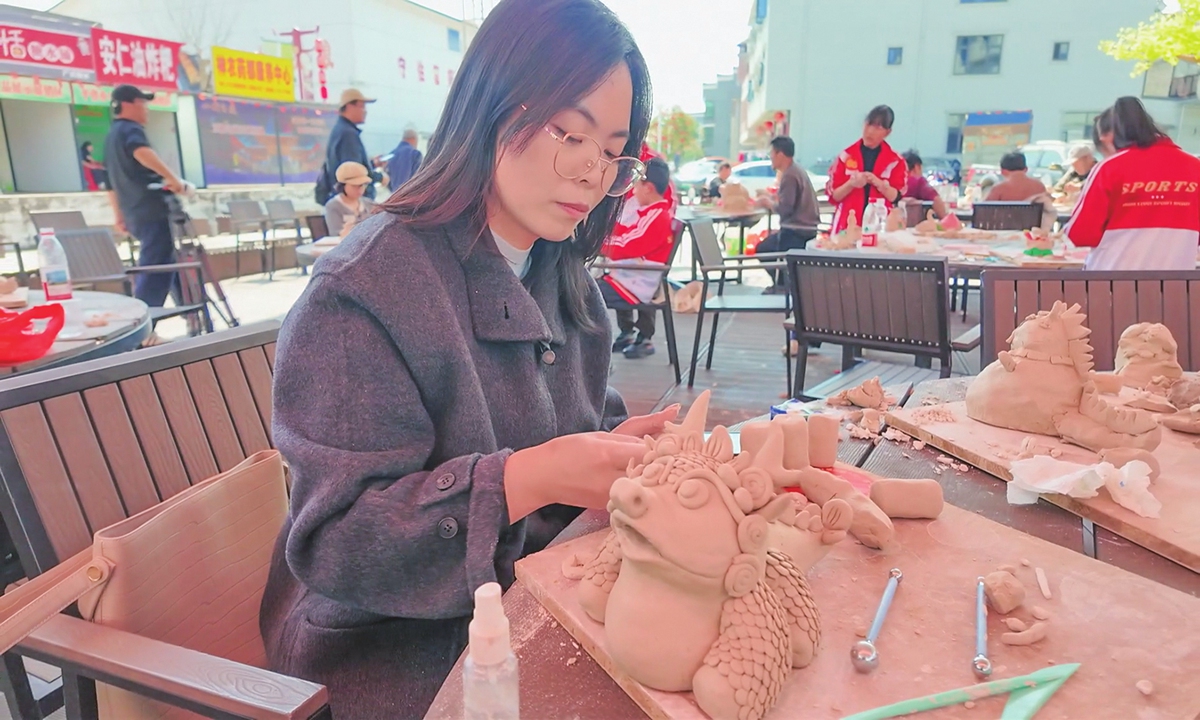
A woman takes part in an animal sculpture competition on March 19, 2026 ahead of the Ganfenshe Festival in Anren county, Central China's Hunan Province.
Herbal bazaar, living heritageAt the heart of the festival is the herbal market, a bustling hub where vendors from across China sell a wide variety of medicinal herbs.
Local herbs such as spatholobus stem, fish mint (houttuynia cordata), and stephania root line the stalls, alongside rare ingredients such as cordyceps and ganoderma, a rare type of fungus used in TCM.
Xiao Yanhua, a 40 something entrepreneur, runs a traditional medicine shop in Shanghai but returns to her hometown every Spring Equinox. "This is our best sales period of the year," she told the Global Times.
Zhou introduced that the prices are noticeably cheaper than in big cities: two yuan (29 cents) per 500 grams for common herbs, compared with three to four yuan elsewhere.
The festival also showcases Anren's intangible cultural heritage, with community opera taking center stage.
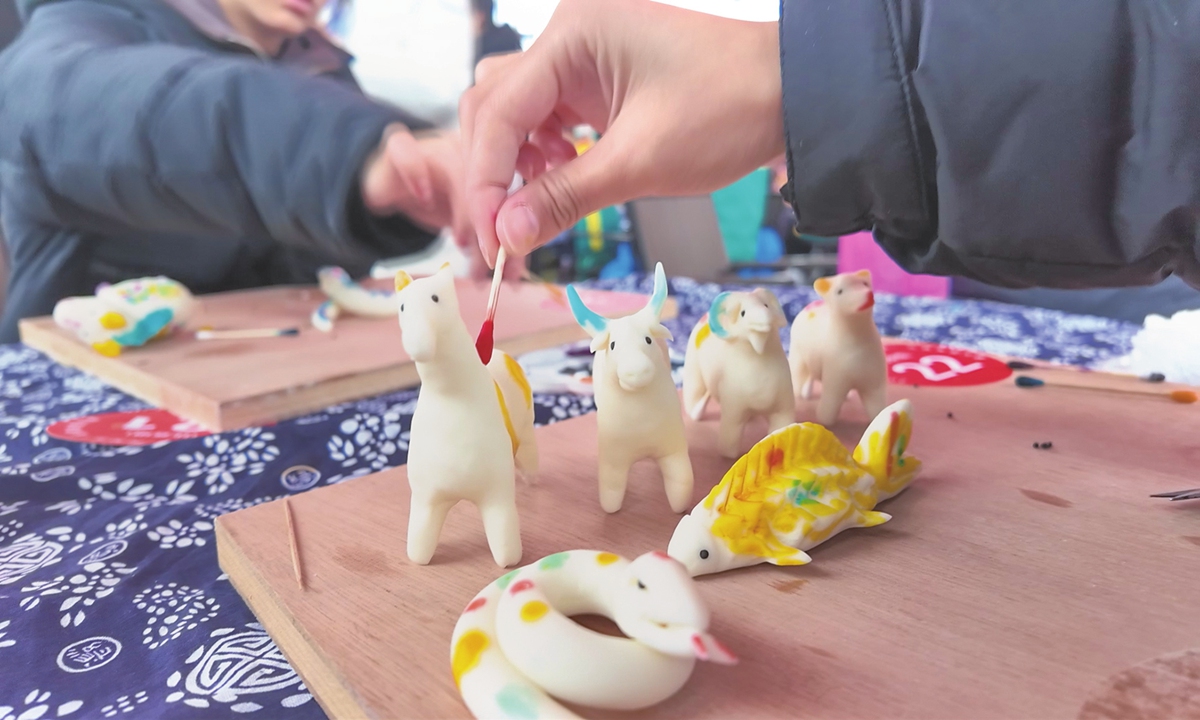
People take part in a rice figurine making competition on March 19, 2026 ahead of the Ganfenshe Festival in Anren county, Central China's Hunan Province.
Unlike formal opera, community opera refers to the traditional performances held during the festival, including local Huagu Opera (also known as Flower Drum Opera) and shadow puppetry."Huagu Opera is our most distinctive local art form. It tells traditional educational stories, and in recent years, we've incorporated the Ganfenshe Festival's history into our performances," Zhou added.
In Anren, the Ganfenshe Festival is the soul of the Spring Equinox. But this celebration of balance and new beginnings is not unique to this southern Hunan town, it echoes across China as people from all walks of life mark the Spring Equinox in their own ways.
Some families fly kites painted with intricate patterns, their strings dancing in the spring breeze while some communities gather to eat spring rolls and fresh greens, savoring the first tastes of the season. What unites them all is a shared reverence for nature's rhythm, a connection to the land, and the quiet joy in the promise of new life.