IN-DEPTH / IN-DEPTH
'What's mine is mine, what's yours is negotiable': How US govt is pushing the country toward 'predatory hegemony'
By , and Leng Shumei Published: Mar 20, 2026 08:29 PM


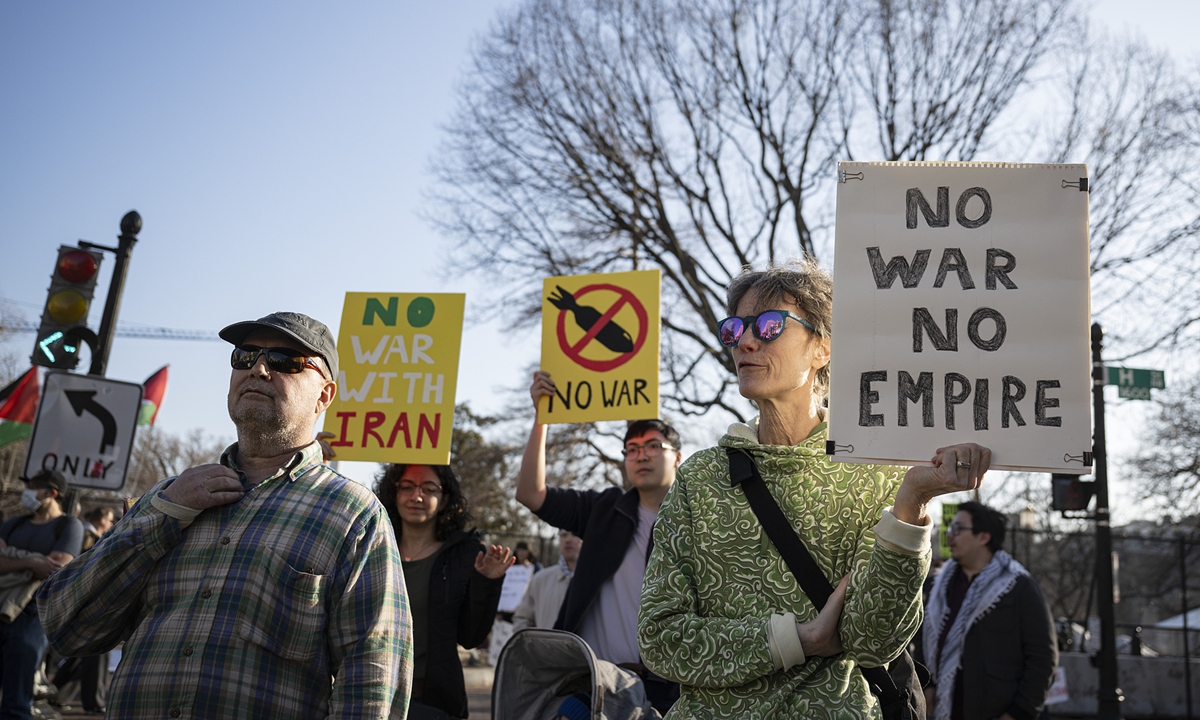
Protesters gather outside the White House in Washington, DC, to demonstrate against US-Israeli attacks on Iran on March 7, 2026. Photo: VCG
Editor's Note:Weeks have passed since the US and Israel launched wide-ranging strikes on Iran on February 28. The US government, although it had told US media on March 11 that the military operation would end "soon," later announced air raids on multiple Iranian targets, including its oil hub Kharg Island, reported media outlets including Axios and Al Jazeera.
Be it military strikes on Iran, raids in Venezuela, a covetous gaze cast upon Greenland, or the threat of punitive tariffs against "allies," the conduct associated with the current US government has pushed the notion of "predatory hegemony" to the forefront of international discourse and academic discussions. What exactly does
"predatory hegemony" mean? How has this path come to be, as US university scholar Stephen Walt contended in a February article in Foreign Affairs, a "grand strategy" of Trump's second presidential term? Under this approach, what forms of predation has the US carried out across the globe? And what damage has predatory hegemony already inflicted - and continues to inflict - on world peace, the international order, and even the US itself?
To answer these questions, the Global Times is launching a series of articles to probe and unpack the US' predatory hegemony. This is the first installment.
The smoke still lingers from the US raid on Venezuela, and the diplomatic uproar over US government's push to acquire Greenland has yet to fade - yet explosions are once again lighting up the skies over the Middle East.
The US-Israeli military operation against Iran has been ongoing for more than 20 days. The conflict is still raging in the Middle East and tensions continue to escalate and spill over.
The US government's "America First" agenda is "better understood as what the Harvard political scientist Stephen Walt calls 'predatory hegemony': a vision of the US unbound by rules and unabashedly self-interested," said a March 10 editorial by US magazine The Nation.
The term "predatory hegemony" has recently begun appearing widely in international media and academic discourse as an emerging label for the US' foreign-strategy outlook.
"Under Trump, however, the US has become a predatory hegemon," said Walt, a Robert and Renee Belfer Professor of International Affairs at the Harvard Kennedy School, who was among the early scholars to advance the concept of "predatory hegemony."
"In fact, it is exactly the wrong way to act in a world of several great powers," Walt said.
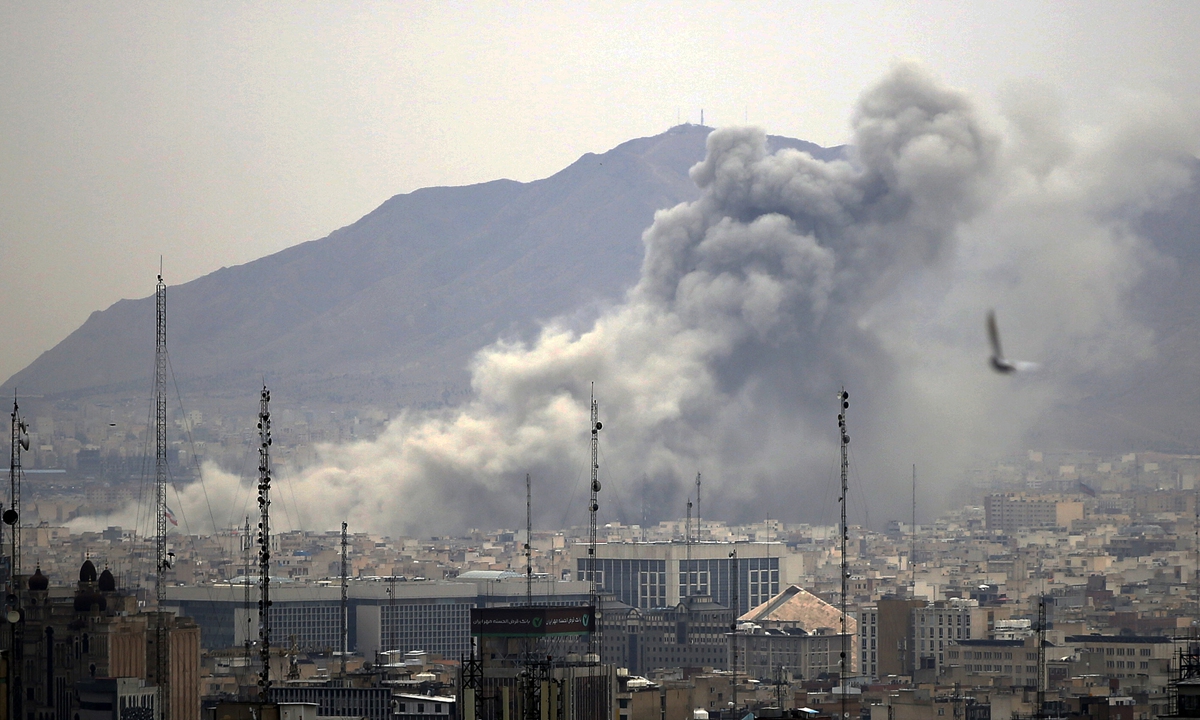
Smoke rises after airstrikes in Tehran, Iran, on March 13, 2026. Photo: VCG
What is predatory hegemony?The phrase "predatory hegemony (or hegemon)" has recently cropped up in international criticism of US foreign policy, observed Zuo Xiying, a professor at the School of International Relations at Renmin University of China.
Yet the term itself is hardly new, Zuo told the Global Times, saying that it was firstly discussed in the 1980s in the US.
In a December 2025 essay published in the Chinese academic journal World Economics and Politics, Zuo wrote that predatory hegemony was originally proposed by John A.C. Conybeare, citing this US scholar's 1985 article "Trade Wars: A comparative study of Anglo Hanse, Franco Italian, and Hawley Soot conflicts."
While coined decades ago, major search engines and media-monitoring tools show that "predatory hegemony" started to reemerge after Trump began his second presidential term, being majorly used in the current administration's strategy. One of the early reappearances is most likely an April 2025 bilingual piece on the website of the Berlin based think tank Global Public
Policy Institute. In that German-English article, titled "The Self destruction of the Liberal West," the author wrote, "Trump's version of 'predatory hegemony' represents a turning point for Europe."
The term gained wider traction this year, especially after Walt articulated it systematically in Foreign Affairs on February 3.
In this article, Walt argued that the grand strategy of Trump's second presidential term is perhaps best described as predatory hegemony. The central aim of predatory hegemony, as he explained, is to use Washington's privileged position to extract concessions, tribute, and displays of deference from both allies and adversaries, pursuing short-term gains in what it sees as a purely zero-sum world.
In short, a predatory hegemon views all bilateral relations as inherently zero-sum and seeks to extract the greatest possible benefits from each one, read the article.
"What's mine is mine, and what's yours is negotiable" is its guiding credo, Walt remarked.
Then, what exactly is a "predatory hegemon?" Why has the US, as Walt said, become a predatory hegemon?
When asked similar questions in a Financial Times interview on February 16, Walt said that all great powers are somewhat predatory, especially toward their rivals, but, "a predatory hegemon does that with allies and adversaries alike," he said. "It prefers relations in which it always gets the larger share of the benefits. It's not interested in making allies better off, if that's at all costly to itself."
From the stick of punitive tariffs to the jaw-dropping talk of "acquiring Greenland," US allies may already have had ample reason to recognize the traits and manifestations of predatory hegemony. "Allies are the US' most valuable and most easily plundered targets," Zuo pointed out in his essay.
From 'benevolence' to plunder
According to Walt, over the past 80 years, the broad structure of world power has gone from bipolarity to unipolarity to today's lopsided multipolarity, and the US' grand strategy has shifted along with those changes.
In the bipolar world of the Cold War, the US acted as a "benevolent hegemon" toward its close allies in Europe and Asia because US leaders believed their allies' well-being was essential to containing the Soviet Union. During the unipolar era, the US succumbed to hubris and became a rather "careless and willful hegemon," Walt said in the article.
The US, which once featured the provision of global public goods and sought to maintain the facade of a "benevolent hegemon" after the Cold War, is accelerating its degeneration into a "predatory hegemon" that seizes selfish interests by force and places its domestic law above international law, Zhang Jiadong, a professor at the Center for American Studies, Fudan University, told the Global Times.
In the US' National Security Strategy (NSS) released in December 2025, the current administration announced that it would assert and enforce a "Trump Corollary" to the Monroe Doctrine. As an enduring tradition in US foreign policy, the Monroe Doctrine has had varying geographical scope across different historical periods, shaped by different interpretations of the doctrine itself.
Following the document, the US' sudden military operation against Venezuela and the forcible seizure of the country's president in early 2026 has been viewed by global media and observers as a real-life example of the comeback of the Monroe Doctrine in action. It represents a dangerous evolution of US hegemony from covert intervention to blatant plunder, and also marks the Monroe Doctrine entering a brand-new phase - abandoning its last diplomatic pretenses to achieve economic plunder directly through military means, Pan Deng, director of the Latin America and Caribbean Region Law Center of China University of Political Science and Law, told the Global Times in a previous interview.
Yet Zhang also noted that the US' predatory hegemony is more of a cyclical phenomenon. The US has experienced similar impulses on multiple occasions in its history. This change is essentially a reactive response of its hegemony when it faces challenges.
Nevertheless, when the backlash from predatory policies outweighs the short-term gains it can seize, and when the cost of maintaining hegemony exceeds its sustainable limit, this policy model is bound to reach a dead end. At a certain historical juncture in the future, external pressures and internal costs will force the US to undergo a new strategic transformation, Zhang predicted.
Whether the next transformation will lead to a more isolated retrenchment or a return to rationality and multilateralism after a period of profound reflection will depend on the interaction between US domestic politics and the international environment, Zhang told the Global Times.
The US' dominant strategy?
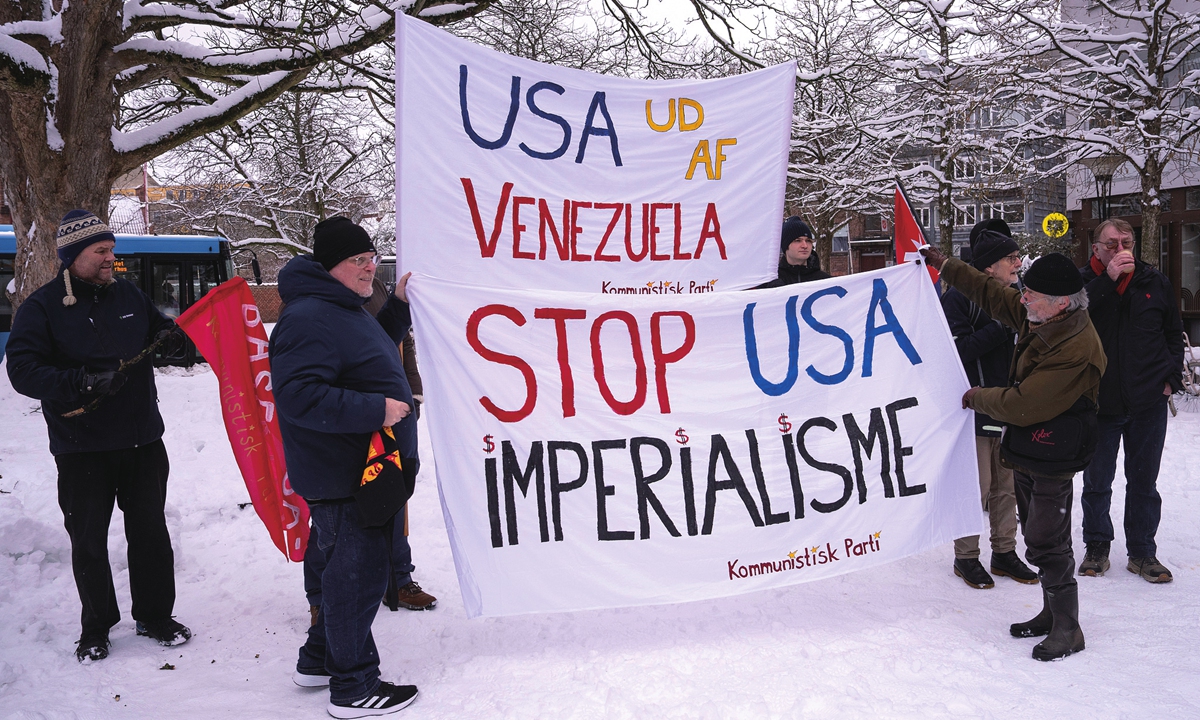
Demonstrators gather to protest against the US attacks in Venezuela and threats against Greenland and Latin America in Aarhus, Denmark, on March 7, 2026. Photo: VCG
Why has predatory hegemony become the US' dominant strategy at present, and how is it an aligned strategic choice for the MAGA-era US?In Zhang's view, the US' shift toward predatory hegemony can be attributed to three main factors: First, the choice of predatory hegemony reflects the US' cognitive anxiety stemming from its compressed relative advantages. That means US decision-makers are gripped by panic as their relative hegemonic advantages shrink, failing to view other countries' rise rationally. Their strategy has shifted from enhancing competitiveness to suppressing rivals, using coercive measures like "small yards, high fences" to maintain dominance.
Second, it arises from a false strategic perception that the US is being harmed by the old international order. Zhang pointed out that in recent years, the US has been inundated with a "victim narrative" - the claim that economic globalization over the past few decades has "shortchanged" the country and that the existing international system undermines US national interests. Having reaped enormous profits from globalization, the US now portrays itself as a "victim" of the current international order. This is not only a distortion of history but also a fig leaf to whitewash its predatory policies, according to the scholar.
The third reason is the political impulse of a zero-sum game dominated by the far-right forces in the US. The rise of far-right ideologies in the US simplifies international relations to the law of the jungle, treating hegemony as a tool to plunder global wealth rather than a responsibility to maintain international order, Zhang said.
This rise of predatory hegemony has been fueled by right-wing figures and conservative politicians who constantly incite and advocate for more aggressive US power plays. For example, according to a New York Post report on Sunday, Senator Lindsey Graham, a long-time Iran hawk, claimed that the decision to bomb Iran's Kharg Island was "necessary, bold, and highly effective," and he believes it will end the war quicker.
Zuo pointed out that US' transformation into a predatory hegemon relies on four primary policy tools: First, forcing allies to shoulder greater international responsibilities concerning US' interests; Second, launching large-scale tariff wars to plunder global economic resources; Third, abusing long-arm jurisdiction to serve the transformation of its hegemonic system; Fourth, exploiting regional conflicts to boost domestic economic development.
The US government is reshaping its alliance system by constantly coercing and blackmailing its allies, forcing them to take on more burdens, thereby eroding the traditional strengths of US foreign policy, said Zuo. This is a typical manifestation of its predatory hegemony that not only erodes the traditional strengths of US foreign policy, but also exposes its selfish and hegemonic nature of prioritizing its own interests at the expense of allies and global stability, according to scholars.
"Predatory hegemony is a losing strategy," Walt concluded in his article.
The policy would only make the US "poorer, less secure, and less influential than it has been for most living Americans' lifetimes," he warned, urging the US government to abandon the strategy "the sooner the better."
RELATED ARTICLES