Forget your age, and your career will always stay young: Lin Zhanxi writes in People’s Daily
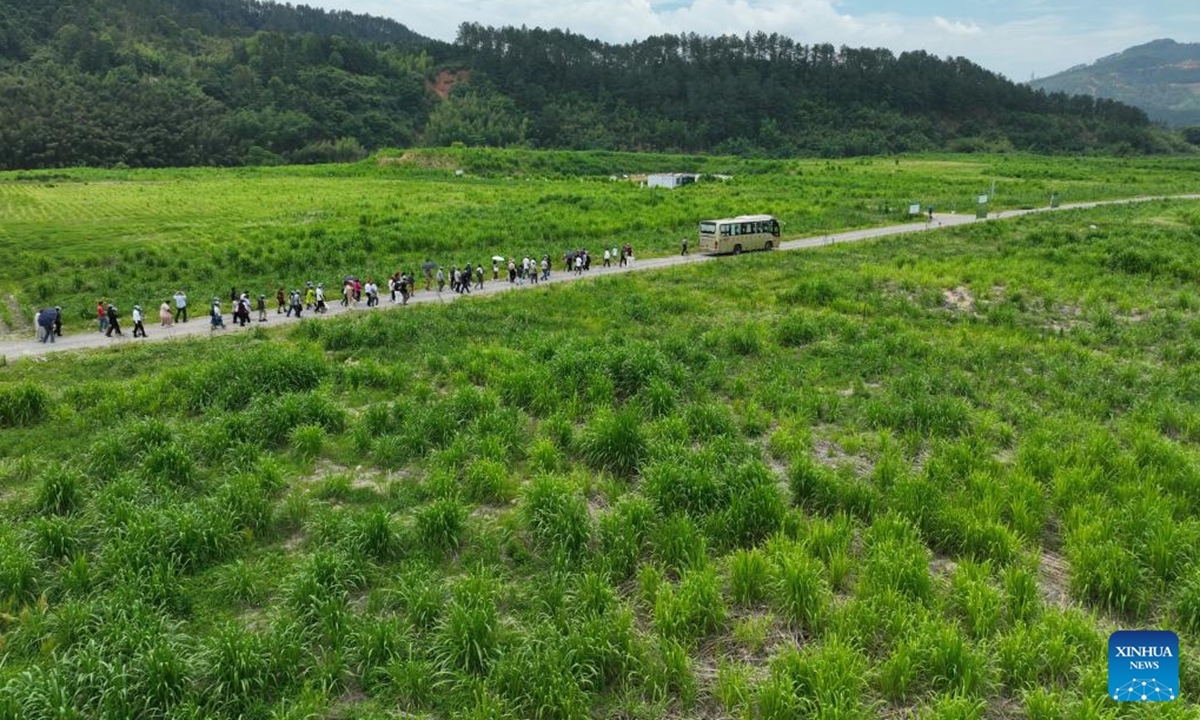
An aerial drone photo taken on May 17, 2025 shows guests visiting a Juncao base in Yongtai county, Fuzhou, East China's Fujian Province. (Xinhua/Lin Shanchuan)
A technology emerging from the lab is only the first step of a long journey. Only when it is brought to where it is most needed and entrusted to those who need it most does it gain life and truly come alive.
For a scientist, both destiny and joy lie in exploration. I have encountered countless difficulties across so many places, yet every challenge has forced us to push beyond technical boundaries and open new fields of application.
This year, I am 83 years old. Normally, at this age, one should be resting - so why am I still running to the front line?
The answer is simple: Forget your age, and your career will always stay young. I am a scientific and technological worker, and also a farmer's child. I have devoted my entire life to the cause of Juncao. As long as I can still walk, my feet will keep stepping on the soil. The era is so good and I have no reason to stop.
Many people know me through Professor Ling in the TV drama Shanhaiqing, also known by its English title "Minning Town." Someone asked, "Was it really that hard?" I replied, "We have all experienced the hardships depicted in the drama. And we also experienced what was not shown in the drama." But the hardship pales in comparison with the sweetness the people gained.
I'm always on the road because I remember that sweetness and why I set out. When it comes to scientific research, ultimately, it's about solving the most urgent and difficult problems weighing on the hearts of common people.
In the late 1970s, our country had an impoverished population of 250 million. The imported basswood cultivation technology for edible fungi, though able to increase income, was like "rob Peter to pay Paul" - to grow mushrooms, all the trees on the mountains had to be cut down. Watching green mountains turn into barren ridges pained me deeply.
Can we replace wood with unwanted weeds like false staghorn fern and miscanthus floridulus? Daring to think is vital, but daring to act is even more so. With the idea, I took a bold step: I borrowed 50,000 yuan ($7,245.90) - 100 times my annual salary at the time - to set up a makeshift lab. There, I worked day and night to crack the code of cultivating edible and medicinal fungi using grass instead of wood. Looking back, I realize how audacious I was. Fortunately, after more than 1,000 days, the first shiitake mushroom cultivated with weeds grew. The excitement at that moment was indescribable. I knew then: we had succeeded! Along the way, I've had moments of fear in retrospect, but I've never regretted it for a second.
With the technology developed, where should we go? Xiang Nan, the then Party chief of East China's Fujian Province said to me: "You must not take the path of personal wealth," and "Use the Juncao technology for poverty alleviation and to contribute to social development - that is the true value of your life." He also personally inscribed a motto in 10 Chinese characters: Develop the Juncao industry, and benefit all humanity. This reflects the breadth of vision and benevolence of the Chinese people: lifting ourselves to benefit others. Though founding a cause is arduous, our hearts are set on safeguarding food security for all humanity. These 10 characters have since become the unchanging principle of my life.
A technology emerging from the lab is only the first step of a long journey. Only when it is brought to where it is most needed and entrusted to those who need it most does it gain life and truly come alive. After planting Juncao grass in areas with soil erosion in Fujian, surface runoff was significantly reduced within the same year. In Xihaigu, an impoverished mountainous area in Northwest China's Ningxia Hui Autonomous Region, the income from a 50-square-meter mushroom shed even exceeded that from 27 mu (1.8 hectares) of wheat. At the Alxa section of the Yellow River, Juncao grass reduced sediment entering the river by 90.9 percent... Where there is poverty, hardship, or poor ecology, that's where I go to plant Juncao.
As of June last year, Juncao technology had been promoted in 606 counties across China and overseas, with planting area exceeding 6 million mu and creating ecological value of over 70 billion yuan.
I have never forgotten the grand goal of "benefiting all humanity." Thanks to this era of openness, and especially riding the momentum of the Belt and Road Initiative, strands of Juncao have crossed oceans and taken root in many countries.
Helping others, however, has been far from easy. From Fiji to South Africa, from Rwanda to Kenya, each nation presents a new "battlefield" against poverty. In some places the conditions are unimaginable: many people still live tribal lives, wearing leaves as clothes and struggling to secure even three meals a day.
The greater the difficulty, the more meaningful our help becomes, and the greater the need for our support. We adapt measures to local conditions, simplifying the technology again and again until illiterate villagers can understand it at a glance and master it quickly.
In Papua New Guinea, the Juncao industry now spans 10 provinces and has become the second-largest pillar industry in the Eastern Highlands Province. In Rwanda, more than 50 Juncao mushroom cooperatives have created jobs for over 30,000 people and doubled their incomes. When locals mention Juncao, they give a thumbs-up and call it China's "grass of prosperity" and "grass of happiness."
Since embarking on foreign-aid journey in 1998, a sense of mission has kept me moving forward, and pride has kept me unwilling to stop. I have seen local people dress in their finest festival attire and raise the Chinese national flag higher than their own. I have seen a minister change his daughter's name to "Juncao" and publish the change in the newspaper. These are honors - and even greater responsibilities.
Every time I travel abroad, I remind my team: we carry the national flag on our backs, bear it on our faces, and must always keep the motherland in our hearts. In a foreign land, you and I represent China. The harsher the conditions, the more we must press forward - only then can we be worthy of the mission entrusted by our country and the earnest hopes of countless local people yearning to escape poverty.
For a scientist, both destiny and joy lie in exploration. I have encountered countless difficulties across so many places, yet every challenge has forced us to push beyond technical boundaries and open new fields of application. What began as simply "substituting grass for wood" has grown far larger: Juncao technology now extends to ecological restoration, biomass energy, and bio-based materials. The superior varieties we bred, such as giant Juncao, have achieved breakthroughs in producing pulp, textile fabrics, and fuel.
Scientific research is never complete. Even in my eighties or nineties, my original aspiration still burns bright. As long as I live one more day, I will keep carrying strands of Juncao toward the light.
Xi Jinping, general secretary of the Communist Party of China Central Committee, said that "Juncao technology is a unique technology developed in China," according to the Xinhua News Agency.
This is the highest recognition and the greatest encouragement. I often say I am merely a "grassroots commoner." It is the country that nurtured me; it is this era that made me possible. Had I not been born in China, I would never have pursued Juncao research. Had it not been for socialist China, this technology would never have been applied to poverty alleviation and public welfare, let alone brought greenery across the globe.
During this year's two sessions, Xi, also Chinese president and chairman of the Central Military Commission, stressed that Chinese modernization is the modernization of common prosperity for all.
As long as mountains and rivers still need governance and as long as poverty remains somewhere on earth, I will stay on this road, continuing to write the great chapter of developing the Juncao industry to benefit all humanity. This is my good fortune, my duty, and the work that gives me joy.
The article was compiled based on an interview with Lin Zhanxi, chief scientist of the China National Engineering Research Center for Juncao Technology conducted by Jiao Siyu of the People's Daily. The article was originally published on page 5 of the People's Daily on March 20, 2026.
RELATED ARTICLES