China’s trade with BRI partner countries gets off to a strong start this year amid growing demand for Chinese goods
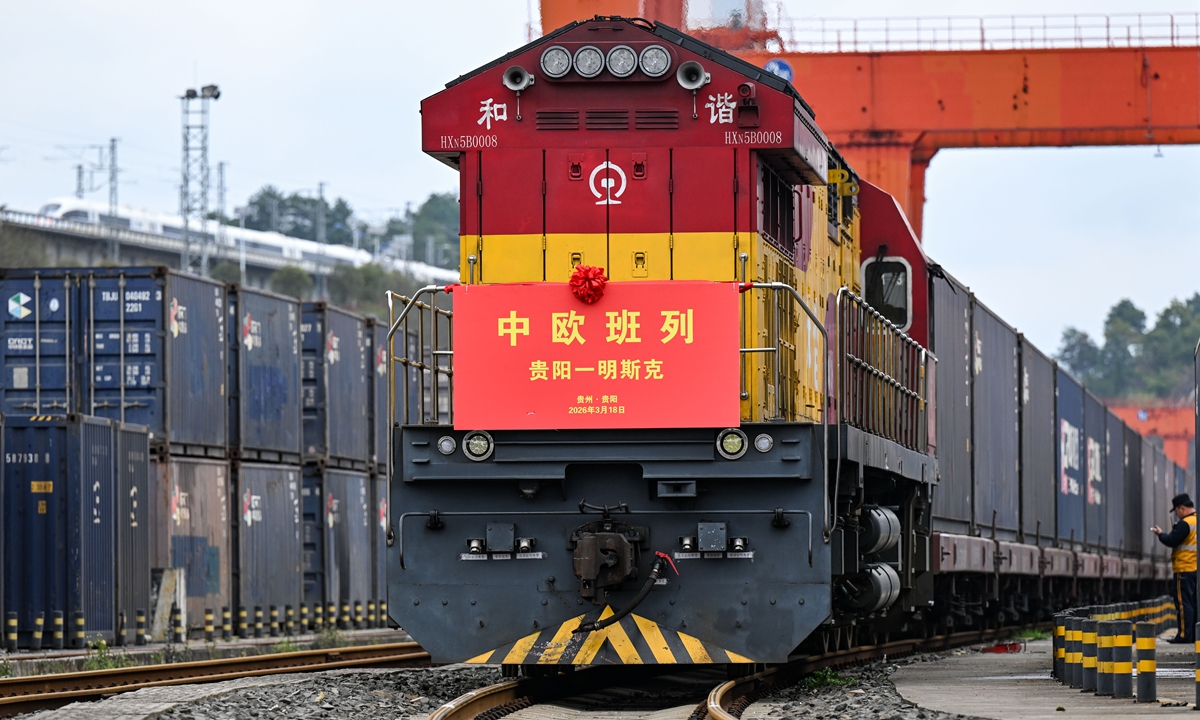
A China-Europe freight train loaded with auto vehicles and auto parts departs from Dulaying international land-sea logistics hub in Guiyang, Southwest China's Guizhou Province on March 18, 2026, heading for Minsk, Belarus. Photo: VCG
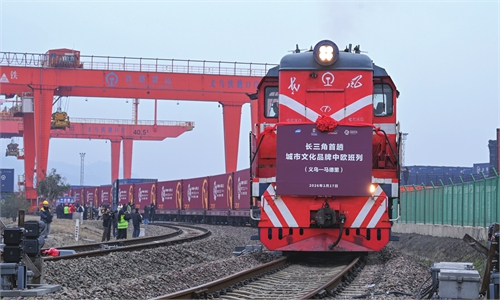
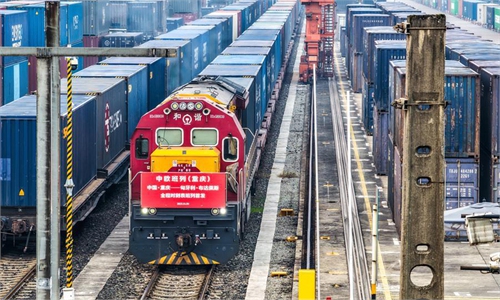
As the rumble of a train faded into the distance, a China-Europe freight train loaded with home appliances and auto parts departed from Hefei, a major automobile manufacturing hub in East China's Anhui Province.
The train was bound for Budapest, Hungary, passing through the Alashankou border crossing. It will supply local factories and households with Chinese-made goods, some of which will then be distributed to other European markets.
Tommy Tan, a senior freight industry insider, said that his cargo train delivery business has been solid this year. In the first two months, his company recorded double-digit export growth, driven by growing overseas demand for high-value Chinese manufactured goods such as white goods, raw materials, and auto parts.
The improved train service and transport stability of China-Europe freight trains have provided strong support for his business. The better-than-expected performance in the first two months has set a positive tone for this year, and the partner countries joining the Belt and Road Initiative (BRI) have provided important support to his expanding business portfolio, Tan said.
Tan's business reflects the brisk commerce between China and the BRI partner countries, as recent official data from various regions highlight the country's efforts to diversify its trade as well as the increasing global demand for high-quality, value-added Chinese-made products.
Trade with the BRI partner countries has become an increasingly important driver of China's stable trade growth, which has helped reduce reliance on any single market, foster a more diversified trade structure, and significantly enhance the resilience of the country's foreign trade, Song Wei, a professor at the School of International Relations and Diplomacy at Beijing Foreign Studies University, told the Global Times on Thursday.
Strong start of the year
In the first two months of this year, Anhui Province exported 27.22 billion yuan ($3.96 billion) worth of goods to the BRI partner countries, up 5 percent year-on-year, accounting for 45.1 percent of its total exports, as a more diversified and stable trade structure is taking shape, according to a local customs official, Anhui Daily reported on Thursday.
Continued improvement in the business environment has helped companies further expand into many emerging markets including the Belt and Road partner countries, effectively mitigating trade barriers and external risks, the newspaper said.
In the first two months, imports and exports of East China's Jiangsu Province with the BRI partner countries reached 535.37 billion yuan, up 28.8 percent year-on-year, contributing 13.9 percentage points to the province's overall trade growth and raising its share by 3.6 percentage points to 51.8 percent, according to data from the Nanjing Customs.
Notably, mechanical and electrical products accounted for more than 70 percent of exports, with strong growth seen in electrical equipment, computers and their components, as well as ship exports, which underscore the growing global demand for China's advanced manufacturing products.
Meanwhile, as a frontier region of the 21st Century Maritime Silk Road, East China's Fujian Province has been deeply integrated into Belt and Road cooperation, with trade in goods with relevant countries and regions continuing to gain momentum.
According to Xiamen Customs, in the first two months, the province's imports and exports with the BRI partner countries reached 165.57 billion yuan, up 14.1 percent year-on-year.
Similarly, market diversification has strengthened foreign trade resilience in other coastal provinces. In the first two months, imports and exports of East China's Zhejiang Province with the BRI partner countries reached 572.78 billion yuan, up 20.5 percent year-on-year.
Increasingly diversified trade
In the factory of Ningbo C.S.I. Power & Machinery Group Co in Ningbo city, a major manufacturing hub in Zhejiang Province, machinery assembly lines are running at full speed, with orders flowing in from all around the world. The company has seen a very strong start this year.
As one of the city's oldest modern industrial enterprises, the company has long aligned its development with the BRI development framework.
In January and February, the company's shipments increased by 49 percent year-on-year, and exports to the BRI partner countries grew even faster, up by a massive 58.77 percent. The company mainly produces high-power generator sets and marine power systems, which are exported to Belt and Road partner countries, Wu Jie, president of Ningbo C.S.I., told the Global Times on Thursday.
Amid current geopolitical tensions and a complex macroeconomic environment, we must stay committed to both "going global" and "bringing in resources," Wu said, noting that the BRI has provided a clear roadmap for his company and plays an important strategic role in ensuring stable, sustained, and high-quality development.
The strong trade growth was reflected not only in machinery products but also in daily items such as pet products. Zhu Qiucheng, CEO of Ningbo New Oriental Electric Industrial Development, an exporter of pet supplies and home furnishing products, told the Global Times that since the beginning of the year, the company's exports to Belt and Road countries have been growing, with a year-on-year increase of about 35 percent. Markets with particularly strong growth include South Korea and Africa. Smart pet products are seeing very fast growth.
Zhu said that they have also strengthened their B2C operations on e-commerce platforms, which has further boosted growth.
In addition to exports, imports to China from the BRI partner countries have witnessed strong growth.
Cui Shiyong, a local fruit trader in South China's Guangxi Zhuang Autonomous Region, has been busy these days. With weeks to go before durian exports from Southeast Asian countries enter their peak season from April to August, Cui has been making preparations such as securing supply sources and booking cold-chain logistics.
Last year, his fruit business with Southeast Asian countries was strong, registering double-digit growth, and he expects the trend to continue this year, driven by rising Chinese household demand for fresh fruits, Cui told the Global Times. Part of his confidence comes from the China-Laos Railway, a landmark transport project under the BRI, which ensures shorter transportation time compared with traditional sea transport.
This year marks the first year of China's 15th Five-Year Plan period (2026-30). In 2026, China vows to strengthen strategic alignment with the Belt and Road partner countries and take more steps to promote stronger infrastructure connectivity, greater connectivity in rules and standards, and closer people-to-people ties, according to this year's Government Work Report.
Building on these efforts, the BRI partner countries have become an important foundation of China's foreign trade, with the trade structure continuing to improve.
Song said that exports to these markets now extend beyond low-value-added goods to high-end, smart, and green products. China's huge consumer market provides a key channel for a wide range of foreign goods, typically, agricultural products.
With the government's ongoing policy support, China's trade network with the BRI partner countries is expected to further expand this year, delivering more mutually beneficial opportunities for all, Song said.
RELATED ARTICLES