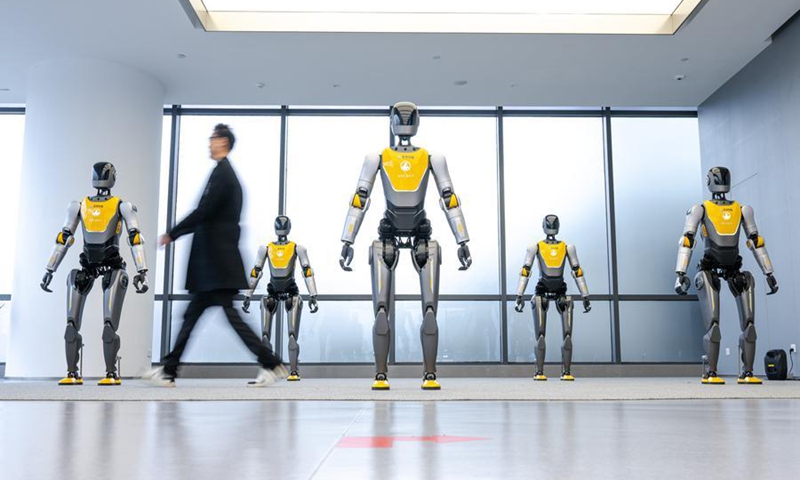
A visitor walks past robots displayed at a humanoid robot innovation center in Wuhan East Lake High-tech Development Zone, also known as the optics valley of China, in Wuhan, central China's Hubei Province, Dec. 4, 2025. (Xinhua/Xiao Yijiu)
As China enters the first year of its 15th Five-Year Plan period (2026-30), it does so against a backdrop of heightened global uncertainty. Geopolitical tensions, supply chain realignments, and uneven economic recovery have made the external environment more complex than at any time in recent decades. Yet such periods of disruption also create opportunities for economies that combine strategic clarity with policy consistency. China's planning framework is designed precisely for such moments.
The annual "two sessions" in early March offered an important window into how policymakers are calibrating the balance between short-term stability and long-term transformation.
In 2026, three signals merit particular attention. The first is the economic growth target and the associated fiscal and monetary policy mix to sustain momentum in a volatile global context. The second is the emphasis on strengthening innovation capacity, especially in artificial intelligence, advanced manufacturing, and digital infrastructure. The third is how these near-term measures align with the early implementation priorities of the 15th Five-Year Plan.
Taken together, these signals point to a consistent policy direction: maintaining growth while accelerating the transition toward a more innovation-driven and consumption-led economy.
Confidence in China's economic outlook rests on several structural foundations. Foremost is the scale of its domestic market. The country's middle-income population is often estimated at around 400 million people, creating one of the world's largest consumer markets. As household incomes rise and the service sector expands, domestic consumption is set to play a more central role in sustaining economic growth. This shift is particularly important in an era when external demand is subject to greater volatility.
Equally significant is China's industrial and manufacturing ecosystem. It remains the world's most comprehensive, supporting both domestic upgrading and participation in international supply chains. This breadth provides resilience as well as a platform for continued technological advancement. Complementing this is sustained investment in research and development, with annual R&D spending now approaching 4 trillion yuan, positioning China as the world's second-largest investor in R&D, after the United States. Such investment is essential for moving up the value chain and fostering indigenous innovation.
The external environment during the 15th Five-Year Plan period will, however, remain challenging. Geopolitical tensions and the reconfiguration of global trade and technology networks are likely to persist.
For China, the central task will be to navigate those pressures while maintaining openness and engagement with the global economy. This is not simply a national imperative. In a more fragmented world, the preservation of open channels for trade, investment, and technological collaboration is critical for sustaining economic growth.
At the same time, the global economy is undergoing profound structural change. Digitalization, AI, and the transition to green energy systems are reshaping industries and creating new drivers of productivity. China is well positioned to participate in — and contribute to — these important transformations. Over the past decade, it has emerged as a major innovator in renewable energy, electric vehicles, digital platforms and high-speed railway system.
A distinguishing feature of China's innovation model is the increasingly close collaboration between universities, research institutes, and private enterprises. This ecosystem has accelerated the commercialization of new technologies and enabled rapid scaling in sectors such as batteries and clean energy. As the 15th Five-Year Plan unfolds, further strengthening this linkage between scientific discovery and market application will be critical.
China's approach to opening-up during the 14th Five-Year Plan period (2021-25) offers additional context for what lies ahead. Measures such as zero-tariff treatment for many least developed countries and the continued expansion of Belt and Road cooperation have enhanced economic connectivity across emerging markets. At the same time, steps to broaden market access in the services and financial sectors have signaled a continued commitment to integration with the global economy.
In an era when protectionist tendencies have resurfaced in some parts of the world, such policies carry broader significance. They underscore the role that large economies can play in sustaining international trade and investment flows. For the 15th Five-Year Plan, the challenge — and opportunity — will be to deepen this openness while ensuring that it supports domestic economic upgrading.

John Quelch Photo: Courtesy of John Quelch
Looking ahead, China's development strategy is likely to remain anchored in three interrelated priorities: innovation, domestic demand, and openness. Innovation will drive productivity and competitiveness. Domestic demand will provide stability and resilience. Openness will enable access to global markets, capital, and ideas.
For international businesses and investors, the message is one of cautious confidence. China's economy is undergoing adjustment, but its trajectory toward higher-quality and innovation-led growth remains intact. For the global economy, China's commitment to innovation and openness has the potential to expand technological capacity, accelerate the green transition, and strengthen supply chain resilience.
In uncertain times, steadiness becomes a competitive advantage. China's 15th Five-Year Plan reflects an effort to combine long-term strategic direction with pragmatic policy adaptation. How effectively this balance is maintained will shape not only China's economic future, but also its contribution to global growth in the years ahead.
The author is the executive vice chancellor, American president, and distinguished professor of social science at Duke Kunshan University in China. bizopinion@globaltimes.com.cn
RELATED ARTICLES